Pipe Schedule Chart Explained: How to Read Wall Thickness
How to read a pipe schedule chart: NPS vs actual OD, why Sch 40 and Sch 80 walls change with size, STD, XS and XXS, and choosing a schedule from design.
By Syed Hasan28 Nov 20268 min read
Ask a new graduate what "2 inch Schedule 80" means and you will often get a confident wrong answer: a pipe two inches across with an 80 something wall. In fact the pipe is not two inches across, and the 80 is not a thickness at all. Mix this up on a material take-off or an inspection report and you can order the wrong pipe, or calculate a corrosion rate against the wrong starting wall.
This post explains how to use a pipe schedule chart properly: what nominal pipe size and schedule actually mean, why the same schedule gives different walls at different sizes, how STD, XS and XXS relate to the numbers, and how an engineer picks a schedule from a pressure design. The few dimensions quoted are standard values from ASME B36.10M, which covers wrought steel pipe; stainless pipe has its own standard, ASME B36.19M. For anything beyond these examples, read the current standard itself rather than a chart copied from somewhere online.
Nominal pipe size: a name, not a measurement
Nominal pipe size (NPS), or its metric twin DN, is a label for a family of pipe that shares one outside diameter. For NPS 1/8 to NPS 12 the label and the real outside diameter do not match. From NPS 14 upward, the outside diameter equals the NPS in inches.
| NPS | DN | Actual outside diameter |
|---|---|---|
| 1/2 | 15 | 21.3 mm (0.840 in) |
| 2 | 50 | 60.3 mm (2.375 in) |
| 4 | 100 | 114.3 mm (4.500 in) |
| 6 | 150 | 168.3 mm (6.625 in) |
| 12 | 300 | 323.8 mm (12.750 in) |
| 14 | 350 | 355.6 mm (14.000 in) |
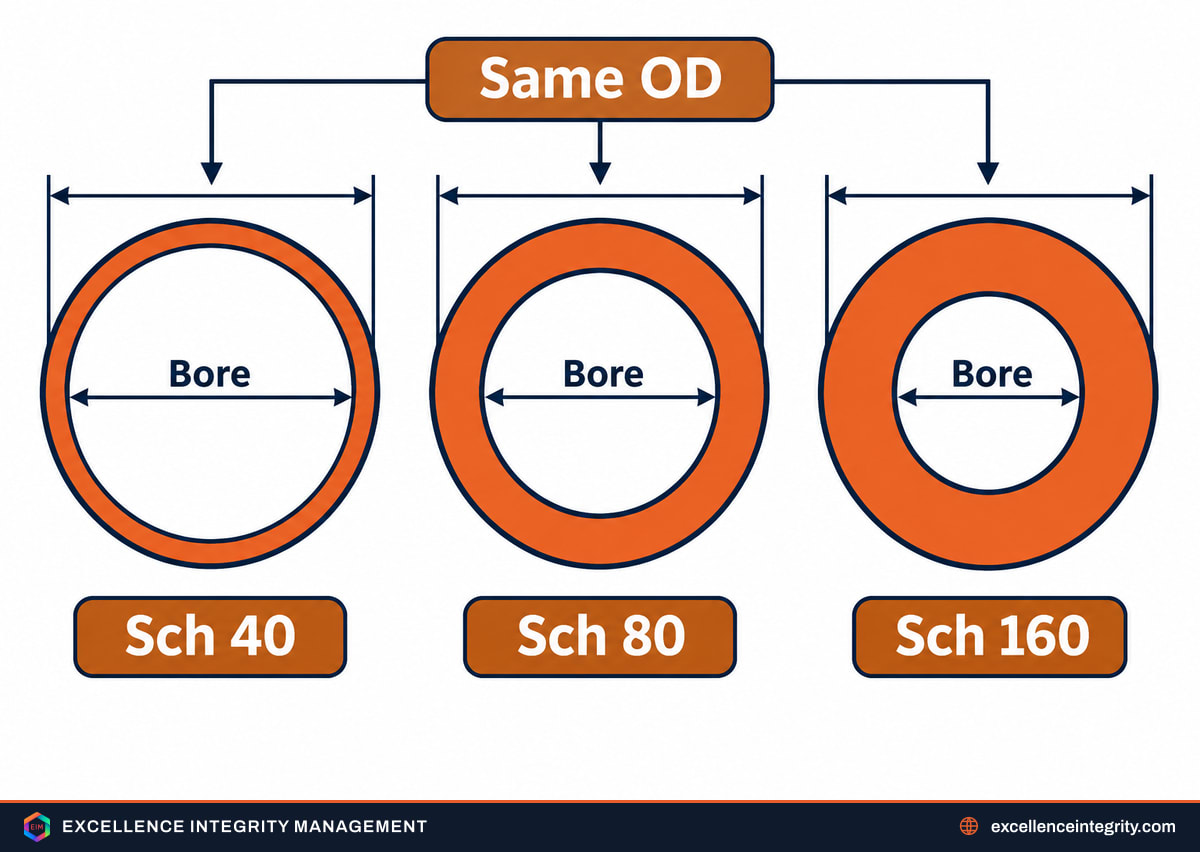
The key point is that the outside diameter stays fixed for a given size whatever the schedule. That is what lets an NPS 2 pipe of any wall fit the same NPS 2 fittings, flanges and supports. When the wall gets thicker, the bore gets smaller.
What the schedule number actually tells you
The schedule number is a code for wall thickness, and it only means something together with the size. The common schedules in ASME B36.10M are 5, 10, 20, 30, 40, 60, 80, 100, 120, 140 and 160, though not every schedule exists at every size. A higher number means a thicker wall at that size.
Here is the catch that trips people up: Schedule 40 at NPS 2 is not the same thickness as Schedule 40 at NPS 6. The wall grows with the diameter.
| NPS | Sch 40 wall | Sch 80 wall |
|---|---|---|
| 1/2 | 2.77 mm (0.109 in) | 3.73 mm (0.147 in) |
| 2 | 3.91 mm (0.154 in) | 5.54 mm (0.218 in) |
| 4 | 6.02 mm (0.237 in) | 8.56 mm (0.337 in) |
| 6 | 7.11 mm (0.280 in) | 10.97 mm (0.432 in) |
So when someone says "it is Schedule 80", your next question is always "at what size?". Without the size, the schedule tells you nothing about the actual wall.
How to read a pipe schedule chart, step by step
Whatever chart you use, the reading is the same:
- Find the row for the nominal size, NPS or DN.
- Read the outside diameter for that row. It applies to every schedule in it.
- Move across to the column for the schedule or weight designation you need.
- Read the nominal wall thickness at that intersection, in millimetres or inches.
- If you need the bore, subtract twice the wall from the outside diameter.
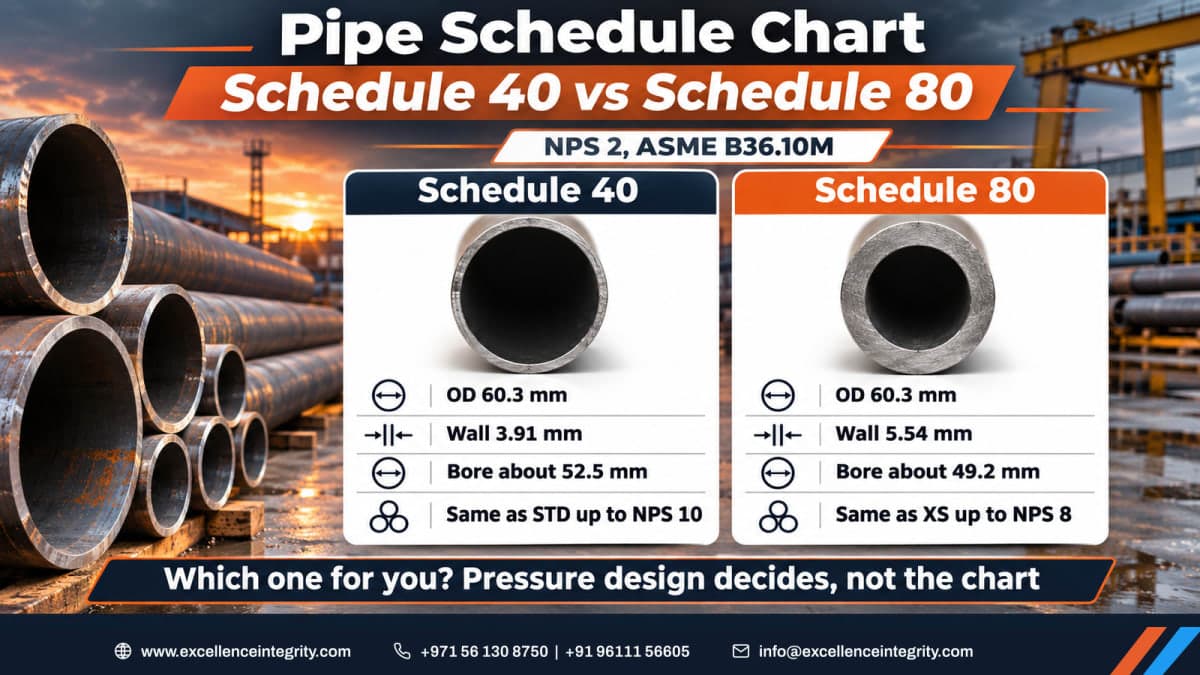
Worked through for NPS 2: the outside diameter is 60.3 mm. Schedule 40 gives a 3.91 mm wall and a bore of about 52.5 mm. Schedule 80 gives 5.54 mm and a bore of about 49.2 mm. Same pipe outside, noticeably less room inside, which matters for flow and for anything that has to pass through the bore.
Remember that the chart gives the nominal wall. The pipe you receive can be thinner than that, within the tolerance of the pipe specification. Carbon steel pipe to ASTM A106, for example, may be up to 12.5 percent under the nominal wall.
STD, XS and XXS: the older weight names
Before schedule numbers there were weight designations, and they are still on drawings and purchase orders today: Standard (STD), Extra Strong (XS) and Double Extra Strong (XXS).
For smaller pipe they line up neatly with schedules. STD has the same wall as Schedule 40 up to NPS 10, and XS has the same wall as Schedule 80 up to NPS 8. Above those sizes they separate. At NPS 12, STD is 9.53 mm (0.375 in) while Schedule 40 is 10.31 mm (0.406 in), and XS is 12.70 mm (0.500 in) while Schedule 80 is 17.48 mm (0.688 in).
That is why "Sch 40 and STD are the same thing" is a rule of thumb, not a fact. On a 12 inch line, swapping one for the other is a real change of wall thickness, and it should be caught at material receiving.
Stainless steel schedules: the S suffix
Stainless steel pipe is covered by ASME B36.19M and uses schedules with an S suffix: 5S, 10S, 40S and 80S. Thin-wall 5S and 10S pipe is common in stainless because the material often needs no corrosion allowance and costs a lot per kilogram.
In the smaller sizes, 40S and 80S have the same walls as Schedule 40 and Schedule 80. In the larger sizes they can differ. Treat 40S and Sch 40 as two separate designations and check the table for the size in front of you.
How engineers pick a schedule from pressure design
A schedule is never chosen from the chart alone. The chart is the last step. The order is:
- Calculate the pressure design thickness from the design pressure, the outside diameter and the allowable stress, using the formula in the piping code, for process plants ASME B31.3.
- Add the corrosion allowance and any mechanical allowance, such as thread or groove depth.
- Allow for the mill under-tolerance, because the pipe can arrive thinner than nominal.
- Pick the first schedule on the chart whose wall, after tolerance, still meets the total.
A simple illustration. Suppose an NPS 2 line needs 4.2 mm once pressure design, corrosion allowance and mechanical allowance are added up. Dividing by 0.875 to cover a 12.5 percent under-tolerance gives about 4.8 mm nominal. Schedule 40, at 3.91 mm, is too thin. Schedule 80, at 5.54 mm nominal and about 4.85 mm at worst tolerance, works.
Real lines also face structural limits, supports and branch loads. A small pipe can satisfy pressure design with a very thin wall and still be too flimsy to survive handling and vibration, which is where a structural minimum comes in; see pressure design versus structural minimum thickness.

Why inspectors care about the nominal wall
For an inspector, the nominal wall from the pipe schedule chart is the starting point of every corrosion rate. If the first thickness reading on a new line is compared with the wrong nominal, the long-term rate is wrong from day one. Record the actual first readings at each thickness monitoring location as the baseline, and treat the chart value as a check, not the measurement.
The schedule also feeds retirement decisions. Whether a corroded section can stay in service depends on its required thickness, not on its schedule, which is why API 570 work starts from the design calculation and the circuit's history; API 570 piping classes and inspection intervals covers how often those readings are taken.
Frequently asked questions
Is Schedule 40 the same as STD?
Only up to NPS 10. In those sizes Schedule 40 and Standard weight have the same wall. Above that they separate: at NPS 12, STD is 9.53 mm (0.375 in) while Schedule 40 is 10.31 mm (0.406 in). Treat them as two designations and check the table for the size you are using.
Does the outside diameter change with schedule?
No. For a given nominal size the outside diameter is fixed whatever the schedule, which is why every schedule of one size fits the same fittings and flanges. A thicker schedule takes its extra wall from the inside, so the bore gets smaller. NPS 2 is 60.3 mm outside in Schedule 40 and Schedule 80 alike.
What does Sch 80 mean on a pipe?
Schedule 80 is a code for wall thickness that only means something together with the nominal size. At NPS 2 it is 5.54 mm (0.218 in), at NPS 6 it is 10.97 mm (0.432 in). It does not mean 80 millimetres or 80 of anything, and the pipe supplied may be thinner than nominal within its specification's tolerance.
Where to go from here
Reading schedules correctly is basic piping literacy, and it underpins thickness monitoring, retirement calculations and repairs. The API 570 piping inspector preparation builds on it with required thickness, corrosion rates and inspection planning for in-service piping. For a refresher on the components schedules apply to, see carbon steel piping components, and for turning thickness readings into a remaining life, how to calculate corrosion rate and remaining life.
Exam preparation
Preparing for API 570?
Practise with exam-style questions, timed mocks and study notes. 1,841 questions in the bank.