AMPP CP3 Cathodic Protection TechnologistExam Guide & Preparation
AMPP CP3 Cathodic Protection Technologist builds on CP2 with a strong focus on interpreting CP data, troubleshooting and mitigating problems in both galvanic and impressed current systems, and design calculations for those systems. AMPP was formed by the 2021 merger of NACE International and SSPC, so this credential is still frequently referenced as "NACE CP3" in job postings, it's the same program under AMPP's current name.
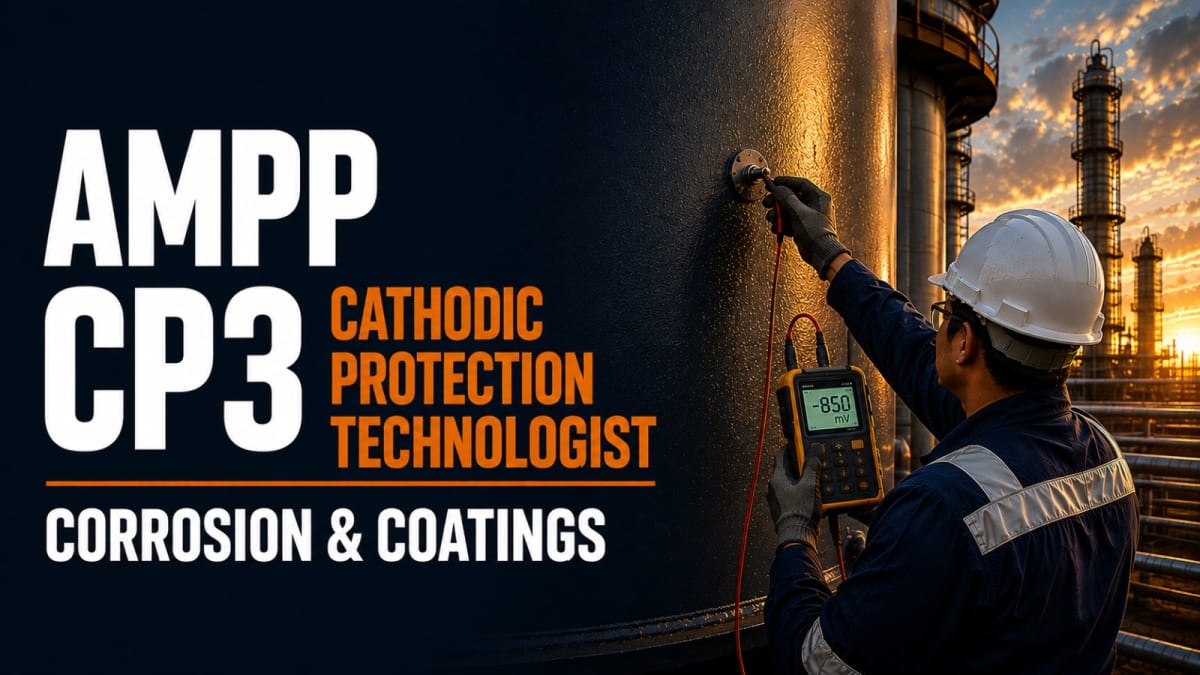
AMPP CP3 Cathodic Protection Technologist builds on CP2 with a strong focus on interpreting CP data, troubleshooting and mitigating problems in both galvanic and impressed current systems, and design calculations for those systems. AMPP was formed by the 2021 merger of NACE International and SSPC, so this credential is still frequently referenced as "NACE CP3" in job postings, it's the same program under AMPP's current name.
Unlike CP1 and CP2, CP3 certification requires passing two separate exams: a Theory Exam (test code NACE-CP3-001), 75 total questions, 70 scored and 5 unscored, over 4 hours, and a Case-Based Exam (test code NACE-CP3-Case), 37 total questions, 32 scored and 5 unscored, also over 4 hours. Both exams are closed-book, administered separately, and candidates must pass both to earn certification.
CP3 candidates are expected to lead and document CP testing, measurement, survey, and inspection work, interpret and analyze CP data with genuine understanding of the underlying electrochemistry, and recognize when a situation is complex or unique enough to require oversight from a CP4 Specialist. Substantial hands-on CP experience, including design work, combined with formal math, science, or engineering education, is critical to success at this level.
Whether you're looking for a structured AMPP CP3 course, self-paced AMPP CP3 online training, or simply a focused way to study for AMPP CP3 certification requirements around a working schedule, EIM's AMPP CP3 training platform is built to fit both the Theory and Case-Based exams.
CP3 vs CP1 vs CP2 vs CP4
AMPP's Cathodic Protection program runs CP1 through CP4 as a progression by depth of competency. CP1 covers basic field testing, CP2 moves into intermediate corrosion theory and design fundamentals. CP3, this certification, adds genuine design calculation ability, data interpretation, and troubleshooting leadership, tested across two separate exams rather than one. CP4, the senior level, covers full system design, specification, and program management.
Attendance in the CP2 course is strongly recommended before attempting CP3, though it isn't a strict mandatory prerequisite the way AMPP CIP's tiered levels require holding the prior level. What is emphasized instead is substantial hands-on CP experience, including design work, combined with formal education in math, science, or engineering, since the Case-Based exam specifically tests applying knowledge to realistic scenarios, not just recalling facts.
Qualification & Prerequisites
What the Exams Actually Test
Five domains, weighted by question share. This is the map the question bank is built directly against.
Close-interval potential surveys, DC surface potential gradient surveys, leading and documenting CP testing
Interpreting CP data with understanding of underlying electrochemistry
Design calculations for galvanic and impressed current systems, migration and mitigation of problems
Series/parallel/series-parallel circuits, Ohm's and Kirchhoff's laws, multimeter and soil resistivity meter operation, reference electrode temperature correction
System commissioning, troubleshooting, AC and lightning effects mitigation
| Domain | Covers | |
|---|---|---|
| 01 | Testing, Surveys & Field Leadership | Close-interval potential surveys, DC surface potential gradient surveys, leading and documenting CP testing |
| 02 | Data Analysis & Electrochemistry Interpretation | Interpreting CP data with understanding of underlying electrochemistry |
| 03 | CP System Design Calculations | Design calculations for galvanic and impressed current systems, migration and mitigation of problems |
| 04 | Advanced Electrical Theory & Instrumentation | Series/parallel/series-parallel circuits, Ohm's and Kirchhoff's laws, multimeter and soil resistivity meter operation, reference electrode temperature correction |
| 05 | Commissioning, Troubleshooting & Interference Mitigation | System commissioning, troubleshooting, AC and lightning effects mitigation |
01. Testing, Surveys & Field Leadership
02. Data Analysis & Electrochemistry Interpretation
03. CP System Design Calculations
04. Advanced Electrical Theory & Instrumentation
05. Commissioning, Troubleshooting & Interference Mitigation
How to Register and What to Expect on Exam Day
Candidates register directly through AMPP, not through EIM or any third-party training provider. The Theory Exam and Case-Based Exam are scheduled and administered separately, and candidates receive a pass/fail grade for each independently, both must be passed to earn CP3 certification.
Check AMPP's current fee schedule for official course and exam pricing, which is separate from EIM's AMPP CP3 self-prep pricing. Candidates have a 4-year window to complete all requirements, if that window is exceeded, any already-passed exams must be retaken as part of a new attempt.
How to Prepare for AMPP CP3 Cathodic Protection Technologist
Self-paced by default. Add live instruction if you want structured guidance.
AMPP CP3 Cathodic Protection Technologist Question Bank
1050 practice questions across 4 modules, mapped to every BOK domain. Study at your own pace, no fixed schedule required.
Sample Practice Questions
A structure-to-electrolyte potential of -700 mV is measured using a copper-copper sulfate reference electrode calibrated at 25 degrees Celsius, but the actual field temperature is lower than 25 degrees Celsius. What effect does this temperature difference have on the reading?
Which of the following conditions will increase galvanic anode polarization, reducing the anode's effective current output over time?
What's Included in the Self-Prep Package
AMPP CP3 Theory Question Bank
Broad-knowledge questions covering testing, data analysis, design calculations, and electrical theory.
AMPP CP3 Case-Based Scenario Practice
Multi-step scenario problems mirroring the Case-Based Exam's applied reasoning format.
AMPP CP3 Study Notes
Downloadable study material covering both the Theory and Case-Based exam content.
Related Certifications
Common Questions
What is the AMPP CP3 certification?
How many exams does AMPP CP3 require?
Do I need to complete AMPP CP2 before taking CP3?
What is the Case-Based Exam and how is it different from the Theory Exam?
How much does AMPP CP3 certification cost?
What happens if I don't complete AMPP CP3 within the time window?
What does EIM's AMPP CP3 training include?
Is AMPP CP3 the same as NACE CP3?
Why AMPP CP3 Cathodic Protection Technologist Matters for Asset Integrity Careers
The Case-Based Exam is what genuinely distinguishes CP3 from CP1 and CP2: rather than testing isolated facts, it presents realistic scenarios, often involving instrument readings, temperature corrections, or troubleshooting decisions, that require applying multiple pieces of CP knowledge together to reach a defensible answer. Candidates who prepare only with flashcard-style fact recall consistently find the Case-Based portion harder than the Theory Exam, even when their theoretical knowledge is strong.
EIM's AMPP CP3 preparation is built around both exam formats separately: a Theory-style question bank for broad knowledge recall, and case-based scenario practice mirroring the multi-step reasoning the Case-Based Exam actually demands, since preparing for only one exam format leaves a real gap for the other.
- ✓1050 practice questions
- ✓4 structured modules
- ✓1 Year
- ✓Mobile-friendly platform
Confused about which certification is right for you? Talk to our experts.