SMRP CMRP Exam Preparation — Maintenance & Reliability Certified Maintenance & Reliability Professional
The CMRP (Certified Maintenance & Reliability Professional) credential is awarded by the SMRP Certifying Organization (SMRPCO), the certifying body of the Society for Maintenance & Reliability Professionals. SMRPCO reports that it is accredited by the ANSI National Accreditation Board (ANAB) under ISO/IEC 17024.
The CMRP (Certified Maintenance & Reliability Professional) credential is awarded by the SMRP Certifying Organization (SMRPCO), the certifying body of the Society for Maintenance & Reliability Professionals. SMRPCO reports that it is accredited by the ANSI National Accreditation Board (ANAB) under ISO/IEC 17024.
It tests whether a professional can connect maintenance and reliability work to business results, across the five pillars of the SMRP Body of Knowledge: Business & Management, Manufacturing Process Reliability, Equipment Reliability, Organization & Leadership, and Work Management. The exam is 110 multiple-choice questions in 2.5 hours, closed book, at Pearson VUE test centres.
SMRPCO stresses that the exam is experience-based. There is no formal education or experience prerequisite, but the questions are scenarios: which action a maintenance or reliability professional should take, not which definition is correct.
EIM's preparation programme is independent. It is not an SMRP or SMRPCO course and is not endorsed by either. Every EIM question is originally written; none is drawn from an SMRPCO question pool.
Where CMRP Sits Among Maintenance & Reliability Credentials
CMRP is SMRPCO's professional-level credential, built around the five pillars and written for engineers, managers and specialists who are accountable for plant performance. SMRPCO also awards the CMRT, a technician-level credential, under the same candidate handbook.
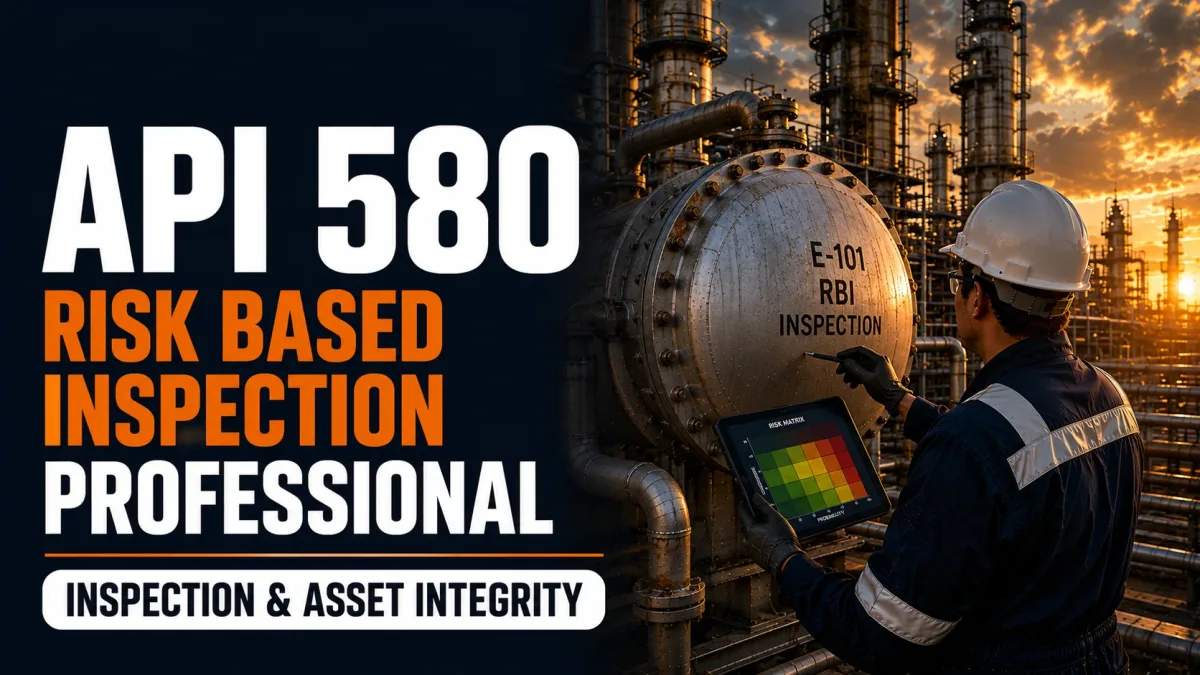
CMRP is broader than a single-discipline credential. API 580 covers risk-based inspection of fixed equipment; CMRP covers how reliability, maintenance strategy and work management deliver business results across the whole plant, of which inspection is one input.
It is also distinct from ISO 55001 asset management. The ISO 55000 series sets the management-system requirements; CMRP tests whether a professional can apply maintenance and reliability practice within such a system. The two complement each other, and the CMRP Body of Knowledge draws on the 2024 editions of ISO 55000 and 55001.
Eligibility & Prerequisites
The Five Pillars — with EIM's Study Weighting
Five domains, weighted by question share. This is the map the question bank is built directly against.
Turning business goals into maintenance and reliability goals: strategy and objectives, administering the plan, measuring performance with KPIs, managing organisational change, communicating with stakeholders, and EHS risk.
Covered in EIMModule 1: CMRP, Maintenance & Reliability Fundamentals · Module 2: Business Strategy & Maintenance Objectives · Module 3: Financial Decision Making & Asset Lifecycle Value · Module 4: Performance Management & M&R KPIs (186 practice questions)
Linking maintenance and reliability to the production process: process flow and parameters, OEE and production losses, process improvement, and the operations–maintenance interface.
Covered in EIMModule 5: Manufacturing / Process Reliability Fundamentals · Module 6: OEE, Production Losses & Continuous Improvement · Module 7: Operations, Maintenance & Process Improvement (144 practice questions)
Reliability engineering (MTBF, MTTR, availability, Weibull), reliability data and ISO 14224, FMEA/FMECA and criticality, RCM and maintenance strategy, condition monitoring and the P-F interval, and root cause analysis of bad actors.
Covered in EIMModule 8: Reliability Engineering Fundamentals · Module 9: Reliability Data, ISO 14224 & Failure Coding · Module 10: FMEA, FMECA & Equipment Criticality · Module 11: RCM & Maintenance Strategy Development · Module 12: Condition Monitoring, PdM & Proactive Reliability · Module 13: Root Cause Analysis, Bad Actors & Defect Elimination (297 practice questions)
Organisation structure and roles, reliability culture, competence and training, and leading change in maintenance and reliability programmes.
Covered in EIMModule 14: Organization, Leadership & Reliability Culture · Module 15: Change Management, Competence & Leadership (120 practice questions)
Work identification and approval, planning and backlog, scheduling and schedule compliance, execution and PM, CMMS, spares and MRO inventory, shutdowns and turnarounds, and work-management performance.
Covered in EIMModule 16: Work Identification, Planning & Backlog Management · Module 17: Scheduling, Execution, PM & CMMS · Module 18: Spares, Shutdowns, WM Performance & Exam Preparation (261 practice questions)
| Domain | Covers | |
|---|---|---|
| 01 | Business & Management | Turning business goals into maintenance and reliability goals: strategy and objectives, administering the plan, measuring performance with KPIs, managing organisational change, communicating with stakeholders, and EHS risk. Covered in EIMModule 1: CMRP, Maintenance & Reliability Fundamentals · Module 2: Business Strategy & Maintenance Objectives · Module 3: Financial Decision Making & Asset Lifecycle Value · Module 4: Performance Management & M&R KPIs (186 practice questions) |
| 02 | Manufacturing Process Reliability | Linking maintenance and reliability to the production process: process flow and parameters, OEE and production losses, process improvement, and the operations–maintenance interface. Covered in EIMModule 5: Manufacturing / Process Reliability Fundamentals · Module 6: OEE, Production Losses & Continuous Improvement · Module 7: Operations, Maintenance & Process Improvement (144 practice questions) |
| 03 | Equipment Reliability | Reliability engineering (MTBF, MTTR, availability, Weibull), reliability data and ISO 14224, FMEA/FMECA and criticality, RCM and maintenance strategy, condition monitoring and the P-F interval, and root cause analysis of bad actors. Covered in EIMModule 8: Reliability Engineering Fundamentals · Module 9: Reliability Data, ISO 14224 & Failure Coding · Module 10: FMEA, FMECA & Equipment Criticality · Module 11: RCM & Maintenance Strategy Development · Module 12: Condition Monitoring, PdM & Proactive Reliability · Module 13: Root Cause Analysis, Bad Actors & Defect Elimination (297 practice questions) |
| 04 | Organization & Leadership | Organisation structure and roles, reliability culture, competence and training, and leading change in maintenance and reliability programmes. Covered in EIMModule 14: Organization, Leadership & Reliability Culture · Module 15: Change Management, Competence & Leadership (120 practice questions) |
| 05 | Work Management | Work identification and approval, planning and backlog, scheduling and schedule compliance, execution and PM, CMMS, spares and MRO inventory, shutdowns and turnarounds, and work-management performance. Covered in EIMModule 16: Work Identification, Planning & Backlog Management · Module 17: Scheduling, Execution, PM & CMMS · Module 18: Spares, Shutdowns, WM Performance & Exam Preparation (261 practice questions) |
01. Business & Management
02. Manufacturing Process Reliability
03. Equipment Reliability
04. Organization & Leadership
05. Work Management
How to Register and What to Expect on Exam Day
Candidates apply directly to SMRPCO, online only, through smrp.org. There are no paper forms and no application deadline. EIM does not administer the exam, process applications or issue the credential.
Once approved, the candidate receives an Authorization to Test from Pearson VUE and books a seat at one of its test centres. The exam must be sat within six months of payment; a missed window means reapplying and paying again. Fees are set by SMRPCO and change, so check smrp.org.
The exam is computer-based: one question per screen, with flag-for-review and a review table at the end. It is closed book. An on-screen calculator is provided and external calculators are not permitted. Candidates whose first language is not English may use a strict translation dictionary, without definitions, which the proctor inspects.
The result is pass or fail, shown on screen, with non-numerical diagnostic feedback by domain. A candidate who does not pass may sit again after six months, reapplying and paying as a new candidate. Certification lasts three years; recertification requires 50 hours from two or more eligible activity categories, as SMRPCO defines them.
Sample Practice Questions
In a balanced M&R KPI set, which statement best describes how leading and lagging indicators should relate to each other?
What does SAE JA1011 provide to an organisation that wants to claim its maintenance analysis process is reliability-centred maintenance?
On a site where planning and scheduling are separate roles, who normally assigns individual technicians to scheduled jobs each day?
What's Included in the Self-Prep Package
SMRPCO Candidate Handbook (CMRP & CMRT)
The authority for exam format, eligibility, timing, retakes and recertification. Published on smrp.org; check for a newer issue before you book.
ISO 55000, 55001 and 55002 — Asset management
ISO 55000 and 55001 were reissued in 2024; ISO 55002 is the 2018 edition. The vocabulary of the Business & Management pillar.
ISO 14224:2016 — Reliability and maintenance data
How equipment, failure modes and failure causes are recorded so reliability data can be trusted. Central to Equipment Reliability.
SAE JA1011 and IEC 60812
The criteria for an RCM process, and FMEA/FMECA. The basis of maintenance strategy development.
Related Certifications

Common Questions
How many questions is the CMRP exam and how long do I get?
Do I need a degree or a set number of years of experience?
Is the CMRP exam open book?
What is the pass mark?
Where and when can I sit the exam?
What happens if I do not pass?
How long is the certification valid?
Are EIM questions taken from the real exam?
In Depth
The exam rewards judgement over recall. Its scenarios ask what a maintenance and reliability professional should do next: which failure is worth analysing, which strategy fits a failure pattern, which metric reveals a problem, how a schedule is protected. A candidate who knows the definitions but has not practised the decisions finds the paper hard.
SMRPCO publishes no pass mark and no weighting by pillar. The weights on this page are EIM's own study weighting, taken from how the EIM question bank is built: Equipment Reliability and Work Management carry the most items because they contain the most functions in the Body of Knowledge (7 and 11 of 33). They are a guide to study time, not a statement about the real paper.
The pace is the other thing to train. 110 questions in 150 minutes is about 82 seconds a question. EIM's timed mocks run at that rate, from a 60-question diagnostic to two full 110-question simulations, each reported by pillar so a weak pillar shows up before exam day.
EIM's readiness guidance is 75% or more on both full simulations with no pillar below 65%. That is EIM's guidance for its own mocks, not an SMRPCO pass mark.
- CMRP, Maintenance & Reliability Fundamentals30 Q
- Business Strategy & Maintenance Objectives52 Q
- Financial Decision Making & Asset Lifecycle Value52 Q
- Performance Management & M&R KPIs52 Q
- Manufacturing / Process Reliability Fundamentals46 Q
- OEE, Production Losses & Continuous Improvement52 Q
- 1Get the bankPay by card and it opens straight away. By bank transfer or UPI, it opens once we confirm.
- 2Practise by moduleQuestions with explanations, timed mock tests and a readiness score that shows what to revise.
- 3Not sure yet?Take the free mock test first. It needs only your name, email and number.
- 4Sit your examTell us how it went and get 10% off your next purchase.
Confused about which certification is right for you? Talk to our experts.