API 571 Certification: Complete Guide to Pressure Equipment Inspection for GCC Professionals
Discover the complete API 571 Certification Guide for GCC professionals. Learn damage mechanisms, metallurgy, inspection methods, corrosion control, API code integration, exam preparation, salary benefits, and career opportunities in oil & gas industries.
Written by Nilanjan SenReviewed by Deepak Rawtal
Published 21 May 2026Reviewed 21 May 20263 min read
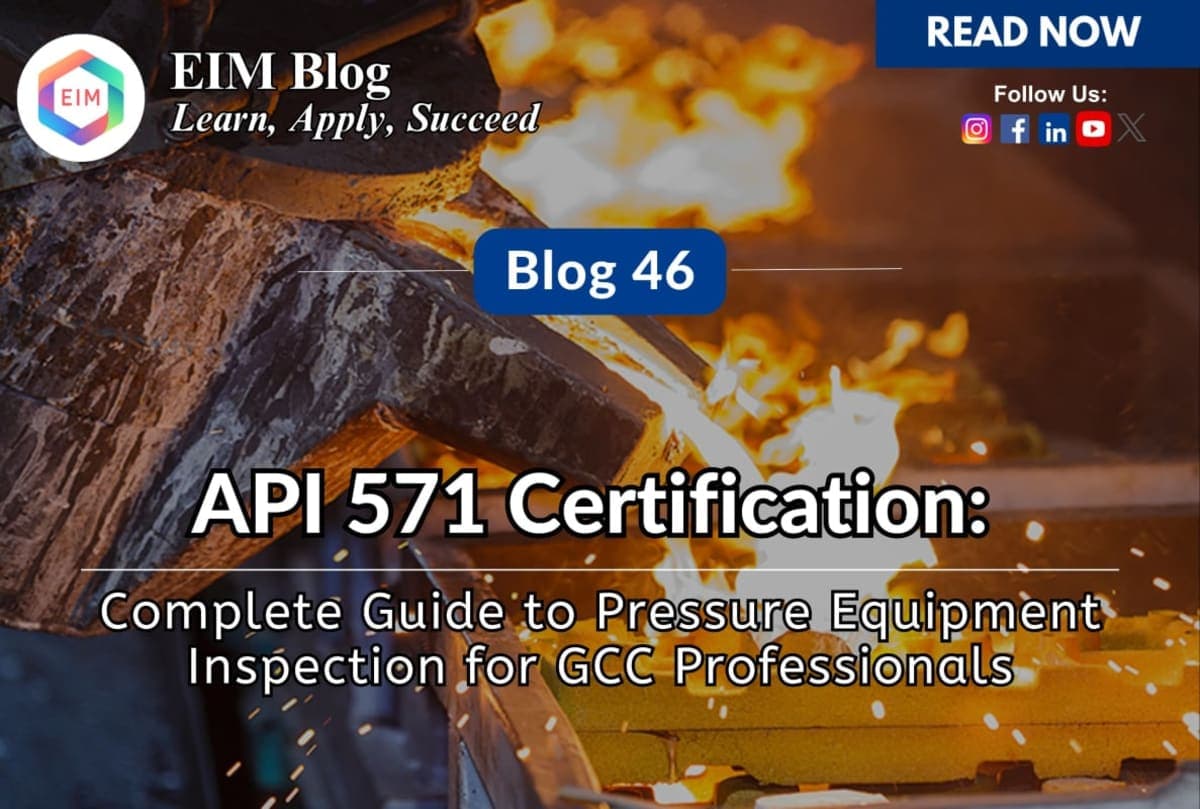
The oil and gas industry in the GCC region operates under some of the harshest process conditions in the world. Refineries, LNG terminals, offshore platforms, petrochemical plants, and pipeline networks continuously face challenges related to corrosion, material degradation, hydrogen damage, stress corrosion cracking, and high-temperature failures.
What is API 571?
API 571, officially titled Damage Mechanisms Affecting Fixed Equipment in the Refining Industry, is a recommended practice published by the American Petroleum Institute (API).
The standard provides technical guidance on deterioration mechanisms affecting:
- Pressure vessels
- Process piping
- Heat exchangers
- Storage systems
- Boilers and heaters
- Refinery process equipment
Why API 571 is Important in GCC Countries
GCC countries including Saudi Arabia, UAE, Qatar, Kuwait, Oman, and Bahrain operate some of the largest refining and petrochemical facilities globally.
These facilities face severe operating conditions such as:
- High ambient temperatures
- Marine chloride exposure
- Sour service environments
- High sulfur crude processing
- Thermal cycling
- High-pressure hydrogen systems
Core Technical Areas Covered in API 571
Materials and Metallurgy
Understanding metallurgy is critical for predicting equipment behavior and preventing failures.
Carbon Steel
- Cost-effective
- Easy fabrication
- High strength
- Widely available
However, carbon steel is vulnerable to:
- Uniform corrosion
- Sulfidation
- Hydrogen-induced cracking
- Microbiologically Influenced Corrosion (MIC)
- Corrosion Under Insulation (CUI)
Stainless Steel
- Chloride SCC
- Pitting corrosion
- Crevice corrosion
- Polythionic acid cracking
Major Damage Mechanisms in API 571
Uniform Corrosion
Uniform corrosion affects the entire metal surface evenly and is one of the most common degradation mechanisms.
Pitting Corrosion
Pitting corrosion causes localized metal loss and can rapidly penetrate equipment.
Stress Corrosion Cracking (SCC)
SCC occurs when tensile stress combines with a corrosive environment.
- Chloride SCC
- Caustic cracking
- Sulfide stress cracking
- Amine SCC
Hydrogen Damage
Hydrogen damage is among the most dangerous mechanisms in refining industries.
- Hydrogen blistering
- HIC
- SOHIC
- High-temperature hydrogen attack
Creep Damage
Creep occurs during prolonged exposure to elevated temperatures.
Corrosion Under Insulation (CUI)
CUI is one of the costliest corrosion mechanisms in the oil and gas industry.
Inspection Technologies Used in API 571
Ultrasonic Testing (UT)
- Thickness measurements
- Corrosion mapping
- Remaining life calculations
Phased Array Ultrasonic Testing (PAUT)
- Weld inspection
- Crack sizing
- Hydrogen damage evaluation
Radiographic Testing (RT)
- Weld quality evaluation
- Internal defect detection
- Corrosion assessment
API Standards Integration
API 571 supports multiple inspection and integrity standards including:
- API 510
- API 570
- API 579-1
- ASME BPVC
- NACE Standards
Career Opportunities After API 571 Certification
- Inspection Engineer
- Corrosion Engineer
- Asset Integrity Engineer
- Metallurgical Engineer
- RBI Specialist
Salary Benefits in GCC Countries
Professionals with API 571 certification often receive:
- 30–50% salary premium
- Better international opportunities
- Faster career growth
- Access to major EPC projects
Digitalization and the Future of Asset Integrity
Online Corrosion Monitoring
- Smart corrosion sensors
- Wireless monitoring systems
- Real-time dashboards
Predictive Analytics
AI-based systems help predict corrosion growth rates, failure probabilities, and remaining equipment life.
Digital Twins
Digital twins simulate equipment degradation and inspection optimization.
Frequently Asked Questions
Is API 571 difficult?
Yes. The exam is technically challenging because it focuses heavily on corrosion mechanisms and metallurgy concepts.
Who should pursue API 571?
Inspection engineers, corrosion specialists, metallurgists, reliability engineers, and API inspectors.
Is API 571 valuable in the GCC region?
Absolutely. GCC industries operate under severe conditions that require strong damage mechanism expertise.
Does API 571 improve salary potential?
Yes. Certified professionals typically receive higher compensation and better opportunities.
Conclusion
API 571 certification is one of the most valuable technical credentials for professionals working in inspection, metallurgy, corrosion engineering, and asset integrity management.
As oil and gas projects continue expanding across the GCC region, demand for professionals with expertise in damage mechanisms and inspection technologies will continue growing.
- Higher salaries
- Better career growth
- Technical specialization
- Leadership opportunities
- Long-term industry relevance