API 577 Welding Inspection and MetallurgyExam Guide & Preparation
API 577 Welding Inspection and Metallurgy certifies your competency in welding processes, welder and procedure qualification, metallurgical effects of welding, and inspection techniques used across static equipment fabrication and repair, based on API RP 577 and ASME Section IX (Part QW).
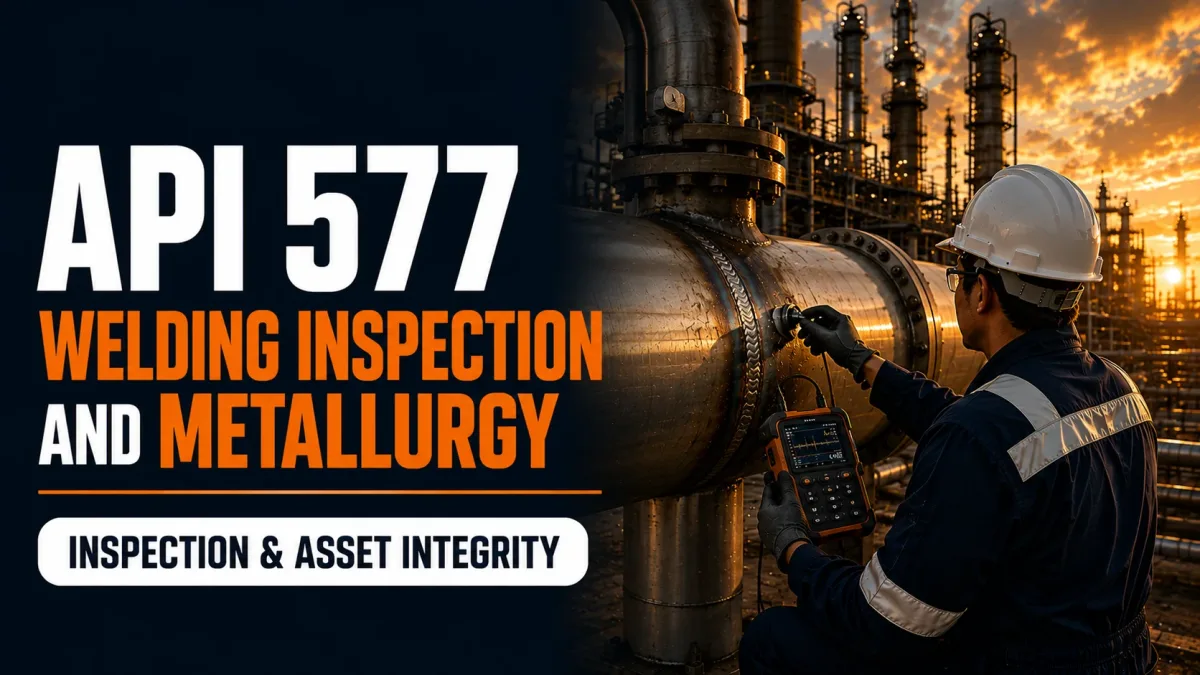
API 577 Welding Inspection and Metallurgy certifies your competency in welding processes, welder and procedure qualification, metallurgical effects of welding, and inspection techniques used across static equipment fabrication and repair, based on API RP 577 and ASME Section IX (Part QW).
Unlike API 510, 570, and 653, which test equipment-specific inspection codes, API 577 is discipline-focused: it validates welding and metallurgy knowledge that supports an inspector implementing those equipment-specific codes, rather than certifying inspection authority over a particular asset type on its own.
The exam runs 110 questions across 3.25 hours, closed-book, with only 100 of the 110 questions scored, the remaining 10 are unscored pretest items. No paper or reference materials are permitted, so unlike API 510, 570, and 653's open-book portion, API 577 tests recall and applied judgment without any lookup support.
Whether you're looking for a structured API 577 course, self-paced API 577 online training, or simply a focused way to study for API 577 certification around a working schedule, EIM's API 577 training platform is built to fit all three.
API 577 vs API 510, 570, and 653
API 510, 570, and 653 each certify inspection authority for a specific equipment category: pressure vessels, piping, and storage tanks respectively. API 577 doesn't certify authority over an equipment type at all, it certifies the underlying welding and metallurgy competency that supports inspection decisions across all three, which is why API 577's own reference practice explicitly describes itself as assisting inspectors implementing API 510, 570, 653, and 582.
This relationship is reflected directly in eligibility: holding a current API 510, 570, or 653 certification automatically qualifies you to sit for API 577, the same auto-qualify pattern API uses for API 571. Many inspectors pursue 577 alongside or shortly after their first equipment-specific certification, since weld integrity is a common thread across pressure vessel, piping, and tank inspection work.
Qualification & Prerequisites
What the Exam Actually Tests
Five domains, weighted by question share. This is the map the question bank is built directly against.
SMAW, GTAW, GMAW, SAW process fundamentals, welding procedure specifications (WPS)
WPS qualification, welder performance qualification (WPQ), essential variables
Heat-affected zone (HAZ) changes, hydrogen cracking, lamellar tearing, post-weld heat treatment
Porosity, slag inclusions, incomplete fusion, undercut, code-based acceptance limits
Visual inspection technique, NDT method selection (RT, UT, MT, PT) as it applies to weld inspection sign-off
| Domain | Covers | |
|---|---|---|
| 01 | Welding Processes & Procedures | SMAW, GTAW, GMAW, SAW process fundamentals, welding procedure specifications (WPS) |
| 02 | Welder & Procedure Qualification (ASME IX) | WPS qualification, welder performance qualification (WPQ), essential variables |
| 03 | Metallurgical Effects of Welding | Heat-affected zone (HAZ) changes, hydrogen cracking, lamellar tearing, post-weld heat treatment |
| 04 | Weld Defects & Acceptance Criteria | Porosity, slag inclusions, incomplete fusion, undercut, code-based acceptance limits |
| 05 | Inspection Techniques & NDT Awareness | Visual inspection technique, NDT method selection (RT, UT, MT, PT) as it applies to weld inspection sign-off |
01. Welding Processes & Procedures
02. Welder & Procedure Qualification (ASME IX)
03. Metallurgical Effects of Welding
04. Weld Defects & Acceptance Criteria
05. Inspection Techniques & NDT Awareness
How to Register and What to Expect on Exam Day
Candidates apply directly through API's Individual Certification Programs (ICP) portal, not through EIM or any third-party training provider. Exams are administered at Prometric testing centers worldwide during specified testing windows throughout the year.
Recertification applications can be submitted up to 90 days before your certification's expiration date, with a further 90-day grace period after expiration before the certification lapses entirely. At this time, API does not require employment verification for API 577 recertification, unlike the initial application, which does require documented eligibility.
How to Prepare for API 577 Welding Inspection and Metallurgy
Self-paced by default. Add live instruction if you want structured guidance.
API 577 Welding Inspection and Metallurgy Question Bank
1050 practice questions across 4 modules, mapped to every BOK domain. Study at your own pace, no fixed schedule required.
Sample Practice Questions
A thick-plate restrained joint on a low-sulfur steel plate develops a subsurface, step-like crack running parallel to the plate surface shortly after welding, without any surface-breaking indication. Which mechanism is most likely responsible?
A welder qualified on a procedure using a specific filler metal classification changes to a different filler metal classification for a production weld. Under ASME Section IX, what is required before this change is permitted?
What's Included in the Self-Prep Package
API 577 Question Bank
Scenario-based questions mapped to the current API 577 Body of Knowledge, with a worked explanation for every answer.
API 577 Study Notes
Downloadable study material covering welding processes, ASME IX qualification, metallurgy, and inspection techniques.
API 577 Mock Test
Full-length practice exam mirroring the real 110-question, 3.25-hour closed-book format.
Related Certifications
Common Questions
What is the API 577 certification?
How many questions are on the API 577 exam?
Is the API 577 exam open-book?
Am I automatically eligible for API 577 if I hold API 510?
How much does API 577 certification cost?
How long is API 577 certification valid?
What does EIM's API 577 training include?
Is API 577 recognized as an inspector certification internationally?
Why API 577 Welding Inspection and Metallurgy Matters for Asset Integrity Careers
A pattern worth understanding before you study: API 577's own reference document, API RP 577, doesn't mandate inspecting every weld or specify exact inspection extent, it's written as guidance an authorized inspector applies with judgment, not a rigid checklist. The exam reflects that same philosophy, questions are built to test whether you understand why a welding or metallurgical issue matters for equipment integrity, not just whether you can recite a definition.
Because the exam is entirely closed-book with no reference material allowed, unlike API 510, 570, and 653's open-book portion, effective API 577 exam preparation leans more heavily on repetition and recall than on reference-navigation practice. EIM's API 577 question bank is built around this reality: every practice question is scenario-based and paired with a worked explanation, so an incorrect answer becomes a diagnostic tool for exactly which welding or metallurgy concept needs another pass.
- ✓1050 practice questions
- ✓4 structured modules
- ✓1 Year
- ✓Mobile-friendly platform
Confused about which certification is right for you? Talk to our experts.