API 580 Risk Based Inspection ProfessionalExam Guide & Preparation
API 580 Risk Based Inspection Professional certifies your competency in developing, implementing, and sustaining a Risk Based Inspection (RBI) program, based on API RP 580, Elements of a Risk-Based Inspection Program, 4th Edition.
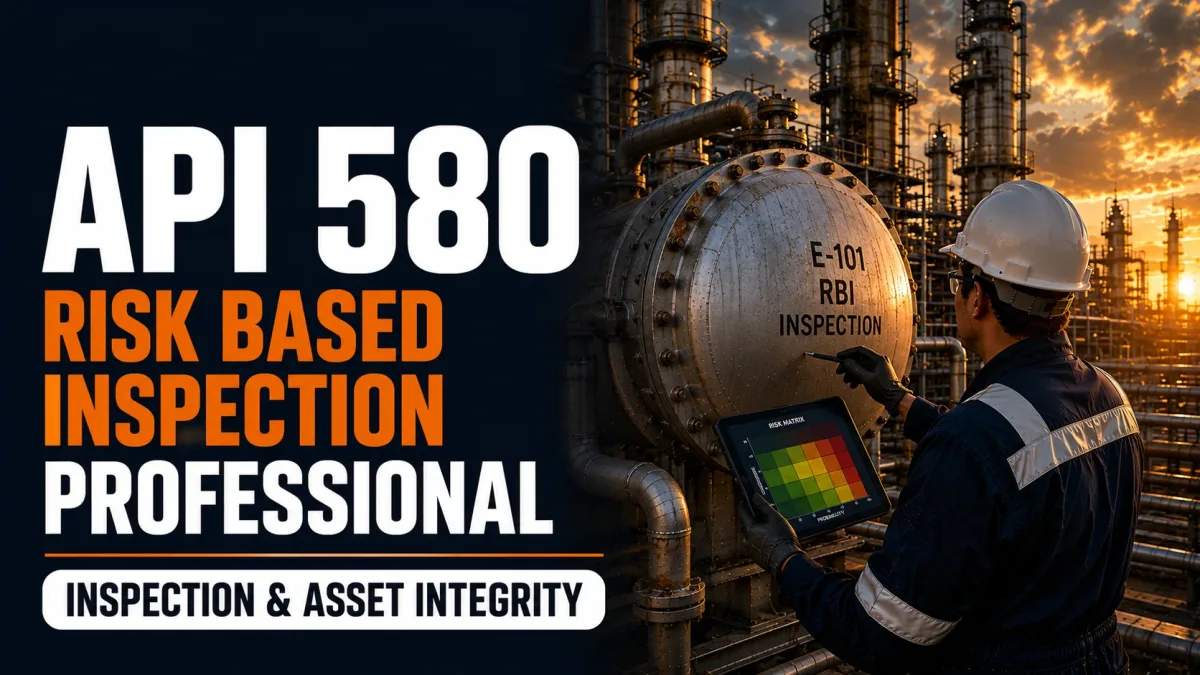
API 580 Risk Based Inspection Professional certifies your competency in developing, implementing, and sustaining a Risk Based Inspection (RBI) program, based on API RP 580, Elements of a Risk-Based Inspection Program, 4th Edition.
Unlike API's equipment-specific certifications, API 580 is methodology-focused: it tests your ability to assess probability of failure and consequence of failure, rank equipment risk, and use that ranking to build a defensible inspection plan, skills that apply across pressure vessels, piping, and storage tanks alike rather than being tied to one asset type.
The exam runs 90 questions across 3.25 hours, closed-book, with only 80 of the 90 questions scored, the remaining 10 are unscored pretest items. Like API 577, no paper or reference materials are permitted, so preparation has to build genuine recall of RBI methodology rather than reference-lookup skill.
Whether you're looking for a structured API 580 course, self-paced API 580 online training, or simply a focused way to study for API 580 certification around a working schedule, EIM's API 580 training platform is built to fit all three.
API 580 vs API 510, 570, 653, and 571
API 510, 570, and 653 each certify inspection authority for a specific equipment category. API 580 doesn't certify authority over an equipment type at all, it certifies the risk methodology that decides how often and how thoroughly any of that equipment should be inspected in the first place. RBI is what turns a flat, calendar-based inspection schedule into a risk-prioritized one, so inspection effort concentrates on the equipment most likely to fail and most costly if it does.
This relationship shows up directly in eligibility: holding a current API 510, 570, or 653 certification automatically qualifies you to sit for API 580, the same auto-qualify pattern used for API 571 and 577. API 580's body of knowledge also draws on API RP 571 (damage mechanisms feed directly into probability-of-failure assessment) and API RP 581 (the quantitative RBI methodology that API 580 introduces at a conceptual level), so candidates who've already studied 571 often find 580's probability-of-failure content more familiar.
Qualification & Prerequisites
What the Exam Actually Tests
Five domains, weighted by question share. This is the map the question bank is built directly against.
RP 580 program elements, RBI implementation roles and responsibilities
Damage mechanism susceptibility, corrosion rate input, inspection effectiveness categories
Flammable and toxic release scenarios, safety, environmental, and financial consequence categories
5x5 risk matrix placement, risk-based inspection interval and technique selection
Quantitative vs. qualitative vs. semi-quantitative RBI approaches, fitness-for-service linkage
| Domain | Covers | |
|---|---|---|
| 01 | RBI Program Fundamentals & Methodology | RP 580 program elements, RBI implementation roles and responsibilities |
| 02 | Probability of Failure (PoF) Assessment | Damage mechanism susceptibility, corrosion rate input, inspection effectiveness categories |
| 03 | Consequence of Failure (CoF) Assessment | Flammable and toxic release scenarios, safety, environmental, and financial consequence categories |
| 04 | Risk Ranking & Inspection Planning | 5x5 risk matrix placement, risk-based inspection interval and technique selection |
| 05 | RP 581 Quantitative Methods & FFS Integration | Quantitative vs. qualitative vs. semi-quantitative RBI approaches, fitness-for-service linkage |
01. RBI Program Fundamentals & Methodology
02. Probability of Failure (PoF) Assessment
03. Consequence of Failure (CoF) Assessment
04. Risk Ranking & Inspection Planning
05. RP 581 Quantitative Methods & FFS Integration
How to Register and What to Expect on Exam Day
Candidates apply directly through API's Individual Certification Programs (ICP) portal, not through EIM or any third-party training provider. Exams are administered at Prometric testing centers worldwide during specified testing windows, with API typically running three exam windows per year.
Recertification applications can be submitted up to 90 days before your certification's expiration date, with a further 90-day grace period after expiration before the certification lapses entirely. Check API's current ICP fee schedule for the official exam fee, published pricing varies by source and update cycle, so always confirm against API's own site before budgeting.
How to Prepare for API 580 Risk-Based Inspection (RBI)
Self-paced by default. Add live instruction if you want structured guidance.
API 580 Risk-Based Inspection (RBI) Question Bank
800 practice questions across 4 modules, mapped to every BOK domain. Study at your own pace, no fixed schedule required.
Sample Practice Questions
A pressure vessel has a high probability of failure due to an actively progressing, poorly monitored corrosion mechanism, but is located in a low-consequence area with minimal inventory and no personnel exposure if it fails. Where should this vessel land on a standard 5x5 risk matrix, and what does that placement imply for its inspection plan?
Two identical vessels operate under the same conditions and share the same damage mechanism susceptibility. Vessel A has a strong recent inspection history with confirmed low corrosion rates. Vessel B has sparse, outdated inspection data. How should their probability of failure assessments differ?
What's Included in the Self-Prep Package
API 580 Question Bank
Scenario-based risk-ranking questions mapped to the current API 580 Body of Knowledge, with a worked explanation for every answer.
API 580 Study Notes
Downloadable study material covering RBI program fundamentals, PoF and CoF assessment, and risk matrix application.
API 580 Mock Test
Full-length practice exam mirroring the real 90-question, 3.25-hour closed-book format.
Related Certifications
Common Questions
What is the API 580 certification?
How many questions are on the API 580 exam?
Am I automatically eligible for API 580 if I hold API 510?
How much does API 580 certification cost?
What is the difference between API 580 and API 581?
How long is API 580 certification valid?
What does EIM's API 580 training include?
Do I need to know API 571 damage mechanisms before studying API 580?
Why API 580 Risk-Based Inspection (RBI) Matters for Asset Integrity Careers
The most common mistake candidates make with API 580 is treating it as a mechanism-identification exam, like a lighter version of API 571, when it's actually a risk-methodology exam. Knowing that a vessel is susceptible to sulfidation matters, but API 580 wants you to connect that susceptibility to a probability-of-failure category, combine it with a consequence-of-failure assessment, and land on a defensible position within a risk matrix, then translate that risk ranking into an actual inspection interval and technique decision.
Because the exam is entirely closed-book, effective API 580 exam preparation means practicing full risk-ranking scenarios repeatedly until the POF-to-COF-to-risk-matrix logic becomes automatic, not something you reconstruct from first principles under time pressure. EIM's API 580 question bank is built around exactly this kind of scenario practice, every question includes a worked explanation showing the reasoning path from given conditions to final risk category.
- ✓800 practice questions
- ✓4 structured modules
- ✓1 Year
- ✓Mobile-friendly platform
Confused about which certification is right for you? Talk to our experts.