Welcome to Excellence Integrity Management - Empowering Professionals Globally.
OFFICIAL CERTIFICATION PREPARATION
Home/Exams/API/API 570 Piping Inspector

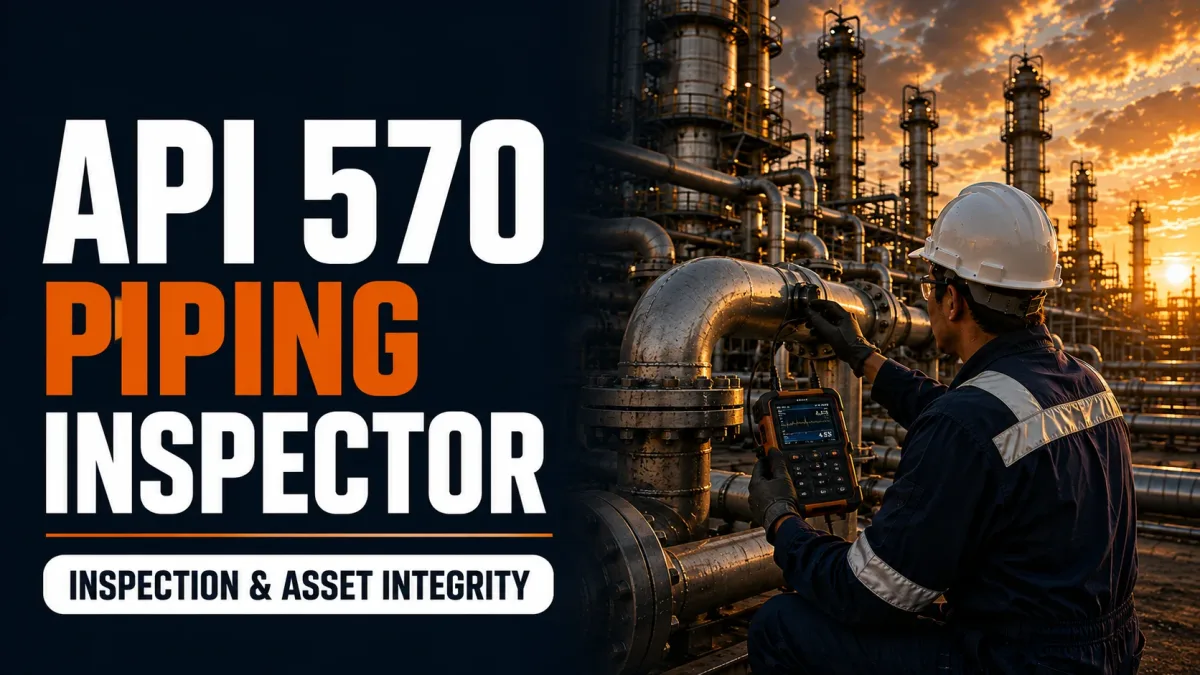
API 570 Piping Inspector Exam Guide & Preparation

API 570 Piping Inspector certifies your competency to inspect, repair, alter, and rerate in-service metallic piping systems in accordance with API 570 and ASME B31.3, the process piping code.

Reviewed by Senior Metallurgical Inspection Engineer, 35+ years · Updated 16 Oct 2026
1,841
Questions
16
Modules
40
Mock tests
595
Flashcards
16
Study notes
1 Year
Access
API 570 Piping Inspector
ONLINE ACCESS
Self-Preparatory Package

Question Bank + Study Notes

$119$14618% OFF
Overview & Scope

API 570 Piping Inspector certifies your competency to inspect, repair, alter, and rerate in-service metallic piping systems in accordance with API 570 and ASME B31.3, the process piping code.

It shares an identical exam structure with API 510 and API 653: 170 total questions, 140 scored, split across a closed-book and open-book portion, but tests a distinct body of knowledge centered on piping-specific construction, inspection, and repair rules rather than pressure vessel or storage tank requirements.

Piping introduces inspection challenges that don't apply the same way to vessels: circuit-based corrosion monitoring, since a single pipe run can have very different corrosion rates at different points depending on flow, elbows, and dead legs, plus a wider range of joint types than a typical pressure vessel presents.

Whether you're looking for a structured API 570 course, self-paced API 570 online training, or simply a focused way to study for API 570 certification around a working schedule, EIM's API 570 training platform is built to fit all three.

Exam Code
API-570
Total Questions
170 (140 scored, 30 unscored pretest)
Format
110 closed-book + 60 open-book, 7.5 hours total
Reference Standards
API 570, ASME B31.3, API 574, API 578, API 571
Certification Validity
3 years
Testing Venue
Prometric testing centers, worldwide
Auto-Qualifies For
None; API 570 does not grant automatic eligibility for any other API exam

API 570 vs API 510, 653, and 571

API 570, 510, and 653 are equipment-specific: each tests code compliance, repair procedures, and inspection intervals for a particular asset type, piping, pressure vessels, and storage tanks respectively. A structural note worth understanding before you study: API treats all three as separate, independently maintained credentials, not tiers of one broader qualification. Experience inspecting pressure vessels doesn't automatically count toward API 570 eligibility, and vice versa, each exam's eligibility table looks specifically for equipment-matched experience.

API 571 sits underneath all three as a mechanism-focused certification: instead of asking how to inspect a specific equipment type, it asks why any of that equipment degrades in the first place. Unlike API 510 and 653, holding API 570 does not by itself grant automatic eligibility for anything further, but many piping inspectors pursue API 571 next to deepen their damage-mechanism knowledge.

Qualification & Prerequisites

Direct Qualification
Not applicable, there is no certification that automatically qualifies you to sit for API 570, and holding API 570 does not automatically qualify you for another API exam either.
Combination Route
Eligibility is a sliding scale based on formal education combined with documented piping-related inspection experience, acquired within the last 10 years while employed by or under contract with an authorized inspection agency. Candidates with a relevant engineering degree need the least documented experience; candidates without a qualifying technical degree need considerably more. Exact experience-year thresholds are published in API 570's eligibility annex and should be verified against the current edition before applying.
BODY OF KNOWLEDGE

Body of Knowledge Breakdown

Several domains, weighted by question share. This is the map the question bank is built directly against.

How to Register and What to Expect on Exam Day

Candidates apply directly through API's Individual Certification Programs (ICP) portal, not through EIM or any third-party training provider. Exams are administered at Prometric testing centers worldwide during specified testing windows throughout the year.

API's 2026 fee schedule lists the official API 570 exam fee at $875 for API members and $1,125 for nonmembers, the same fee structure used across API's ICP inspector exams. This official fee covers only your Prometric exam seat; it does not include study material, a question bank, or structured exam preparation.

Who built this

Senior Metallurgical Inspection Engineer, 35+ years

This material was reviewed by a mechanical engineer with over 35 years in inspection, corrosion management, failure analysis and QA/QC across refineries in India and the Middle East.

Sample Practice Questions

02: API 570 Inspection Classes & Intervals

Two corrosion monitoring locations on the same piping circuit show corrosion rates of 0.004 in/yr and 0.012 in/yr respectively. Which rate should govern the next thickness-inspection interval for that circuit?

A. The average of the two rates
B. 0.004 in/yr, the more optimistic reading
C. 0.012 in/yr, the higher, more conservative rate
D. Neither, a new monitoring location must be established first
Explanation: API 570 interval decisions are always constrained by the more conservative governing rate within a circuit, using the lower corrosion rate would understate the risk at the faster-corroding location and is a common trap for candidates who default to averaging.
Module 2 · Damage Mechanisms & High-Risk Locations

Which configuration is most vulnerable to vibration-induced fatigue?

A. A braced NPS 2 vent on a static storage line
B. An unbraced small-bore connection carrying a valve near a reciprocating compressor
C. A long-radius elbow in low-velocity water service
D. A blind flange on a deadleg
Explanation: Unbraced small-bore connections with cantilevered mass near vibration sources are the classic case. Why not A: Bracing and a static service remove the vibration source and cantilevered response that drive fatigue. Why not C: A long-radius elbow in low-velocity water service has no significant cyclic loading. Why not D: A blind flange on a deadleg is not a vibration source or a cantilevered small-bore mass. Reference: RP 571 3.43; RP 574
Module 4 · B31.3 & B16.5 Calculations

Which B31.3 chapter covers inspection, examination and testing?

A. Chapter V
B. Chapter III
C. Chapter IX
D. Chapter VI
Explanation: Chapter VI (340–346) covers inspection, examination and testing. Why not A: Chapter V covers fabrication, assembly and erection, not inspection, examination and testing. Why not B: Chapter III covers materials, not inspection, examination and testing. Why not C: Chapter IX is not the inspection chapter; inspection, examination and testing are in Chapter VI (340–346). Reference: B31.3 Chapter VI
Module 6 · NDE, PMI & PRDs

If Section V and the referencing code conflict, which governs?

A. The referencing code
B. Section V
C. The more stringent one in every case
D. The examiner's procedure
Explanation: Section V states that the referencing code takes precedence. Why not B: Section V is invoked by the referencing code and itself states that the referencing code's requirements take precedence in a conflict. Why not C: There is no general 'most stringent wins' rule; Section V explicitly defers to the referencing code where the two differ. Why not D: The examiner's procedure must comply with Section V and the referencing code; it cannot override either document. Reference: ASME V Article 1
Module 9 · Open-Book Code Navigation Workbook

About how much time is available per question in the open-book session?

A. 3 minutes 45 seconds
B. 1 minute 30 seconds
C. 2 minutes 15 seconds
D. 6 minutes 00 seconds
Explanation: 225 minutes ÷ 60 questions. Why not B: Ninety seconds would mean 225 minutes spread over 150 questions; the open-book session has 60 questions, giving 3.75 minutes. Why not C: 2 minutes 15 seconds corresponds to about 100 questions in 225 minutes, not 60 questions. Why not D: Six minutes per question would need 360 minutes for 60 questions; 225 ÷ 60 gives only 3.75 minutes. Reference: Examination format
Module 12 · API 571 Damage Mechanism Visual Atlas

Which mechanism is confirmed by deposit sampling and biological analysis?

A. Galvanic corrosion
B. Erosion
C. MIC
D. Mechanical fatigue
Explanation: MIC needs biological evidence for confirmation. Why not A: Galvanic corrosion is confirmed by dissimilar metals in an electrolyte, not biological analysis. Why not B: Erosion is confirmed by flow-related features and velocity, not biological analysis. Why not D: Mechanical fatigue is confirmed by crack form such as beach marks, not deposit sampling. Reference: API RP 571 3rd Ed. 3.45
Module 14 · Piping Repair & PCC-2 Casebook

Who must approve an alteration before the inspector authorises it?

A. The welding foreman
B. The operations manager
C. The NDE examiner
D. The piping engineer
Explanation: Alterations need the engineer's prior approval. Why not A: The welding foreman supervises welding but has no authority to approve alteration design. Why not B: The operations manager does not give engineering approval for alterations. Why not C: The NDE examiner performs examinations and does not approve alteration design. Reference: API 570 5th Ed. Section 8

What's Included in the Self-Prep Package

Q
API 570 Question Bank

Scenario-based questions mapped to the current API 570 Body of Knowledge, with a worked explanation for every answer.

S
API 570 Study Notes

Downloadable study material covering ASME B31.3, inspection classes, and repair and alteration procedures.

M
API 570 Mock Test

Full-length practice exam mirroring the real closed-book and open-book split under timed conditions.

Common Questions

What is the API 570 certification?
API 570 certifies competency in the in-service inspection, repair, alteration, and rerating of process piping systems, based on API 570 and ASME B31.3.
What is the difference between API 570 and API 510?
API 570 covers in-service piping systems; API 510 covers in-service pressure vessels. The exam format is identical, but the reference codes and body of knowledge are equipment-specific and don't cross-qualify.
How long is the API 570 exam?
7.5 hours total, including a short tutorial, 2.75 hours for the closed-book section, a 45-minute lunch break, and 3.75 hours for the open-book section.
How much does API 570 certification cost?
API's 2026 fee schedule lists the official exam fee at $875 for API members and $1,125 for nonmembers. This covers only the official exam; EIM's API 570 course, question bank, and study material are priced separately.
How many years of experience do I need for API 570?
Eligibility is a sliding scale based on education and documented piping inspection experience within the last 10 years, exact thresholds are published in API's current eligibility table and vary by educational background.
What does EIM's API 570 training include?
A structured API 570 question bank, downloadable study notes, and a full-length mock test that mirrors the real exam's closed-book and open-book format, all available as self-paced online training.
Is API 570 recognized as an inspector certification internationally?
Yes, API 570 inspector certification is recognized globally across refining and petrochemical operations and is frequently named specifically in piping inspection job requirements, including across the GCC.
What does the open-book portion of API 570 actually let me reference?
Only the specific sections listed on that exam cycle's Publications Effectivity Sheet, not the entire code. Knowing where to find a provision quickly matters as much as knowing the material exists.

Why API 570 Piping Inspector Matters for Asset Integrity Careers

A pattern that consistently trips up API 570 candidates is treating corrosion monitoring as a single number per circuit rather than a set of location-specific readings. Two corrosion monitoring locations on the same piping circuit can show meaningfully different rates depending on flow velocity, turbulence at elbows and tees, and whether a segment is a dead leg. Effective API 570 exam preparation means practicing scenario questions that require you to identify which reading actually governs the next inspection interval, not just calculating a single average.

EIM's API 570 question bank and study notes are built around this reality: every practice question is scenario-based and mapped to the current Body of Knowledge, and the accompanying API 570 mock test mirrors the real exam's closed-book and open-book time pressure so your practice time trains the actual skill the exam demands.

Start preparing

API 570 Piping Inspector

1 Year access, on any device.

Inside the bank
  • Fundamentals, Components & Inspection Practices40 Q
  • Damage Mechanisms & High-Risk Locations45 Q
  • Corrosion Rate, Remaining Life & Intervals105 Q
  • B31.3 & B16.5 Calculations185 Q
  • Welding, ASME IX & RP 57785 Q
  • NDE, PMI & PRDs106 Q

Plus 964 questions in full-length timed mock papers, for 1,841 in all.

How it works
  1. 1Get the bankPay by card and it opens straight away. By bank transfer or UPI, it opens once we confirm.
  2. 2Practise by moduleQuestions with explanations, timed mock tests and a readiness score that shows what to revise.
  3. 3Not sure yet?Take the free mock test first. It needs only your name, email and number.
  4. 4Sit your examTell us how it went and get 10% off your next purchase.
Free Career Counselling

Confused about which certification is right for you? Talk to our experts.

Share