AMPP Pipeline Coating Inspector (PCI) SpecialtyExam Guide & Preparation
AMPP Pipeline Coating Inspector (PCI) is a specialty focus area within AMPP's Coating Inspector Program, covering the specific coating systems, application methods, and inspection techniques used on pipeline projects, fusion bonded epoxy (FBE), field joint coating, and pipeline-specific holiday detection, that general coating inspection training doesn't cover in depth.
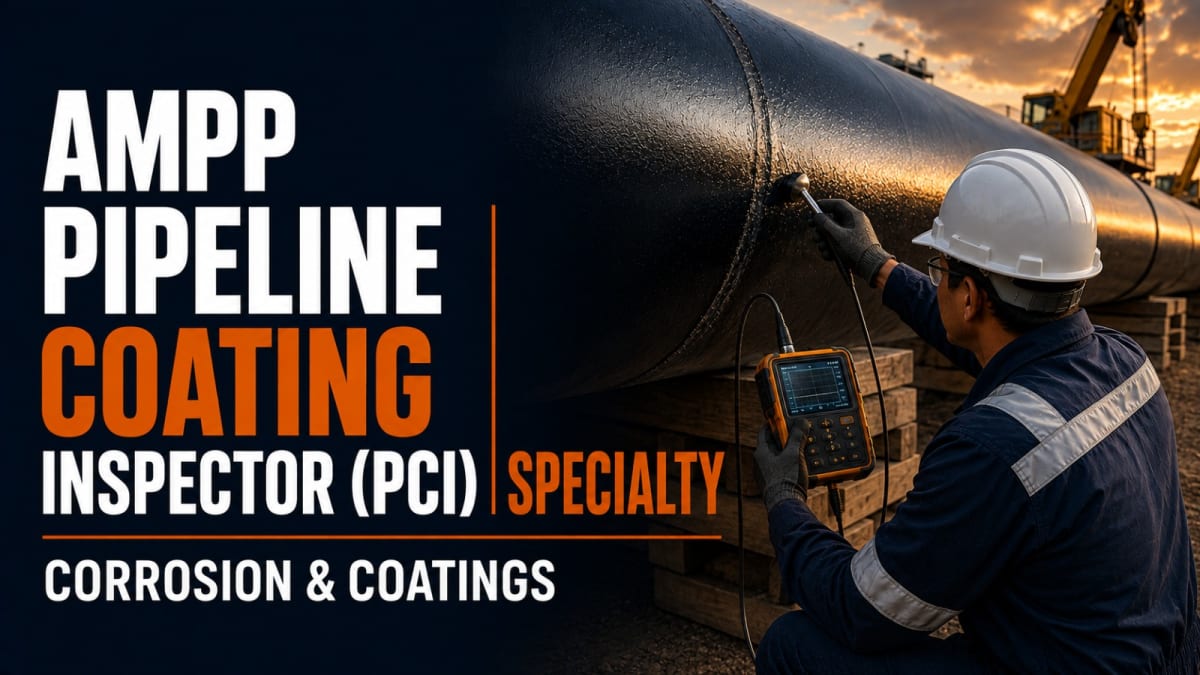
AMPP Pipeline Coating Inspector (PCI) is a specialty focus area within AMPP's Coating Inspector Program, covering the specific coating systems, application methods, and inspection techniques used on pipeline projects, fusion bonded epoxy (FBE), field joint coating, and pipeline-specific holiday detection, that general coating inspection training doesn't cover in depth.
Important: unlike CIP Level 1, 2, or 3, PCI is not a standalone certification with its own independent exam pathway. It's explicitly structured by AMPP as an enhancement to an existing Basic Coatings Inspector (CIP Level 1), Certified Coatings Inspector (CIP Level 2), or Senior Certified Coatings Inspector (CIP Level 3) certification, you need an active CIP certification at some level before this specialty applies to you. "PCI" is also a legacy name, SSPC's original Protective Coatings Inspector program used this same acronym before merging into what's now called AMPP CIP, so you may see the term used both ways in older job postings.
Pipeline coating work has genuinely distinct technical demands from general industrial coating inspection: field joint coating happens under time pressure at remote trenchside locations, FBE and three-layer polyethylene/polypropylene systems behave differently from liquid-applied coatings, and holiday detection voltage settings and technique differ for pipeline-specific coating thicknesses and geometries.
Whether you're looking for structured AMPP PCI training, self-paced AMPP PCI online study material, or a focused way to build pipeline coating inspection competency on top of your existing CIP certification, EIM's AMPP PCI program is built for exactly that.
PCI Specialty vs Standard CIP Levels
CIP Level 1, 2, and 3 build general coating inspection competency, applicable across storage tanks, structural steel, marine, and industrial facility coatings. PCI narrows that competency specifically to pipeline applications, systems, and field conditions a general CIP certification doesn't specifically prepare you for, remote trenchside field joint coating under time pressure, FBE and three-layer PE/PP systems, and pipeline-specific holiday detection technique.
This makes PCI complementary to your CIP level, not a replacement or a competing credential. A CIP Level 1 inspector who adds PCI specialty knowledge becomes meaningfully more valuable for pipeline construction projects specifically, without needing to progress all the way to CIP Level 2 or 3 first, though PCI content builds on whatever CIP level you currently hold.
Who Should Take This Specialty
What This Specialty Covers
Five domains, weighted by question share. This is the map the question bank is built directly against.
Fusion bonded epoxy (FBE), three-layer PE/PP systems, liquid pipeline coatings
Field joint application methods, trenchside inspection under time and weather pressure
Voltage setting for pipeline coating thickness, technique for pipe geometry
Handling and installation damage identification, repair assessment
Pipeline coating inspection documentation requirements, relevant standards
| Domain | Covers | |
|---|---|---|
| 01 | Pipeline Coating Systems | Fusion bonded epoxy (FBE), three-layer PE/PP systems, liquid pipeline coatings |
| 02 | Field Joint Coating | Field joint application methods, trenchside inspection under time and weather pressure |
| 03 | Pipeline Holiday Detection | Voltage setting for pipeline coating thickness, technique for pipe geometry |
| 04 | Coating Damage Assessment During Construction | Handling and installation damage identification, repair assessment |
| 05 | Documentation & Standards | Pipeline coating inspection documentation requirements, relevant standards |
01. Pipeline Coating Systems
02. Field Joint Coating
03. Pipeline Holiday Detection
04. Coating Damage Assessment During Construction
05. Documentation & Standards
How to Register and What to Expect on Exam Day
PCI specialty content and any associated coursework is accessed directly through AMPP, not through EIM or any third-party training provider. Since PCI enhances an existing CIP certification rather than functioning as an independent credential, there is no separate ICP application or Prometric registration process the way there is for a standalone exam like CIP Level 2.
EIM's AMPP PCI self-study program is a training resource, not an exam registration pathway. Access is granted directly upon purchase, with no external application or eligibility documentation required beyond already holding an active CIP certification.
How to Prepare for AMPP Pipeline Coating Inspector (PCI) Specialty
Self-paced by default. Add live instruction if you want structured guidance.
AMPP Pipeline Coating Inspector (PCI) Specialty Question Bank
900 practice questions across 4 modules, mapped to every BOK domain. Study at your own pace, no fixed schedule required.
Practice Scenarios
During field joint coating application at a trenchside location, ambient conditions show high humidity and a surface temperature near the dew point. What is the most appropriate inspector action?
A holiday detector calibrated for a thick, three-layer PE pipeline coating is used at a voltage setting appropriate for a much thinner FBE-only coating. What is the likely result?
What's Included in the Self-Study Package
AMPP PCI Study Notes
Downloadable study material covering pipeline coating systems, field joint coating, and holiday detection.
AMPP PCI Practice Question Set
Applied scenario questions built around real pipeline coating inspection situations.
Field Joint Coating Case Studies
Worked examples of trenchside inspection decisions under realistic field conditions.
Related Certifications
Common Questions
Is AMPP PCI a standalone certification?
Do I need CIP Level 2 or 3 specifically for PCI, or is Level 1 enough?
Is AMPP PCI the same as SSPC PCI?
What does the AMPP PCI specialty cover?
How much does the AMPP PCI specialty cost?
What does EIM's AMPP PCI training include?
Why is field joint coating weighted so heavily in this specialty?
Can I pursue AMPP PCI without any CIP certification?
Why AMPP Pipeline Coating Inspector (PCI) Specialty Matters for Asset Integrity Careers
Field joint coating is arguably the single highest-value topic in pipeline coating inspection specifically, because it's applied in the field, at the trench, under real-world time and weather pressure, rather than in a controlled shop environment the way most pipe body coating is. A field joint coating failure is also disproportionately likely to become the corrosion initiation point on an otherwise well-coated pipeline, since it's the one coating application step that can't be shop-controlled.
EIM's AMPP PCI study material is built around this reality, weighting field joint coating inspection heavily alongside FBE and three-layer system knowledge, since that's where pipeline-specific inspection judgment actually earns its keep on a real project, not in memorizing coating chemistry that's identical to what a general CIP inspector already knows.
- ✓900 practice questions
- ✓4 structured modules
- ✓1 Year
- ✓Mobile-friendly platform
Confused about which certification is right for you? Talk to our experts.