CSWIP 3.1 Welding InspectorExam Guide & Preparation
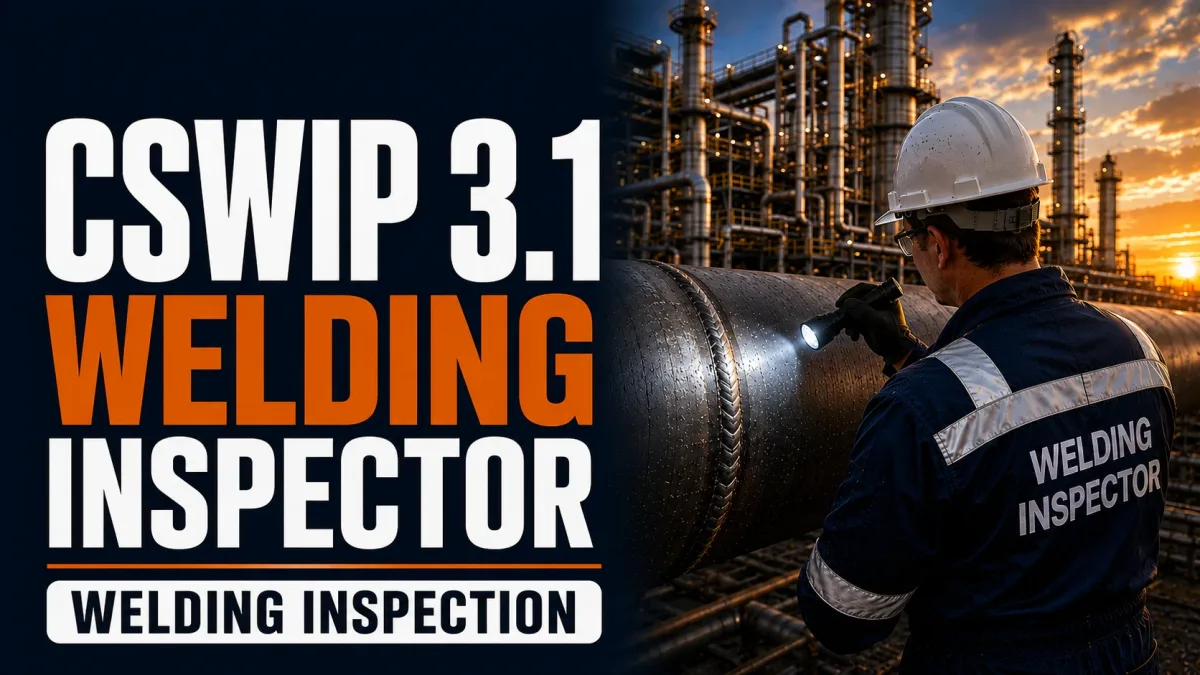
CSWIP 3.1 Welding Inspector is TWI's mid-tier welding inspection qualification, sitting between the entry-level CSWIP 3.0 (Visual Welding Inspector) and the senior-level CSWIP 3.2 (Senior Welding Inspector). It's one of the most consistently required welding inspection credentials across oil and gas, marine, offshore, and structural steel fabrication globally, and is frequently named specifically, alongside AWS CWI, in job postings and client qualification requirements, including major operators across the Middle East.
CSWIP 3.1 Welding Inspector is TWI's mid-tier welding inspection qualification, sitting between the entry-level CSWIP 3.0 (Visual Welding Inspector) and the senior-level CSWIP 3.2 (Senior Welding Inspector). It's one of the most consistently required welding inspection credentials across oil and gas, marine, offshore, and structural steel fabrication globally, and is frequently named specifically, alongside AWS CWI, in job postings and client qualification requirements, including major operators across the Middle East.
Unlike API exams, CSWIP 3.1 requires attending an approved training course before you're eligible to sit the exam, course and exam are bundled into a single pathway rather than separate steps. The standard path runs 5 days total: 4 days of training covering welding processes, weld defects, materials, heat treatment, visual inspection, destructive and non-destructive testing awareness, and codes and standards, followed by 1 day of examination.
The exam itself consists of multiple written papers covering general welding technology, plate practical, pipe practical, and macro examination, alongside a hands-on practical weld inspection assessment. Candidates must score at least 70% in each individual test to pass, a single weak paper can fail the whole attempt even if your overall average would otherwise clear 70%.
Whether you're looking for a structured CSWIP 3.1 course, self-paced CSWIP 3.1 online training, or simply a focused way to study for CSWIP 3.1 certification requirements around a working schedule, EIM's CSWIP 3.1 training platform is built to fit all three.
CSWIP 3.1 vs CSWIP 3.0 vs CSWIP 3.2
CSWIP 3.0, 3.1, and 3.2 form a progression by inspection scope and depth. CSWIP 3.0 covers visual inspection fundamentals with no formal experience prerequisite. CSWIP 3.1, this certification, requires 3 years of documented welding inspection experience, or 2 years already holding CSWIP 3.0, or 1 year as a welding instructor or supervisor, and adds welding procedure review, material verification, and code compliance depth well beyond 3.0's visual-only scope. CSWIP 3.2 requires 2 years holding CSWIP 3.1 and adds advanced content including radiographic interpretation.
CSWIP 3.1 is the credential most employers specifically name in job requirements, since 3.0 alone is generally considered entry-level supervised competency, while 3.2 represents senior-level expertise beyond what most standard inspection roles require day to day.
Qualification & Prerequisites
What the Exam Actually Tests
Five domains, weighted by question share. This is the map the question bank is built directly against.
Inspector duties, discontinuity vs. defect distinction, welding terminology
Fusion welding process fundamentals, consumable identification and selection
Defect classification against standards such as ISO 5817, acceptance criteria interpretation
Carbon-manganese, low-alloy, and stainless steel weldability; pre-heat and post-weld heat treatment
Pre-weld, in-process, and post-weld inspection; welding procedure and welder qualification review; NDT method awareness
| Domain | Covers | |
|---|---|---|
| 01 | Duties, Discontinuity vs. Defect & Terminology | Inspector duties, discontinuity vs. defect distinction, welding terminology |
| 02 | Welding Processes & Consumables | Fusion welding process fundamentals, consumable identification and selection |
| 03 | Weld Defects & Code-Based Acceptance Criteria | Defect classification against standards such as ISO 5817, acceptance criteria interpretation |
| 04 | Materials, Weldability & Heat Treatment | Carbon-manganese, low-alloy, and stainless steel weldability; pre-heat and post-weld heat treatment |
| 05 | Inspection Stages, WPS/WQR Review & NDT Awareness | Pre-weld, in-process, and post-weld inspection; welding procedure and welder qualification review; NDT method awareness |
01. Duties, Discontinuity vs. Defect & Terminology
02. Welding Processes & Consumables
03. Weld Defects & Code-Based Acceptance Criteria
04. Materials, Weldability & Heat Treatment
05. Inspection Stages, WPS/WQR Review & NDT Awareness
How to Register and What to Expect on Exam Day
Candidates enroll through a TWI-approved training provider, not through EIM directly. The standard pathway bundles a 5-day course (4 days training, 1 day exam) together, enrollment and exam booking typically happen as part of the same registration process, unlike CSWIP 3.0 where they're separate steps.
Candidates must pass a vision test showing near-vision acuity of Jaeger J1 at not less than 30 cm (or better) in at least one eye, natural or corrected, plus color perception sufficient to distinguish the colors used in the test. Check your chosen training provider's current course and exam fees, which vary by provider and region, separate from EIM's CSWIP 3.1 self-prep pricing.
How to Prepare for CSWIP 3.1 Welding Inspector
Self-paced by default. Add live instruction if you want structured guidance.
CSWIP 3.1 Welding Inspector Question Bank
1250 practice questions across 4 modules, mapped to every BOK domain. Study at your own pace, no fixed schedule required.
Sample Practice Questions
An inspector observes a weld with a surface irregularity that, upon measurement, falls within the acceptance criteria specified in the governing code for that joint type. How should this irregularity be classified?
A carbon-manganese steel with a relatively high carbon equivalent (CE) is being welded. What is the primary risk this presents, and what mitigation is typically applied?
What's Included in the Self-Prep Package
CSWIP 3.1 Question Bank
Scenario-based questions covering welding processes, defect classification, materials, and inspection stages.
CSWIP 3.1 Study Notes
Downloadable study material covering all 5 body of knowledge domains with per-paper exam structure in mind.
CSWIP 3.1 Mock Test
Practice test structured around the exam's multi-paper, 70%-per-paper passing format.
Related Certifications

Common Questions
What is the CSWIP 3.1 certification?
Do I need welding experience before taking CSWIP 3.1?
How is the CSWIP 3.1 exam structured?
Can I take the CSWIP 3.1 exam without attending the training course?
What is the difference between CSWIP 3.0 and CSWIP 3.1?
How much does CSWIP 3.1 certification cost?
Is CSWIP 3.1 recognized internationally?
What does EIM's CSWIP 3.1 training include?
Why CSWIP 3.1 Welding Inspector Matters for Asset Integrity Careers
The per-paper 70% passing threshold is the detail that catches the most candidates off guard, it's genuinely possible to average well above 70% across all papers combined while still failing the exam outright because one specific paper, often the macro examination or pipe practical, fell just short. Effective CSWIP 3.1 exam preparation means treating each paper as its own pass/fail hurdle, not optimizing for an overall average.
The core conceptual distinction CSWIP 3.1 tests repeatedly is discontinuity versus defect: all defects are discontinuities, but not all discontinuities are defects, the difference lies entirely in whether the finding falls within or outside the applicable code's acceptance criteria. EIM's CSWIP 3.1 question bank is built around this distinction specifically, since candidates who master it consistently outperform those who've only memorized defect names in isolation.
- ✓1250 practice questions
- ✓4 structured modules
- ✓1 Year
- ✓Mobile-friendly platform
Confused about which certification is right for you? Talk to our experts.