API 510 Eligibility: Education, Experience and What Counts
API 510 eligibility explained: the education and pressure vessel experience combinations API accepts, the 10-year rule, and how to document your experience.
Written by Nilanjan SenReviewed by Deepak Rawtal
Published 18 Oct 2026Reviewed 16 Oct 20263 min read
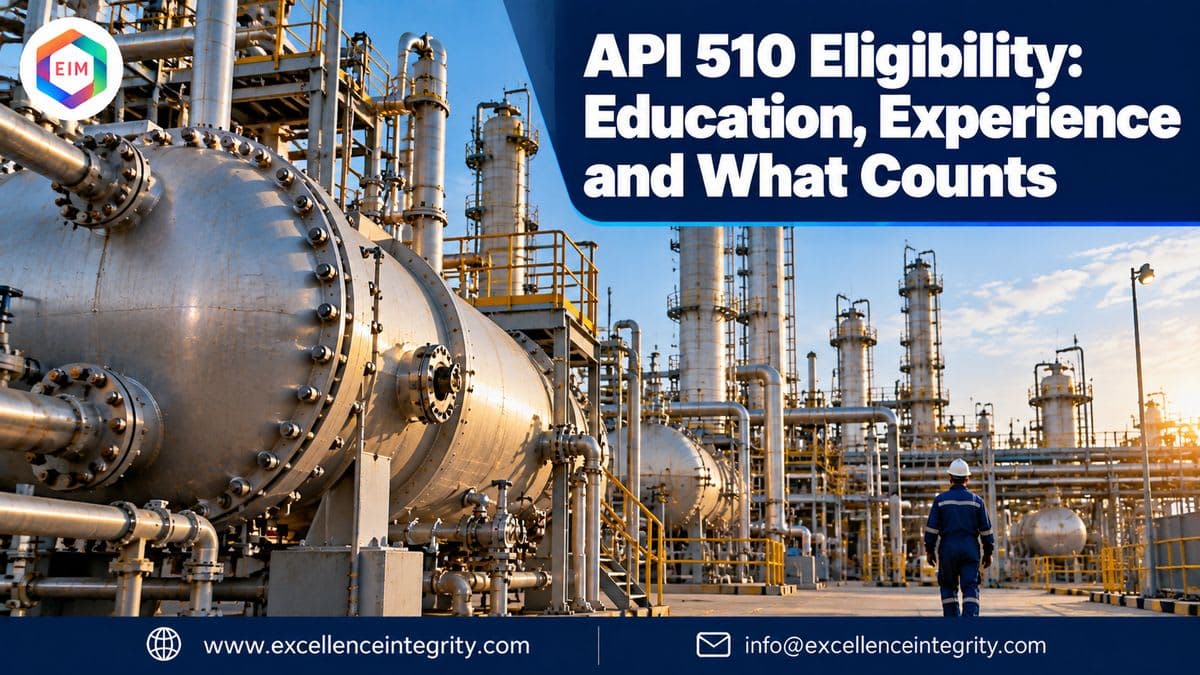
API 510 is often the first API inspector certification an engineer goes for, so it is often the first API application they fill in. The rules are simple, but the experience has to be the right kind, from the right period, and described well. Here are the requirements as API publishes them (checked against API's own pages on 16 October 2026).
Short answer: an engineering or technology degree plus 1 year of pressure vessel inspection experience. Without a degree you need 2, 3 or 5 years depending on your education. All of it must be from the last 10 years, with an authorised inspection agency.
The requirements
| Your education | Experience needed | What the experience must cover |
|---|---|---|
| Bachelor's degree or higher in engineering or technology, or 3+ years of technical military service | 1 year | Supervising or performing inspection activities as described in API 510 |
| 2-year degree or certificate in engineering or technology, or 2 years of technical military service | 2 years | Design, construction, repair, operation or inspection of pressure vessels, of which 1 year in supervising or performing inspection |
| High school diploma or equivalent | 3 years | As above |
| No formal education | 5 years or more | As above |
Two conditions apply to every row. The experience must be from the last 10 years, and gained while employed by, or under contract with, an authorised inspection agency. API verifies the experience you document on the application. Military service does not count after a dishonourable discharge.
Reading the table
The degree row asks for less experience, but it is narrower: the whole year must be in supervising or performing inspection. The other rows allow wider pressure vessel work, such as design, fabrication, repair or operation, as long as at least one year of it is inspection.
The experience must be with pressure vessels. Piping or storage tank work counts towards API 570 or API 653, not API 510.
Documenting your experience
- Name the equipment. Columns, drums, exchangers, reactors: say what you inspected.
- Say what you did. Thickness surveys, internal inspections, repair inspection, pressure tests.
- Give dates for each role, so the reviewer can check the 10-year window.
- Show the agency link. The work must be for, or under contract with, an authorised inspection agency.
API verifies the experience after you apply, so describe it exactly as it happened.
Where API 510 leads
API 510 has one advantage over 570 and 653: holding it automatically qualifies you to sit API 571, the damage mechanisms exam. A current API 510 also qualifies you for API 577. For how the three equipment certifications compare, read API 510 vs API 570 vs API 653.
Keeping it after you pass
The certificate is valid for 3 years. To renew, API asks for three things:
- Work: at least 20% of your time over the last three years spent performing or supervising pressure vessel inspection. If you have not been doing that work, you sit the full exam again.
- Continuing professional development: 24 CPD hours in each 3-year cycle.
- A web quiz every 6 years: 25 open-book questions, with four hours to complete it.
You can apply up to 90 days before expiry, with a 90-day grace period after it. Late fees apply after the expiry date.
Next step
See API 510 exam fees and dates for the next windows and deadlines, and our API 510 study plan to prepare. Exam details and sample questions are in our API 510 certification guide.