API 653 Shell Minimum Thickness: tmin, Joint Efficiency and Maximum Fill Height
How API 653 calculates minimum tank shell thickness: the tmin formula, allowable stress, joint efficiency and maximum fill height, with a worked example.
Written by Nilanjan SenReviewed by Deepak Rawtal
Published 18 Oct 2026Reviewed 7 Oct 20266 min read
Every API 653 inspection of an aboveground storage tank comes back to one question: is each shell course still thick enough for the liquid it holds? The calculation behind the answer is short, appears in both the closed-book and open-book parts of the API 653 exam, and is the basis for decisions to repair, rerate or reduce the fill height. This guide explains the formula, where each value comes from, and works through a full example.
Short answer: For an entire shell course, API 653 uses tmin = 2.6 (H − 1) D G / (S E); for a locally thinned area, tmin = 2.6 H D G / (S E). No course may be less than 0.100 in. S comes from API 653 Table 4.1 and depends on the material and the course; E is the joint efficiency from Table 4.2. If a course is too thin, the same formula, rearranged, gives the maximum safe fill height.
The formulas
Entire course: tmin = 2.6 (H − 1) D G / (S E) Local area: tmin = 2.6 H D G / (S E)
- tmin: minimum acceptable thickness, in inches, but never less than 0.100 in for any course.
- H: height in feet from the bottom of the course (or, for a local area, from the bottom of the evaluated length L) to the maximum liquid level.
- D: nominal tank diameter, in feet.
- G: highest specific gravity of the contents.
- S: maximum allowable stress, in psi, from API 653 Table 4.1.
- E: joint efficiency, from API 653 Table 4.2.
The "− 1" in the entire-course formula reflects the fact that the critical point for a full course sits about a foot above its bottom. A local area is evaluated at its own position, so no foot is deducted. API's Body of Knowledge for the March 2027 exam lists these calculations under API 653 4.3.3.1 and 4.3.4.1.
Where S comes from
API 653 Table 4.1 gives the allowable stress for each material. The values follow a simple pattern based on the material's minimum yield strength (Y) and tensile strength (T): for the bottom two courses, the smaller of 0.80Y or 0.429T; for the upper courses, the smaller of 0.88Y or 0.472T. Higher allowable stress in the upper courses reflects their lower consequence and stress state. In the exam and in practice, take S from the table for the material and course.
For ASTM A36 plate (Y = 36,000 psi, T = 58,000 psi), that gives about 24,880 psi for the bottom two courses and about 27,380 psi for the upper courses.
Where E comes from
Joint efficiency reflects the type of joint and how much radiography was done when the tank was built. API 653 uses the tank's original joint efficiency, with Table 4.2 giving values by construction standard and edition where the original is unknown. When the corroded area being evaluated is far enough away from welds and joints, API 653 allows E = 1.0; check the distance rule in 4.3.3.1. The value matters: as the example shows, E = 0.85 instead of 1.0 raises tmin by about 18%.
Worked example
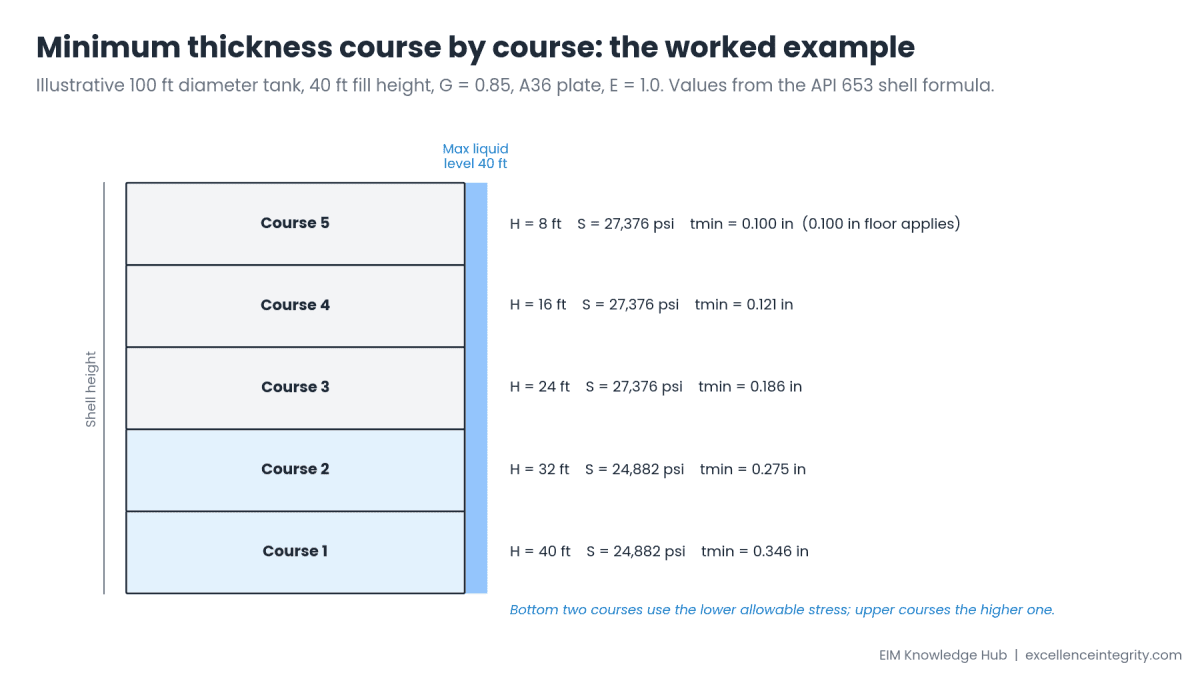
A 100 ft diameter tank stores product with G = 0.85 to a maximum level of 40 ft. It has five 8 ft courses of A36 plate, with E = 1.0.
| Course | H (ft) | S (psi) | Calculation | tmin (in) |
|---|---|---|---|---|
| 1 | 40 | 24,880 | 2.6 × 39 × 100 × 0.85 / 24,880 | 0.346 |
| 2 | 32 | 24,880 | 2.6 × 31 × 100 × 0.85 / 24,880 | 0.275 |
| 3 | 24 | 27,380 | 2.6 × 23 × 100 × 0.85 / 27,380 | 0.186 |
| 4 | 16 | 27,380 | 2.6 × 15 × 100 × 0.85 / 27,380 | 0.121 |
| 5 | 8 | 27,380 | 2.6 × 7 × 100 × 0.85 / 27,380 = 0.057 | 0.100 (code minimum) |
When a course is too thin: maximum fill height
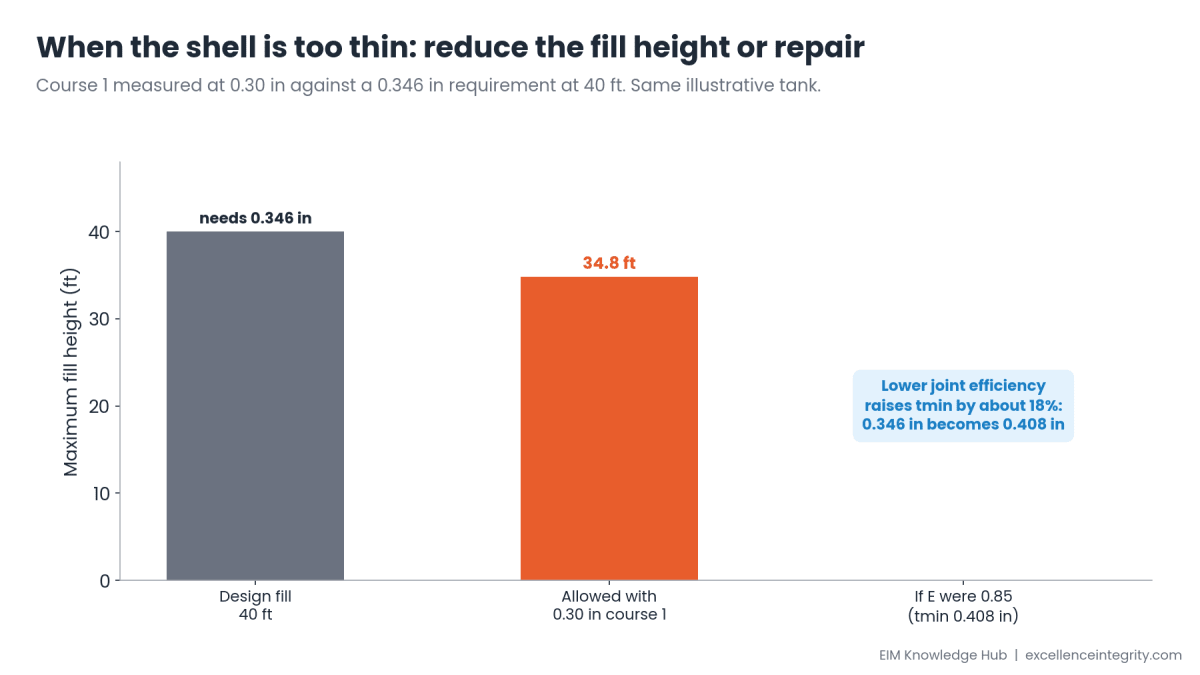
Suppose the inspection finds course 1 averaging 0.30 in, below the 0.346 in required at 40 ft. Rearranging the entire-course formula gives the maximum fill height for that thickness:
H = S E t / (2.6 D G) + 1 = 24,880 × 1.0 × 0.30 / (2.6 × 100 × 0.85) + 1 = 34.8 ft
The owner can rerate the tank to a 34.8 ft fill height, repair the course, or a combination, with the other loads (wind, seismic and so on) also checked. For a local area, the same rearrangement applies without the "+ 1". API states that the fill-height formula is provided in the exam.
Common mistakes
- Using the wrong H. For an entire course, H runs from the bottom of that course; for a local area, from the bottom of the evaluated length.
- Mixing up the two formulas. The "− 1" applies only to the entire course.
- Using the wrong column of Table 4.1. Bottom two courses and upper courses have different allowable stresses.
- Forgetting the 0.100 in minimum for upper courses, where the formula gives very small values.
- Ignoring the corrosion allowance needed to reach the next inspection; see our guide to corroded areas and pitting.
Preparing for API 653
EIM is an independent training provider; API certifies tank inspectors. EIM's self-paced API 653 preparation includes a question bank, practice mode with explanations, timed mock tests, study notes, flashcards, a readiness score and a study plan worked back from your exam date, with one year of access. See the API 653 page. Sitting in March 2027? Applications close on 7 January 2027, and the codebooks changed: read what changed for 2027.
Frequently asked questions
What is the API 653 tmin formula?
For an entire shell course, tmin = 2.6 (H − 1) D G / (S E). For a locally thinned area, tmin = 2.6 H D G / (S E). Neither may be less than 0.100 in.
Why is there a "− 1" in the formula?
For an entire course, the critical point is taken about one foot above the bottom of the course. A local area is evaluated at its own position, so no foot is deducted.
Where do I find the allowable stress S?
API 653 Table 4.1, by material and course. The bottom two courses use the lower allowable stress.
What joint efficiency should I use?
The tank's original joint efficiency, or the value from API 653 Table 4.2 where it is unknown. API 653 allows E = 1.0 for corroded areas far enough from welds; check the distance rule in 4.3.3.1.
How do I calculate maximum fill height?
Rearrange the formula: H = S E t / (2.6 D G) + 1 for an entire course, or without the + 1 for a local area. API provides this formula in the exam.
Sources
- API: API 653 Body of Knowledge, March 2027 (calculation topics and references)
- API 653, Tank Inspection, Repair, Alteration, and Reconstruction: 4.3.3.1, 4.3.4.1, Tables 4.1 and 4.2. Formulas cited; tables not reproduced.
- Worked example prepared by EIM. Checked 7 October 2026.