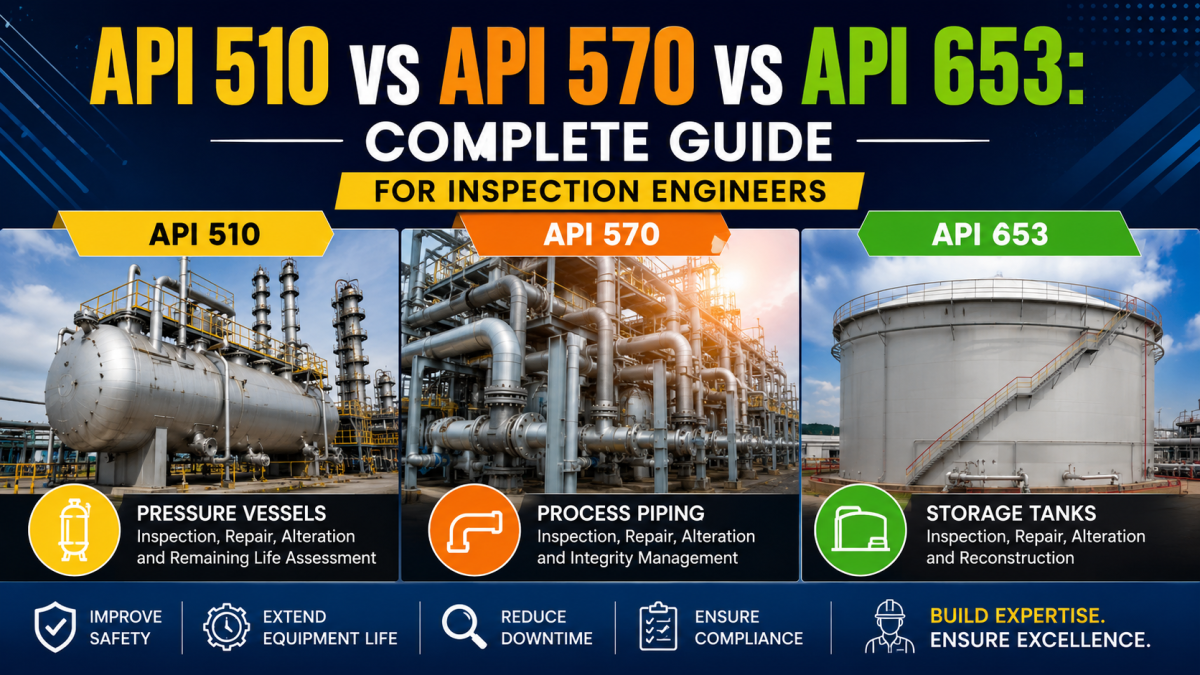
API 510 vs API 570 vs API 653: Complete Guide for Inspection Engineers
In the oil & gas industry, ensuring the integrity of pressure equipment is critical for maintaining safe, reliable, and efficient operations. The American Petroleum Institute (API) has developed internationally recognized inspection codes that help engineers inspect, maintain, repair, and extend the life of industrial assets.
Among these, API 510, API 570, and API 653 are the three most widely used inspection standards. While they share the common goal of ensuring mechanical integrity, each standard applies to a different type of equipment.
If you're an inspection engineer, maintenance professional, asset integrity specialist, or preparing for an API certification, understanding the differences between these standards is essential.
What Are API Inspection Codes?
API inspection codes establish standardized procedures for inspecting, repairing, altering, rerating, and maintaining equipment used in petroleum, petrochemical, and chemical processing facilities.
These standards help organizations:
- Improve plant safety
- Reduce unexpected failures
- Extend equipment service life
- Comply with industry regulations
- Optimize inspection costs
- Support risk-based maintenance strategies
The three primary inspection codes are:
- API 510 – Pressure Vessel Inspection Code
- API 570 – Piping Inspection Code
- API 653 – Above-Ground Storage Tank Inspection Code
Quick Comparison
| Feature | API 510 | API 570 | API 653 |
|---|---|---|---|
| Equipment | Pressure Vessels | Process Piping | Storage Tanks |
| Primary Industry | Oil & Gas, Petrochemical | Oil & Gas, Chemical | Refineries & Tank Farms |
| Design Code Reference | ASME Section VIII | ASME B31.3 | API 650 |
| Main Focus | Pressure Boundary Integrity | Piping Reliability | Tank Structural Integrity |
| Typical Equipment | Reactors, Drums, Columns | Pipelines, Headers, Pipework | Atmospheric Storage Tanks |
API 510 – Pressure Vessel Inspection Code
What is API 510?
API 510 provides inspection, repair, alteration, rerating, and remaining life assessment requirements for pressure vessels operating in petroleum refining and chemical processing industries.
The objective is to ensure vessels continue operating safely throughout their service life.
Equipment Covered
- Pressure Vessels
- Reactors
- Separators
- Columns
- Distillation Towers
- Drums
- Heat Exchanger Shells
Main Inspection Activities
- Internal Inspection
- External Inspection
- Thickness Measurement
- Remaining Life Assessment
- Pressure Testing
- Fitness-for-Service Evaluation
- Repair Recommendations
Common Damage Mechanisms
- General Corrosion
- Pitting Corrosion
- Stress Corrosion Cracking
- Hydrogen Damage
- High Temperature Creep
- Fatigue
API 570 – Piping Inspection Code
What is API 570?
API 570 governs the inspection, repair, alteration, rerating, and integrity management of process piping systems used in refineries, petrochemical plants, and gas processing facilities.
Unlike API 510, this standard focuses exclusively on piping systems that transport process fluids.
Equipment Covered
- Process Pipelines
- Pipe Spools
- Headers
- Branch Connections
- Valves
- Flanges
- Fittings
Main Inspection Activities
- Visual Inspection
- Ultrasonic Thickness Measurement
- Corrosion Circuit Monitoring
- Remaining Life Calculations
- Leak Detection
- On-Stream Inspection
Common Damage Mechanisms
- Internal Corrosion
- External Corrosion
- Corrosion Under Insulation (CUI)
- Erosion
- Flow Accelerated Corrosion
- Fatigue Cracking
API 653 – Above-Ground Storage Tank Inspection
What is API 653?
API 653 establishes inspection, repair, alteration, reconstruction, and fitness assessment requirements for above-ground atmospheric storage tanks originally built according to API 650 or API 12C.
It ensures tanks remain structurally safe throughout decades of service.
Equipment Covered
- Crude Oil Storage Tanks
- Diesel Tanks
- Water Tanks
- Chemical Storage Tanks
- Floating Roof Tanks
- Fixed Roof Tanks
Main Inspection Activities
- Tank Bottom Inspection
- Shell Inspection
- Roof Inspection
- Settlement Survey
- Foundation Assessment
- Bottom Corrosion Evaluation
- Hydrostatic Testing
Common Damage Mechanisms
- Bottom Plate Corrosion
- Shell Corrosion
- Roof Corrosion
- Foundation Settlement
- Weld Cracking
- Floating Roof Seal Damage
Equipment and Applicable API Code
| Equipment | Applicable Standard |
|---|---|
| Pressure Vessel | API 510 |
| Separator | API 510 |
| Reactor | API 510 |
| Heat Exchanger Shell | API 510 |
| Process Piping | API 570 |
| Pipeline | API 570 |
| Pipe Rack | API 570 |
| Crude Oil Storage Tank | API 653 |
| Diesel Storage Tank | API 653 |
| Water Storage Tank | API 653 |
Key Differences Between API 510, API 570 & API 653
API 510
- Focuses on pressure vessels.
- Based primarily on ASME Section VIII.
- Covers vessel rerating and repair.
- Used for equipment operating under internal pressure.
API 570
- Dedicated to process piping systems.
- Emphasizes corrosion circuits.
- Supports on-stream inspections.
- Helps maintain piping reliability.
API 653
- Specifically for above-ground storage tanks.
- Includes settlement monitoring.
- Addresses foundation integrity.
- Covers reconstruction and major tank repairs.
Which API Certification Should You Choose?
Choose API 510 if you work with:
- Pressure Vessels
- Reactors
- Columns
- Heat Exchangers
Choose API 570 if you work with:
- Pipelines
- Process Piping
- Corrosion Monitoring
- Piping Inspection
Choose API 653 if you work with:
- Tank Farms
- Storage Facilities
- Oil Terminals
- Atmospheric Storage Tanks
Many experienced inspectors pursue all three certifications to expand their expertise and career opportunities in asset integrity management.
Inspection Best Practices
- Implement Risk-Based Inspection (RBI) where appropriate.
- Monitor corrosion rates and damage mechanisms regularly.
- Maintain complete inspection histories and records.
- Perform periodic thickness measurements using suitable NDT techniques.
- Repair defects before they become critical.
- Ensure inspection intervals comply with applicable API requirements.
- Keep inspection personnel trained and certified.
Frequently Asked Questions (FAQs)
What is the difference between API 510 and API 570?
API 510 applies to pressure vessels, while API 570 covers process piping systems. Each standard provides inspection and maintenance requirements specific to the equipment it governs.
Does API 653 apply to underground tanks?
No. API 653 is intended for above-ground atmospheric storage tanks built to API 650 or API 12C. Underground storage tanks are covered by other standards and regulations.
Can one inspector hold multiple API certifications?
Yes. Many inspection professionals obtain API 510, API 570, and API 653 certifications to qualify for a wider range of inspection roles and projects.
Is Risk-Based Inspection (RBI) compatible with these standards?
Yes. Risk-Based Inspection methodologies can be used, where applicable, to help determine inspection intervals and priorities in accordance with applicable API requirements.
Conclusion
API 510, API 570, and API 653 are the cornerstone inspection standards for pressure vessels, piping systems, and above-ground storage tanks. Understanding the scope and application of each code enables engineers to select the correct inspection practices, maintain mechanical integrity, and improve plant safety.
By implementing these standards effectively, organizations can reduce unplanned shutdowns, extend equipment life, optimize maintenance costs, and maintain compliance with industry best practices.
About Excellence Integrity Management (EIM)
At Excellence Integrity Management (EIM), we provide specialized training, consulting, and technical solutions in Asset Integrity Management, API Inspection, Risk-Based Inspection (RBI), Corrosion Engineering, Mechanical Integrity, Reliability Engineering, and Oil & Gas Inspection. Our industry experts help engineers and organizations enhance safety, reliability, and operational excellence through practical, standards-based learning.