The 14 PSM Elements Explained: How Process Safety Management Fits Together
The 14 elements of OSHA's process safety management standard in plain English: what each does, how they connect, key time cycles, and where PSM fails.
By Syed Hasan6 Nov 20266 min read
Process safety management (PSM) is the system that keeps hazardous chemicals inside pipes and vessels and stops small failures becoming major incidents. The best-known framework is the US Occupational Safety and Health Administration's PSM standard, 29 CFR 1910.119, with its 14 elements. Many operators in the Gulf and India build their own process safety systems on the same ideas, alongside frameworks such as CCPS's Risk Based Process Safety.
This guide explains each element in plain English, shows how they depend on each other, lists the time cycles that cannot be missed, and covers why PSM failures so often turn up in a different element from the one that gets the blame.
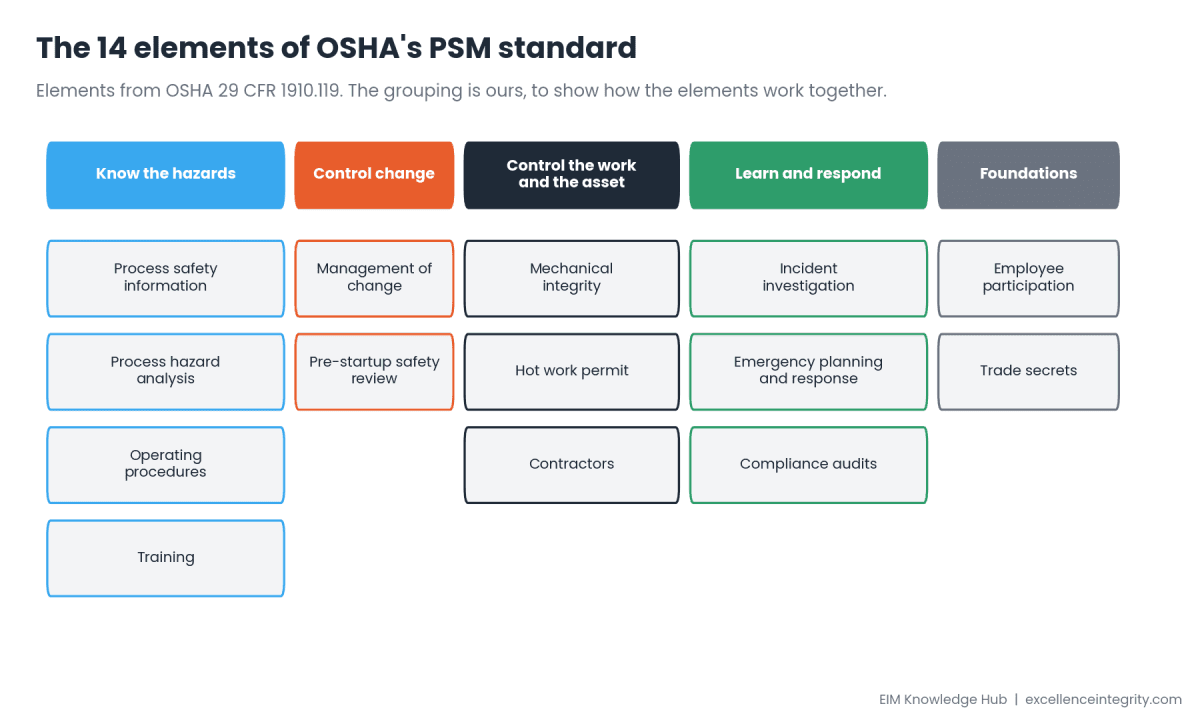
Short answer: The 14 elements are employee participation, process safety information, process hazard analysis, operating procedures, training, contractors, pre-startup safety review, mechanical integrity, hot work permits, management of change, incident investigation, emergency planning and response, compliance audits, and trade secrets. They only work as a system: a weak element quietly undermines the others.
The 14 elements at a glance
Know the hazards
- Process safety information (PSI). The written facts about the chemicals, the technology and the equipment: hazards of materials, process chemistry, safe limits, P&IDs, relief system design basis, materials of construction. Every other element depends on PSI being complete and current.
- Process hazard analysis (PHA). A systematic study of what can go wrong, using methods such as HAZOP, what-if or FMEA, carried out by a team with process and operating knowledge. Recommendations must be resolved and tracked.
- Operating procedures. Written instructions for each operating phase, including start-up, normal operation, emergency shutdown and the consequences of deviating from safe limits.
- Training. Initial training for everyone operating the process, and refresher training to keep it current.
Control change
- Management of change (MOC). Any change to chemicals, technology, equipment or procedures (other than replacement in kind) is reviewed for its safety impact before it is made.
- Pre-startup safety review (PSSR). Before new or modified equipment starts, a check that it was built as designed, procedures are ready, the PHA is done and people are trained.
Control the work and the asset
- Mechanical integrity (MI). Written procedures, inspection and testing, and correction of deficiencies for process equipment such as vessels, piping, relief systems, controls and pumps. This is where inspection, RBI and fitness-for-service live.
- Hot work permit. Control of welding, cutting and other ignition sources on or near covered processes.
- Contractors. Selecting contractors with good safety performance, informing them of hazards, and making sure they follow the site's safe work practices.
Learn and respond
- Incident investigation. Investigating every incident that resulted in, or could reasonably have resulted in, a catastrophic release, and acting on the findings.
- Emergency planning and response. A plan for the whole plant, including handling small releases.
- Compliance audits. Regular audits to check the system works as written, with findings resolved.
Foundations
- Employee participation. Consulting employees on PHAs and the other elements, and giving them access to the information.
- Trade secrets. Making sure confidential information is still available to those who need it for PSM, under confidentiality agreements.
The clocks you cannot miss
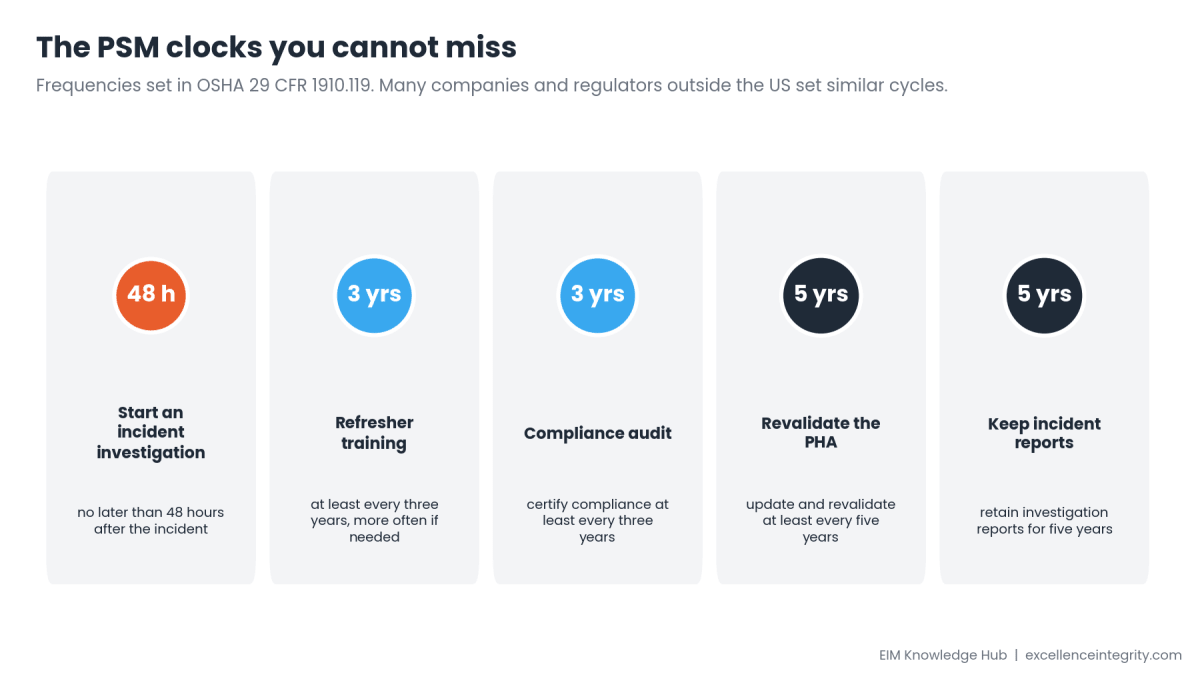
OSHA's standard sets several fixed cycles: incident investigations must start no later than 48 hours after the incident. Refresher training is required at least every three years, and so is the compliance audit. PHAs must be updated and revalidated at least every five years, and incident investigation reports are kept for five years. Even where OSHA does not apply, these cycles are a sensible benchmark.
Why failures are rarely in the element that gets blamed
Investigations often stop at the last action before the event: an operator opened the wrong valve, a contractor started hot work in the wrong place. Look further back and the root usually sits in another element. Typical chains look like this:
- A change was made without MOC, so the PSI was never updated, so the next PHA worked from old drawings, so a hazard was missed.
- Mechanical integrity deferred an inspection, a corroded line failed, and the incident was recorded as an operating upset.
- Operating procedures were out of date, training taught the old version, and the operator followed what they were taught.
That is why good investigations ask, for each finding, which element should have caught it. And it is why the elements are best managed as one system, with owners who talk to each other.
Where inspection and integrity engineers fit
Inspectors and integrity engineers carry much of the mechanical integrity element, and they touch several others: their findings feed MOC when repairs change design, PSSR when equipment returns to service, PHA when damage mechanisms change, and incident investigation when something fails. Integrity operating windows link MI to operating procedures; relief device testing links MI to the relief basis in PSI. See our guides to integrity operating windows and PSV test intervals.
Learn more with EIM
EIM's live Process Safety Management (PSM) course runs over 20 sessions (40 hours) on weekends, with recordings. It covers PSM versus occupational safety, OSHA's 14 elements, process safety information, hazard identification and HAZOP with a workshop, LOPA, SIS and SIL, MOC, PSSR, permit to work, operating procedures, mechanical integrity, PHA programmes, incident investigation and RCA, emergency response, process safety KPIs, culture and auditing, and a capstone project. No batch is published at the moment; check the course page for the next date.
For self-paced study, EIM's Process Safety Management programme covers the 14 elements, what each is for, and why failures are rarely in the element that gets blamed, with reference to OSHA 1910.119, CCPS and IEC 61511. EIM is an independent training provider.
Frequently asked questions
What are the 14 elements of PSM?
Employee participation, process safety information, process hazard analysis, operating procedures, training, contractors, pre-startup safety review, mechanical integrity, hot work permit, management of change, incident investigation, emergency planning and response, compliance audits, and trade secrets.
How often must a PHA be revalidated?
Under OSHA's standard, at least every five years.
How often are PSM compliance audits required?
OSHA requires compliance to be certified by audit at least every three years.
What is the difference between PSM and occupational safety?
Occupational safety focuses on personal injuries such as slips and falls. Process safety focuses on preventing major releases, fires and explosions from hazardous processes. A plant can have a good injury record and still have serious process safety gaps.
Does OSHA PSM apply in the Gulf?
OSHA is a US regulation. Gulf and Indian operators use their own regulations and company standards, often built on the same elements or on CCPS's Risk Based Process Safety framework.
Sources
- OSHA 29 CFR 1910.119, Process Safety Management of Highly Hazardous Chemicals. Paraphrased, not quoted.
- CCPS, Guidelines for Risk Based Process Safety. Cited, not quoted.
- Checked 7 October 2026.