PSV Inspection and Test Intervals: How Often, and Why It Matters
How often relief valves should be tested under API 510, why the as-received pop test matters most, and what a good PSV programme checks.
By Harish Haseeb4 Nov 20265 min read
A pressure relief valve may sit untouched for years, then have a few seconds to save a vessel. In a layer of protection analysis it is often the most heavily credited barrier on the page. Yet relief valves are also easy to neglect: they are out of sight, they rarely operate, and when they are pulled for overhaul, the most important piece of evidence is often destroyed before anyone records it.
This guide covers how often relief valves should be tested, the shop sequence that gets the most value from each overhaul, and the field checks that matter as much as the valve itself.
Short answer: API 510 sets default maximum test and inspection intervals of 5 years for typical process service and 10 years for clean, non-fouling, non-corrosive service, unless documented experience or a risk-based assessment supports a different interval. The single most useful step is the as-received pop test before the valve is cleaned: it shows whether the valve would actually have worked.
How often: the default maximums
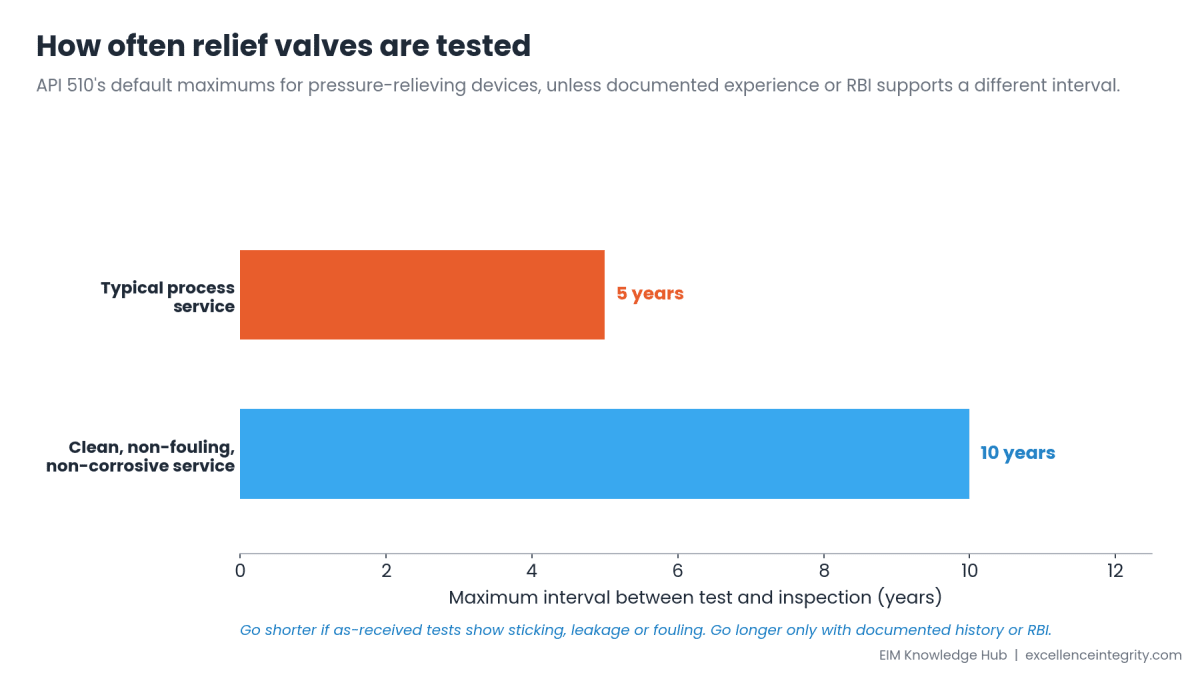
API 510 requires pressure-relieving devices to be tested and inspected often enough to confirm they perform reliably in their particular service. Its default maximums are 5 years for typical process service and 10 years for clean, non-fouling, non-corrosive service. API 570 takes a similar approach for piping systems. A documented test history or an RBI assessment can justify a different interval; so can poor results, in the other direction.
In practice, the interval should respond to evidence. A valve that pops cleanly at set pressure, with no leakage and a clean internal condition, three times in a row supports a longer interval. One that sticks, leaks or comes out fouled needs a shorter one, and a look at why.
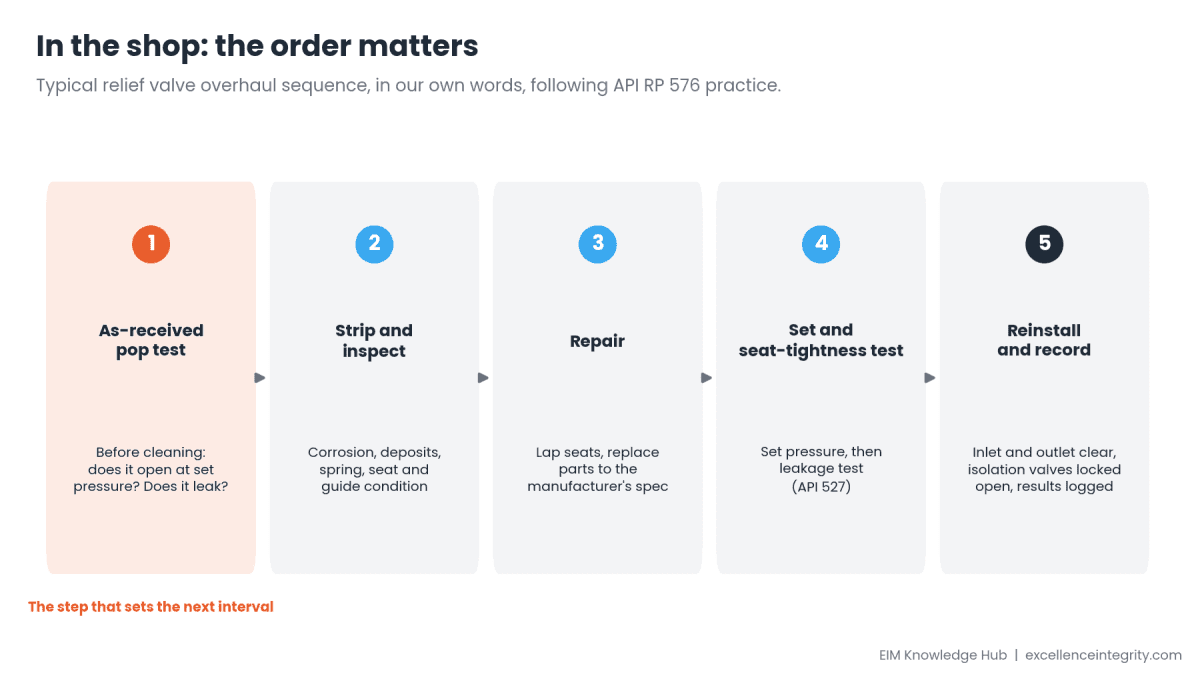
In the shop: why the order matters
- As-received pop test. Before any cleaning, test the valve as it came out of service. Did it open at set pressure, above it, or not at all? Did it leak below set? If it opened high, a second test that opens normally suggests it was stuck by deposits.
- Strip and inspect. Record corrosion, deposits, spring condition, seat and disc damage, guide galling and bellows condition.
- Repair. Lap seats and replace parts to the manufacturer's specification, using a qualified repair organisation.
- Set and seat-tightness test. Set the valve and test for leakage, typically to API 527 for seat tightness.
- Reinstall and record. Results go into the valve's history, which is what justifies the next interval.
API RP 576, Inspection of Pressure-relieving Devices (5th edition, 2024, with Addendum 1 in February 2026), covers this process in detail and is part of the API 510, 570 and 653 exam body of knowledge.
In the field: the checks that matter as much as the valve
A perfectly overhauled valve still fails its purpose if the installation is wrong. Field checks include:
- Inlet and outlet piping free of blockage, deposits, and excessive pressure drop that could cause chattering.
- Isolation valves under the PSV locked or car-sealed open, with the lock status recorded.
- Bellows vents open and clear on balanced bellows valves.
- Discharge piping supported, draining, and free of liquid traps.
- Rupture discs upstream of valves: correct orientation, no pressure between disc and valve, and replacement on schedule.
- Tag and set pressure matching the current relief study after any process change.
When the relief basis changes
Relief valves are sized for specific scenarios: blocked outlet, fire, tube rupture, control valve failure and others, using API 520 for sizing and API 521 for relief system design. When the process, throughput or feed changes, those scenarios change too. A valve that was right ten years ago may now be undersized. Relief studies should be revalidated through management of change, not only during overhaul.
Five common PSV programme failures
- Cleaning before the as-received test, losing the evidence.
- Fixed intervals that never change, whatever the test history says.
- Valves overhauled, but installations never inspected.
- Relief studies not updated after debottlenecking or feed changes.
- Records that cannot be trended, so nobody can show the interval is justified.
Learn more with EIM
EIM's self-paced PSV & Flare System Integrity programme covers relief devices and the flare network: the sizing basis (API 520 and 521), testing (API RP 576 and API 527), and revalidating after plant changes. It is built for process safety engineers who own relief studies, inspection engineers running PSV testing, and operations and turnaround planners, and gives an EIM certificate of completion. See the programme EIM is an independent training provider.
The EIM Calculator includes a PSV sizing tool alongside MAWP and remaining-life calculations. For how relief valves are credited in risk studies, see HAZOP vs LOPA vs SIL.
Frequently asked questions
How often should a pressure relief valve be tested?
API 510's default maximums are 5 years for typical process service and 10 years for clean, non-fouling, non-corrosive service, unless documented experience or an RBI assessment supports a different interval. Poor test results call for shorter intervals.
What is an as-received test?
A pop test of the valve as it was removed from service, before any cleaning or repair. It shows whether the valve would have opened at set pressure in service.
What does API 527 cover?
Seat tightness testing of pressure relief valves, used after setting to confirm leakage is within limits.
Can RBI extend PSV intervals?
Yes. API 510 allows intervals to be set by a risk-based assessment, supported by documented test history.
Who can repair relief valves?
A repair organisation experienced in valve maintenance, working to the manufacturer's specifications and the applicable codes. Jurisdictions may set additional requirements.
Sources
- API 510, Pressure Vessel Inspection Code: pressure-relieving device intervals. Paraphrased, not quoted.
- IChemE Hazards XXII, paper 34: PRV inspection and testing intervals (quoting API 510)
- API RP 576, Inspection of Pressure-relieving Devices, 5th edition (2024), Addendum 1 (2026); API 527; API 520; API 521. Cited, not quoted.
- All checked 7 October 2026.