Well Integrity vs Well Control: What's the Difference, and Why It Matters
Well control handles a kick during operations; well integrity keeps two barriers in place for the life of the well. Standards and roles compared.
By Syed Hasan2 Nov 20265 min read
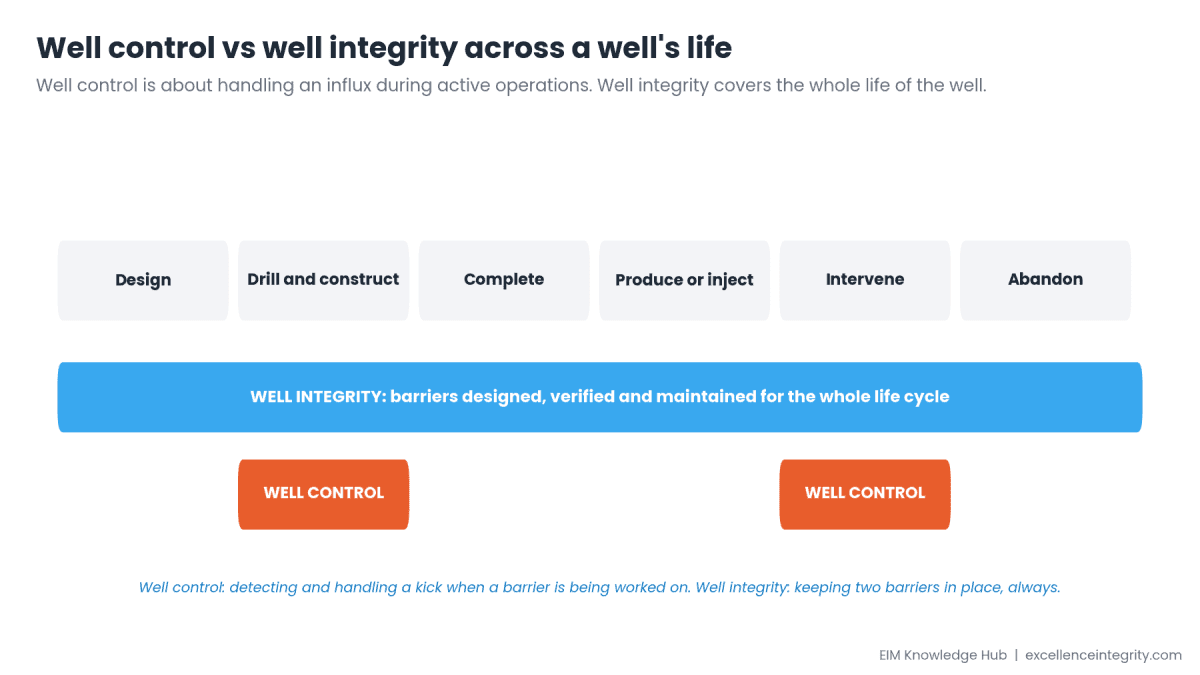
"Is this a well control course?" is one of the first questions people ask about well integrity training. The answer is no, and the distinction matters. The two disciplines share a vocabulary of barriers, pressures and kicks, but they answer different questions at different points in a well's life.
Short answer: Well control is about preventing and handling an influx of formation fluid (a kick) during active operations such as drilling, completion and intervention. Well integrity is about designing, verifying and maintaining barriers so the well contains its fluids through its whole life, from design to abandonment. Well control is a critical part of it, but only part.
Two disciplines across one life cycle
| Well control | Well integrity | |
|---|---|---|
| Core question | Can we detect and safely handle a kick right now? | Will this well contain its fluids for its whole life? |
| When | Drilling, completion, workover and intervention | Design, construction, production, intervention and abandonment |
| Typical tools | Mud weight, kick detection, BOP, shut-in and kill procedures | Barrier design, barrier testing, annulus monitoring, barrier schematics, risk-based management |
| Typical roles | Drillers, toolpushers, drilling supervisors | Well integrity engineers, production and completions engineers, asset integrity managers |
| Typical references | Industry well control training schemes and BOP standards | NORSOK D-010, ISO 16530-1 and -2, API RP 90-1 and 90-2 |
The two-barrier principle
At the heart of well integrity is a simple idea: there should be two independent, tested barriers between the reservoir and the environment at all times. NORSOK D-010, whose fifth revision was published in 2021, sets this out for drilling and well operations and defines well integrity, in short, as using technical, operational and organisational solutions to reduce the risk of an uncontrolled release of formation fluids throughout the life of the well.
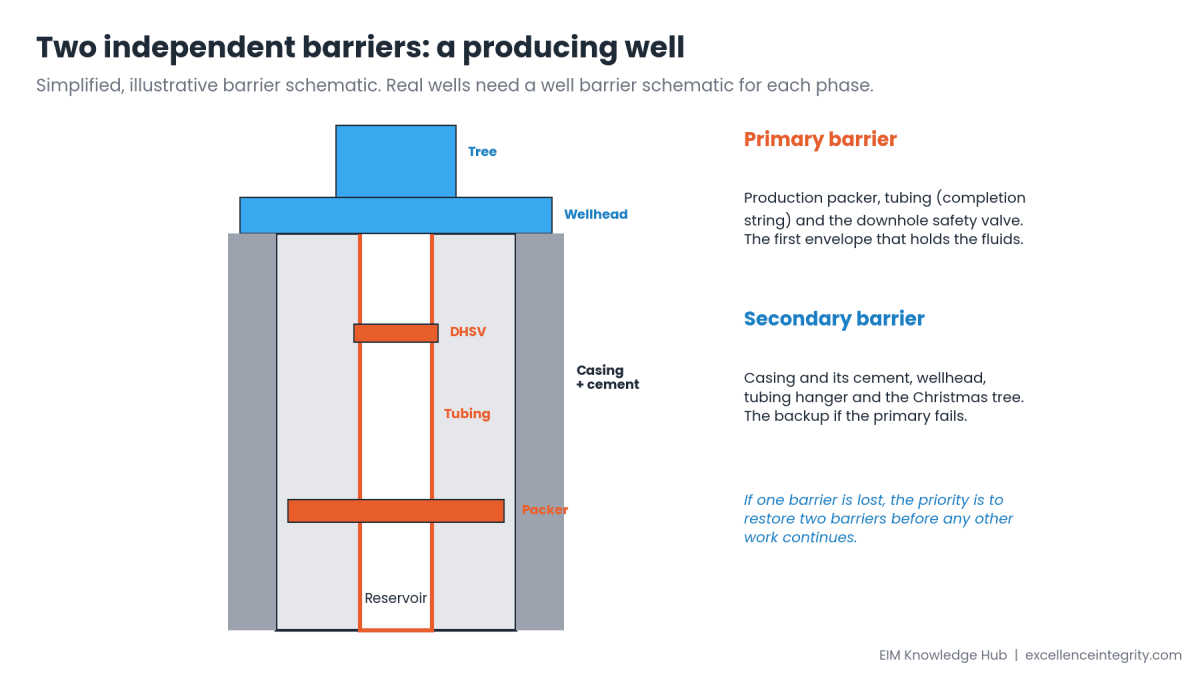
- Primary barrier: the first envelope that contains the fluids. In a producing well this typically includes the production packer, the tubing and the downhole safety valve. During drilling, the main primary barrier is the fluid column.
- Secondary barrier: the back-up if the primary fails: typically the casing and its cement, the wellhead, the tubing hanger and the Christmas tree. During drilling, the blowout preventer forms part of it.
- If a barrier is lost, the priority is to restore two barriers before any other work continues.
Each barrier is made up of well barrier elements, such as a cemented casing, a valve or a packer, each with acceptance criteria and a way to test it. Drawing them on a well barrier schematic for each phase is one of the most useful habits in the discipline.
Where things go wrong in producing wells
Most of a well's life is spent producing or injecting, long after the drilling rig has left. That is where well integrity, rather than well control, does most of its work:
- Sustained annulus pressure. Pressure that builds up again after bleed-down can signal a leaking barrier element. API RP 90-1 (offshore) and RP 90-2 (onshore) give guidance on managing annular casing pressure.
- Valve leaks. Downhole safety valves and tree valves must be tested against acceptance criteria; leaks erode the barrier envelope.
- Corrosion and erosion. Tubing and casing corrosion, especially in sour or high-CO2 wells, slowly weakens the barriers.
- Cement degradation and poor original cement jobs, which may only show up years later.
- Changes in use, for example converting a producer to an injector, which changes the loads on every barrier element.
The standards in brief
| Document | What it covers (our summary) |
|---|---|
| NORSOK D-010 (rev. 5, 2021) | Minimum requirements for well barriers in drilling and well operations, including barrier element acceptance criteria |
| ISO 16530-1 (2017) | Life-cycle governance of well integrity: how an operator manages it from design to abandonment |
| ISO/TS 16530-2 | Well integrity in the operational phase |
| API RP 90-1 / RP 90-2 | Annular casing pressure management for offshore and onshore wells |
Which do you need?
- On a rig or in intervention operations, well control training and certification is usually mandatory for the role. That is a separate, specific requirement.
- Responsible for wells in production, or asked to manage the integrity of a well stock, you need well integrity: barrier thinking, testing, annulus management and risk-based decisions.
- An asset integrity manager responsible for wells without a wells background benefits most from understanding the barrier concept and the life-cycle standards.
Learn more with EIM
EIM's self-paced Well Integrity Management programme covers barrier thinking for wells: the barrier envelopes, how to prove they are intact, and what to do when one fails, with reference to NORSOK D-010, ISO 16530-1 and API RP 90. It is built for well integrity engineers, production and completions engineers, and asset integrity managers responsible for wells without a wells background. It is EIM training with a certificate of completion, not a well control certification. See the programme EIM is an independent training provider.
For the surface side, the self-paced Pipeline Integrity Management programme covers threats, inline inspection and defect assessment.
Frequently asked questions
Is well integrity the same as well control?
No. Well control is about handling an influx during active operations. Well integrity covers the barriers that contain the well's fluids throughout its life. Well control is one part of well integrity.
What is the two-barrier principle?
The principle that two independent, tested barriers should be in place between the reservoir and the environment at all times, so that the failure of one does not lead to an uncontrolled release.
What is a well barrier element?
A physical component, such as cemented casing, a packer or a valve, that does not stop flow on its own but forms a barrier together with other elements.
What is sustained casing pressure?
Annulus pressure that rebuilds after being bled down. It can indicate a leaking barrier element and should be investigated and managed, with guidance in API RP 90-1 and 90-2.
Does EIM's programme give a well control certificate?
No. EIM's Well Integrity Management programme gives an EIM certificate of completion. Well control certification is a separate requirement for rig and intervention roles.
Sources
- NORSOK D-010, Well integrity in drilling and well operations, revision 5 (2021). Paraphrased, not quoted.
- ISO 16530-1:2017, Well integrity: life cycle governance; ISO/TS 16530-2, Well integrity for the operational phase.
- API RP 90-1 and API RP 90-2, Annular casing pressure management.
- SPE: Well integrity standards and practices, ISO 16530 and API RP 90
- All checked 7 October 2026.