The Inspector's CV: How to Get Past the 7-Second Scan
How inspection, corrosion and QA/QC professionals can rebuild their CV: what recruiters see first, turning duties into outcomes, and Gulf-specific details.
By Syed Hasan31 Oct 20265 min read
Most inspection professionals who apply and hear nothing back assume the problem is their experience. Usually it is not. It is the way the CV presents that experience: a list of duties every inspector shares, buried under paragraphs a recruiter will never read.
Ladders' 2018 eye-tracking study found that recruiters spent an average of 7.4 seconds on the initial screen of a CV. Whether the true figure is 7 seconds or 20, the lesson holds: the first scan decides whether anyone reads the rest. This guide shows inspectors, corrosion engineers and QA/QC professionals how to pass it.
Short answer: Put your current title, your certifications and your dates where the eye lands first. Replace duties ("responsible for inspection") with outcomes ("found three CUI cases before they reached minimum thickness"). Use the exact certification names recruiters search for, and add the details Gulf recruiters expect, such as location and visa status.
What recruiters look at first

Ladders' study found that the CVs recruiters spent longest on had simple layouts, clear section and job headings, and job titles that were easy to spot. Dense paragraphs and poor layout that does not draw the eye down the page performed worst. For an inspector, that means:
- A headline title under your name that matches the job you want: "Senior Static Equipment Inspector", not "Mechanical Engineer".
- One line of certifications directly beneath it, using the official names: API 510 · API 570 · API 653 · CSWIP 3.1 · ASNT UT Level II · AMPP CIP Level 2.
- Current role and dates at the top of your experience, with the most relevant achievements first.
- Previous roles in the same clear format.
- Education, short.
- For Gulf roles: current location, visa or residency status, notice period, and whether you hold a regional driving licence, because recruiters often filter on these.
Turn duties into outcomes
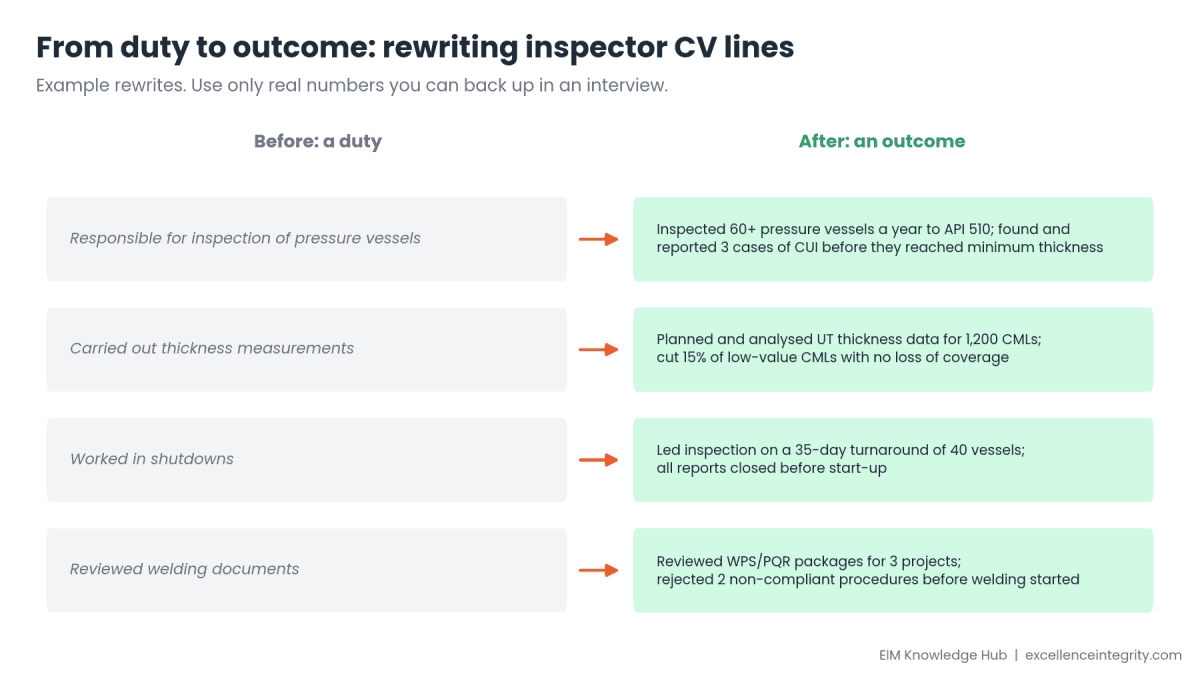
Every inspector "carried out inspections". What makes you different is what happened because you did. A strong CV line has three parts: what you did, at what scale, and what result it produced.
Useful numbers for inspectors include how many items, CMLs or welds you inspected, how many units or shutdowns, and the days or weeks of turnaround. Add defects found before failure, rework avoided, reports closed on time, procedures reviewed or rejected, and cost or time saved. If you do not have exact figures, use honest ranges ("40 to 50 vessels per turnaround").
Use the words the filters search for
Many employers and agencies use applicant tracking systems that search CVs for keywords from the advert. Three habits help:
- Mirror the advert's terms where they are true for you: "static equipment", "in-service inspection", "turnaround", "RBI", "API 570".
- Write certification names in full at least once, and include legacy names where recruiters still use them, for example "AMPP Certified Coatings Inspector, CIP Level 2 (formerly NACE CIP Level 2)". Our guide to NACE becoming AMPP explains the old and new names.
- Avoid putting key information in images, tables or text boxes, which some systems cannot read.
Gulf-specific details
Conventions vary by employer, but Gulf recruiters commonly expect information that CVs in other regions leave out: nationality, current location, visa or residency status (and whether it is transferable), notice period, and a professional photo. Include what is relevant and accurate, and leave out anything that is not. Make certification numbers and expiry dates easy to verify; inspection employers often check them.
Your LinkedIn profile is the second CV
- Headline: your target title plus your top certifications, not just your current employer.
- About: three short paragraphs: what you inspect, the scale you work at, and two results you are proud of.
- Licences and certifications: add each one with its issuing body, so recruiters searching for it find you.
- Experience: reuse your outcome lines from the CV.
Five mistakes that cost interviews
- A career objective paragraph at the top. On a quick scan for titles and dates, it is easy to skip. A headline title does the job better.
- Listing every code you have ever opened. Keep to the codes and certifications relevant to the role.
- Expired certifications presented as current. State the validity honestly; it will be checked.
- One CV for every job. Reorder the first half for each type of role.
- Numbers you cannot explain. Every figure on the CV is an interview question.
Where EIM can help
EIM's Career Navigator rebuilds CVs and LinkedIn profiles for inspection, corrosion, rotating equipment, welding and turnaround professionals who apply and hear nothing back. Its starting point is simple: your experience is not the problem; your CV and LinkedIn are. Explore Career Navigator
For senior professionals with ten years or more aiming for a leadership move, the Leadership Career Strategy Program offers one-to-one positioning work. The One-to-One Career Acceleration Mentoring course runs eight weekly sessions on judgement, credibility and leadership readiness, by arrangement. And EIM Daily includes career guidance calls for a CV review or Gulf job strategy.
Frequently asked questions
How long should an inspector's CV be?
Two pages is common for experienced inspectors. What matters more is that the first half of page one carries your title, certifications and most relevant results.
Should I include a photo?
For many Gulf employers, yes; it is common practice there. For roles elsewhere, follow local norms.
How do I show shutdown experience?
List turnarounds with duration, number of items and your role, for example "Inspection lead, 35-day turnaround, 40 vessels".
Should I list certifications I am still studying for?
Yes, if clearly marked, for example "API 653 (exam booked, March 2027)". Never present it as held.
Do recruiters really spend only seconds on a CV?
Ladders' 2018 eye-tracking study measured an average initial screen of 7.4 seconds. Other studies report longer times, but all agree the first scan is short.
Sources
- HR Dive: Eye-tracking study shows recruiters look at resumes for 7 seconds (Ladders 2018)
- Ladders: Eye-Tracking Study 2018 (summary PDF)
- Example CV lines invented by EIM for illustration. Checked 7 October 2026.