NACE MR0175 / ISO 15156 in Plain English: What Sour Service Really Requires
What NACE MR0175/ISO 15156 actually requires: when sour service applies, the three parts, hardness limits, SSC severity regions, and MR0175 vs MR0103.
By Asjad Imam29 Oct 20265 min read
"NACE compliant" may be the most misunderstood phrase in oil and gas procurement. It appears on data sheets, mill certificates and purchase orders, often as if it were a single stamp of approval. In reality, NACE MR0175/ISO 15156 is a three-part standard that asks the user to understand the environment first, and then sets limits that depend on it.
This guide explains, in plain terms, when the standard applies, how it is organised, what the key limits are, and how it differs from MR0103 for refineries. It is a guide to the standard, not a substitute for it.
Short answer: MR0175/ISO 15156 covers materials for equipment in oil and gas production and gas treatment where H2S is present. Below an H2S partial pressure of 0.3 kPa (0.05 psia), carbon steel normally needs no special precautions for sulfide stress cracking. Above it, materials must meet the standard's requirements, which depend on how severe the environment is. Refineries use a separate standard, MR0103.
Which edition is current?
At the time of writing, the current edition is ANSI/NACE MR0175-2021/ISO 15156:2020, the fourth edition, identical to ISO 15156-1, -2 and -3:2020 and published together with its technical circulars. Technical circulars can change specific requirements, so always check them alongside the main text, and check which edition your project specification calls for.
When does sour service apply?
The trigger most people remember is an H2S partial pressure of 0.3 kPa (0.05 psia) in the gas phase. Below it, carbon and low-alloy steels are normally considered outside the range where SSC precautions are needed. Above it, the standard's requirements apply, and how strict they are depends on the severity of the environment.
Partial pressure is not the only factor. pH of the water phase, chloride content, temperature, and the presence of elemental sulfur all change the risk, particularly for corrosion-resistant alloys. The standard expects the equipment user to define these conditions, including upsets and future changes such as reservoir souring.
How the standard is organised
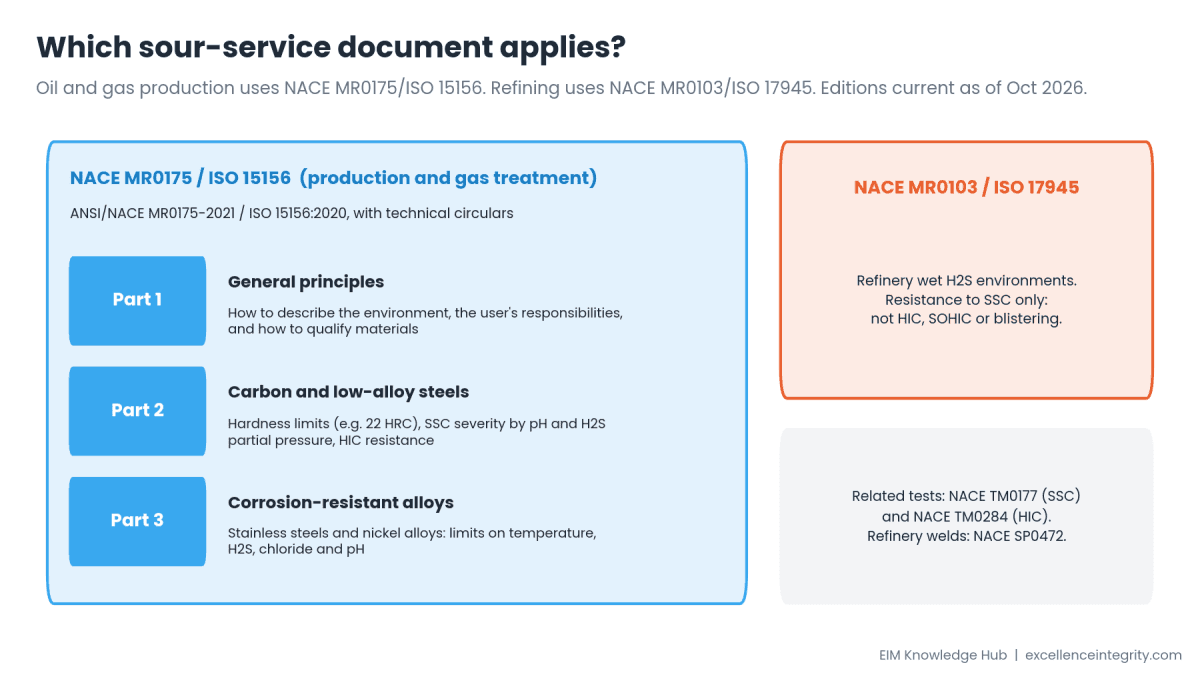
- Part 1: General principles. How to define the service environment, the responsibilities of the user and the supplier, and how materials can be qualified, either from listed experience or by testing.
- Part 2: Carbon and low-alloy steels. Requirements for resistance to SSC (including hardness limits) and to hydrogen-induced cracking, and how severity varies with pH and H2S partial pressure.
- Part 3: Corrosion-resistant alloys and other alloys. Stainless steels, duplex, nickel alloys and others, each with limits on temperature, H2S partial pressure, chloride and pH, and sometimes elemental sulfur.
The numbers people quote, in context
22 HRC for carbon steel
The best-known limit is a maximum hardness of 22 HRC for carbon and low-alloy steels to resist SSC, together with requirements on heat treatment and welding. Hardness is the property that best tracks SSC susceptibility, which is why welds and heat-affected zones get so much attention. Some materials and conditions have their own limits, so check Part 2 for your exact case.
SSC severity regions
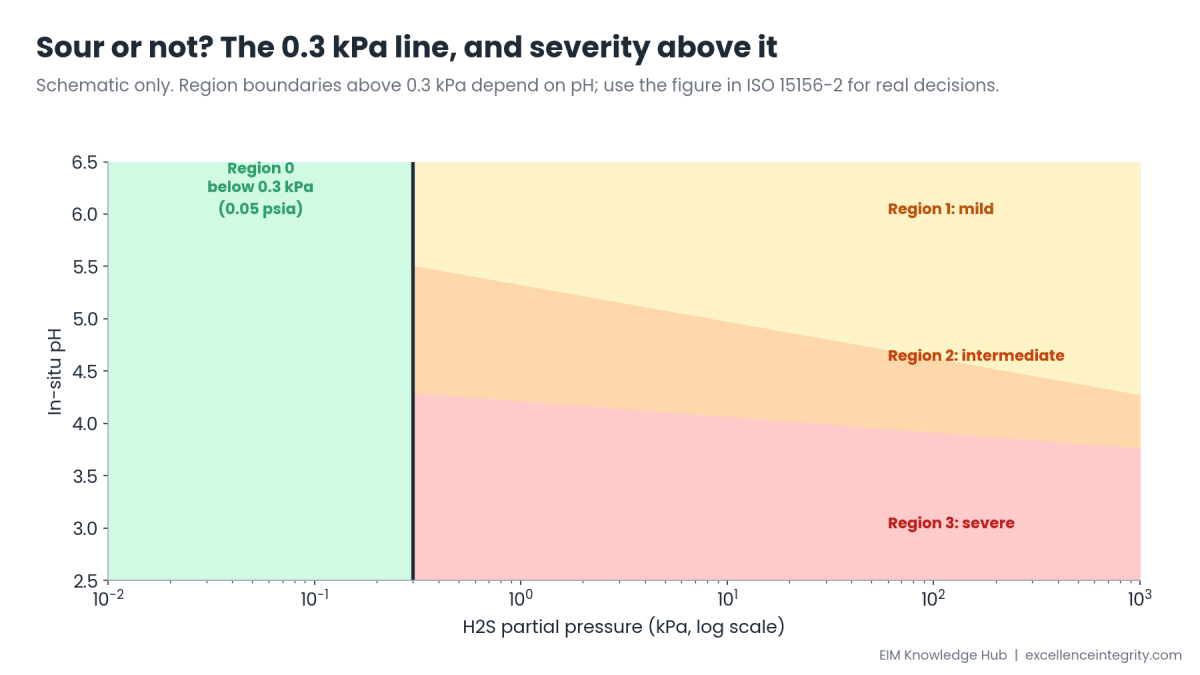
Above 0.3 kPa, Part 2 divides the environment into severity regions by in-situ pH and H2S partial pressure: lower pH and higher H2S mean a more severe region and stricter requirements. Some steels acceptable in a mild region need qualification for a severe one.
"NACE compliant" does not mean "fit for service"
Three misunderstandings cause most of the trouble:
- Compliance is environment-specific. A corrosion-resistant alloy may be acceptable at one temperature and chloride level and not at another. A certificate that simply says "MR0175" does not tell you which limits were checked.
- The standard addresses cracking, not general corrosion. Weight-loss corrosion, CO2 corrosion and erosion need their own assessment.
- Production and refining are different. MR0175/ISO 15156 is for production and gas treatment. For refinery environments, NACE MR0103/ISO 17945 sets SSC requirements, and it does not address HIC, SOHIC or blistering.
What to ask a supplier
- Which edition of MR0175/ISO 15156, and which technical circulars, does the material comply with?
- Which part, clause or table, and for what environmental limits?
- What hardness testing was done on base metal, welds and heat-affected zones, and where?
- For HIC-sensitive products such as plate and pipe, what HIC testing was done, for example to NACE TM0284?
Related tests and standards
| Document | What it does (our summary) |
|---|---|
| NACE TM0177 | Laboratory testing of metals for resistance to SSC and SCC in H2S environments (2024 edition current at the time of writing) |
| NACE TM0284 | Evaluating pipeline and pressure vessel steels for resistance to HIC (2026 edition current at the time of writing) |
| NACE MR0103 / ISO 17945 | SSC-resistant metallic materials for refinery environments |
| NACE SP0472 | Refinery practice for avoiding environmental cracking of carbon steel welds, including a 200 HBW weld deposit hardness limit |
For how these damage mechanisms differ, read our guide to wet H2S damage: blistering, HIC, SOHIC and SSC.
Learn more with EIM
EIM is an independent training provider. Our live Material Selection and Failure Analysis course with Mr. Deepak Rawtal covers material selection principles, corrosion resistance, failure analysis and degradation mechanisms in refinery and process service. Check the course page for the next batch.
For production systems, the self-paced Internal Corrosion Management programme covers sweet and sour corrosion, and Well Integrity Management covers barrier thinking for wells.
Frequently asked questions
Are NACE MR0175 and ISO 15156 the same?
Yes. They are published as one jointly designated standard, ANSI/NACE MR0175/ISO 15156, in three parts.
At what H2S level does MR0175 apply?
The commonly quoted threshold is an H2S partial pressure of 0.3 kPa (0.05 psia) in the gas phase. Below it, carbon steel normally needs no special SSC precautions; above it, the standard's requirements apply.
What is the hardness limit for carbon steel in sour service?
22 HRC is the well-known general limit for carbon and low-alloy steels, with additional requirements for heat treatment and welds. Check Part 2 for your material and condition.
Can I use MR0175 for a refinery?
Refining has its own standard, NACE MR0103/ISO 17945. Some refinery specifications reference both, so follow your project specification.
Does MR0175 cover HIC?
Part 2 includes requirements relating to HIC for carbon and low-alloy steels, and HIC resistance is tested to NACE TM0284. MR0103, for refineries, addresses SSC only.