Wet H2S Damage Explained: Blistering, HIC, SOHIC and SSC
The four forms of wet H2S damage in carbon steel: how blistering, HIC, SOHIC and SSC differ, what drives each, and how to prevent and inspect for them.
By Asjad Imam24 Oct 20266 min read
Few damage mechanisms cause as much confusion as wet H2S damage. Four different problems share one cause, and their acronyms get used interchangeably on site. Yet they behave differently: one depends on hardness, one does not care about stress at all, and one can grow through a weld that passed every hardness check.
The stakes are real. An industry survey by API, reported in Oil & Gas Journal, found cracks in about a quarter of the vessels inspected in wet H2S service. The data is old, but the lesson has not changed: if you do not look for it, you will not find it.
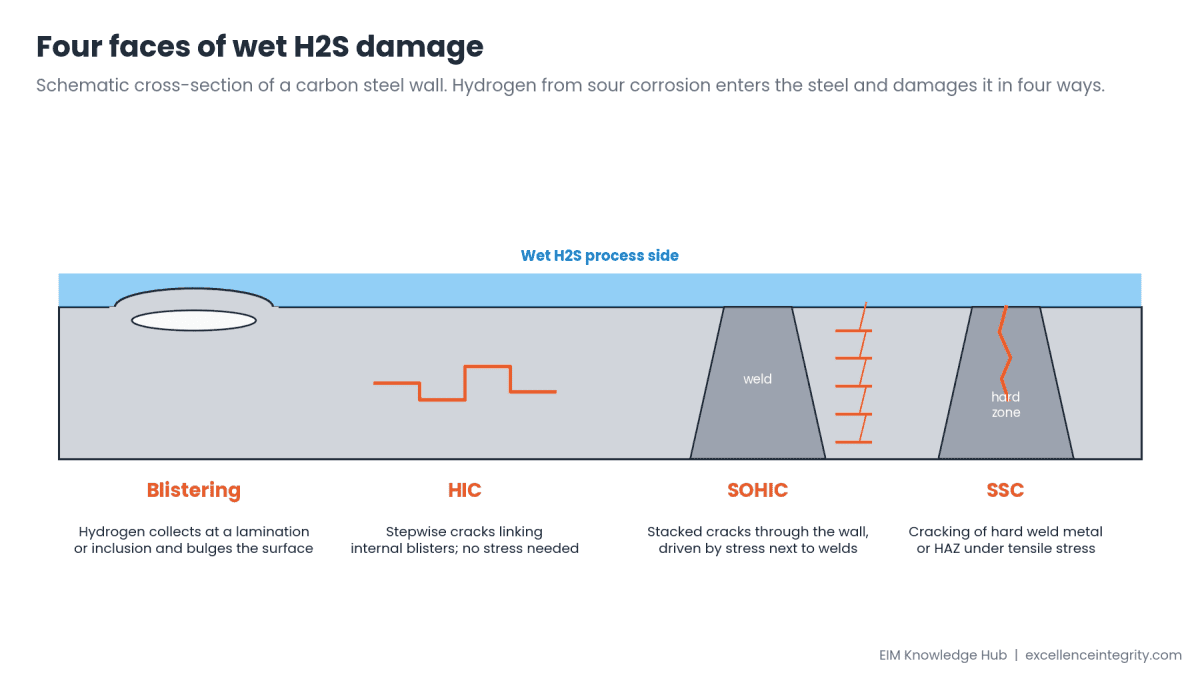
Short answer: In wet H2S service, corrosion releases atomic hydrogen that enters the steel. Blistering and HIC happen where that hydrogen collects at inclusions, and need no stress. SOHIC is stacked cracking driven by stress, usually beside welds. SSC is cracking of hard zones, such as hard weld metal or heat-affected zones, under tensile stress.
Why wet H2S damages steel
When carbon steel corrodes in water containing H2S, the reaction produces atomic hydrogen at the surface. Normally it would pair up into hydrogen gas and leave. Sulfide hinders that, so a large share of the atomic hydrogen diffuses into the steel instead. What it does next depends on where it ends up and on the condition of the steel.
API RP 571 describes the conditions that promote this damage. In our words: there must be free liquid water, and then any one of these makes damage more likely: dissolved H2S above about 50 ppm in the water; acidic water (pH below about 4) with some H2S; alkaline water (pH above about 7.6) with dissolved cyanide and some H2S; or an H2S partial pressure in the gas above about 0.05 psia (0.3 kPa). Blistering, HIC and SOHIC are reported from ambient temperature up to around 150 °C.
The four forms
Blistering
Hydrogen atoms collect at a lamination or inclusion, recombine into gas, and build pressure until the steel bulges. Blisters are often visible on the surface and detectable with ultrasonic testing. They do not need applied stress, and they are not related to hardness.
Hydrogen-induced cracking (HIC)
When blisters form at different depths, the cracks between them link up in a stepwise pattern, running mostly parallel to the surface. HIC also needs no applied stress and is not related to hardness. It is controlled mainly by steel cleanliness: low sulfur content and inclusion shape control.
Stress-oriented hydrogen-induced cracking (SOHIC)
SOHIC is a stack of small HIC-type cracks aligned through the wall, driven by stress. It usually appears next to welds, where residual stress is high, and it can lead to through-wall cracking. Cleaner steel reduces it but may not eliminate it; post-weld heat treatment, which lowers residual stress, helps.
Sulfide stress cracking (SSC)
SSC is a form of hydrogen stress cracking in hard, high-strength zones under tensile stress. In carbon steel equipment this usually means hard weld deposits or heat-affected zones. Hardness control is the primary defence. SSC is most likely at around ambient temperature.
What drives each form
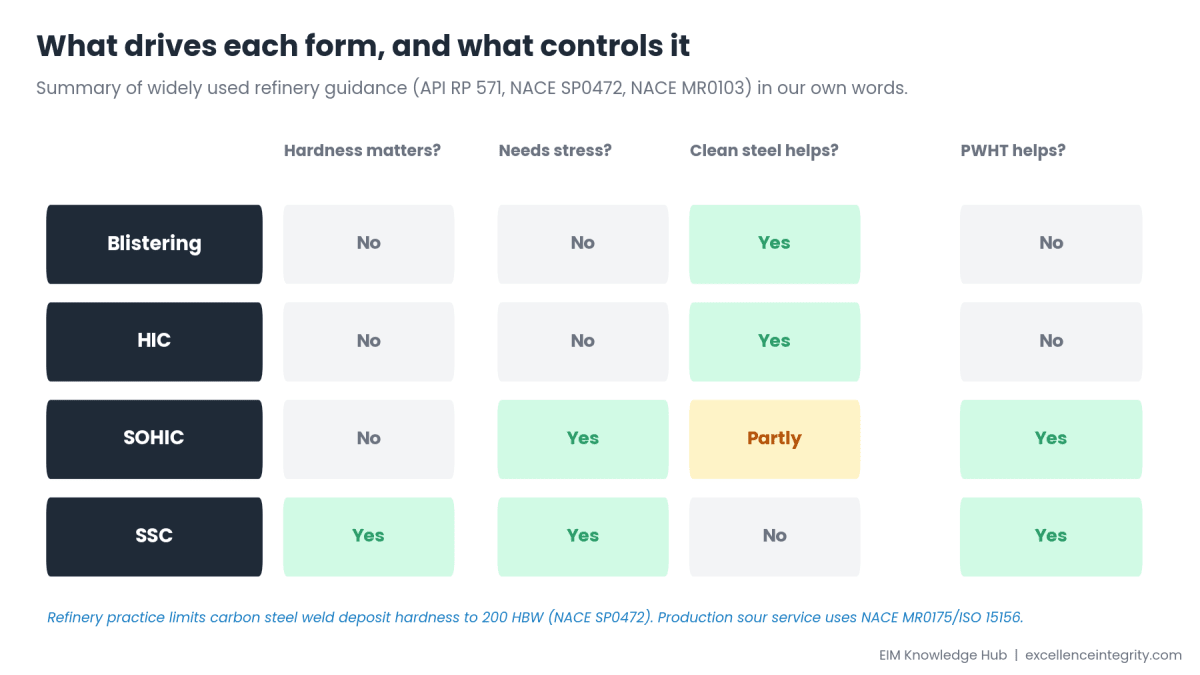
This is the table to remember for exams and for real decisions. A hardness survey protects you against SSC but tells you nothing about HIC. HIC-resistant plate protects you against blistering and HIC but does not remove the risk of SOHIC at welds.
The standards and how they fit together
| Document | What it covers (our summary) |
|---|---|
| API RP 571 | Describes wet H2S damage, its critical factors, affected equipment and inspection. |
| NACE MR0175/ISO 15156 | Materials for sour service in oil and gas production. Sets hardness limits, for example 22 HRC for carbon steel. |
| NACE MR0103 | Refinery-specific materials requirements for resistance to SSC. Does not address blistering, HIC or SOHIC. |
| NACE SP0472 | Refinery weld practice. Limits carbon steel weld deposit hardness to 200 HBW, lower than the 22 HRC (237 HBW) in MR0175/ISO 15156. |
| NACE TM0284 | Laboratory test for steel resistance to HIC, used to qualify HIC-resistant plate and pipe. |
Note that these are legacy NACE standards and keep their NACE names under AMPP. Check the edition your specification calls for.
Prevention
- For blistering and HIC: specify HIC-resistant steel (low sulfur, inclusion shape control, qualified by HIC testing), or use clad or lined construction in severe service.
- For SOHIC: effective post-weld heat treatment to reduce residual stress, plus clean steel, and design that avoids stress concentrations.
- For SSC: control hardness of welds and heat-affected zones through welding procedure qualification, production hardness testing and PWHT where required.
- For all four: reduce the driving force in the process where you can, for example with water washing, inhibitors, or by controlling cyanide in the water phase.
Inspection
- Blistering and HIC: visual inspection for surface blisters, and ultrasonic scanning to find and size internal laminations and stepwise cracks.
- SOHIC and SSC: surface-breaking cracks are commonly found with wet fluorescent magnetic particle testing (WFMT) after surface preparation; advanced UT techniques such as phased array and TOFD help size cracks through the wall.
- Plan by risk: focus on welds, heat-affected zones and repair welds in the wettest, most sour locations. Track changes in process conditions that could increase hydrogen charging.
Learn more with EIM
EIM's live Material Selection and Failure Analysis course, led by Mr. Deepak Rawtal (Senior Metallurgical Inspection Engineer, 45 years in metallurgical and materials testing), covers material selection principles, types and causes of failure, refinery design references, and degradation mechanisms and prevention.
Next batch: 16 to 19 November 2026, Monday to Thursday, 19:00 to 21:00 UAE time.
4 sessions of 2 hours (8 CPD hours), with an EIM certificate of completion. See the course
Preparing for API 571? Wet H2S damage is examined in detail. Our live API 571 Damage Mechanisms - Exam Preparation course covers it in week 2 (localised and chemical-environment damage), and our 10-week API 571 study plan shows how to fit it into your revision. EIM is an independent training provider; API runs the certification.
Frequently asked questions
What is the difference between HIC and SSC?
HIC forms at inclusions inside the steel, needs no applied stress and is not related to hardness. SSC forms in hard zones under tensile stress and is controlled mainly by limiting hardness.
Does PWHT prevent HIC?
No. PWHT reduces residual stress and hardness, which helps against SOHIC and SSC, but it cannot remove the inclusions where HIC starts. Clean, HIC-resistant steel is the answer for HIC.
Is MR0175 or MR0103 used in refineries?
Refining has its own standard, NACE MR0103, for SSC resistance in refinery environments. MR0175/ISO 15156 was written for oil and gas production.
What hardness limit applies to refinery carbon steel welds?
NACE SP0472 limits weld deposit hardness to 200 HBW for carbon steel in refinery wet H2S service. Always follow your project specification.
Can wet H2S damage happen without H2S gas in the line?
Yes, if there is free water containing dissolved H2S. The water phase is what matters.
Sources
- API RP 571, Damage Mechanisms Affecting Fixed Equipment in the Refining Industry, 3rd edition: wet H2S damage. Summarised, not quoted.
- NACE SP0472 preview (ANSI webstore)
- NACE MR0103 preview (ANSI webstore)
- Oil & Gas Journal: Ways to deal with wet H2S cracking revealed by study
- All checked 7 October 2026.