Types of Shaft Keys and Where Each One Is Used
Parallel, taper, gib head, feather, Woodruff, saddle, tangent and round keys explained: where each is used, how to size one and what to inspect.
By Harish Haseeb23 Oct 20268 min read
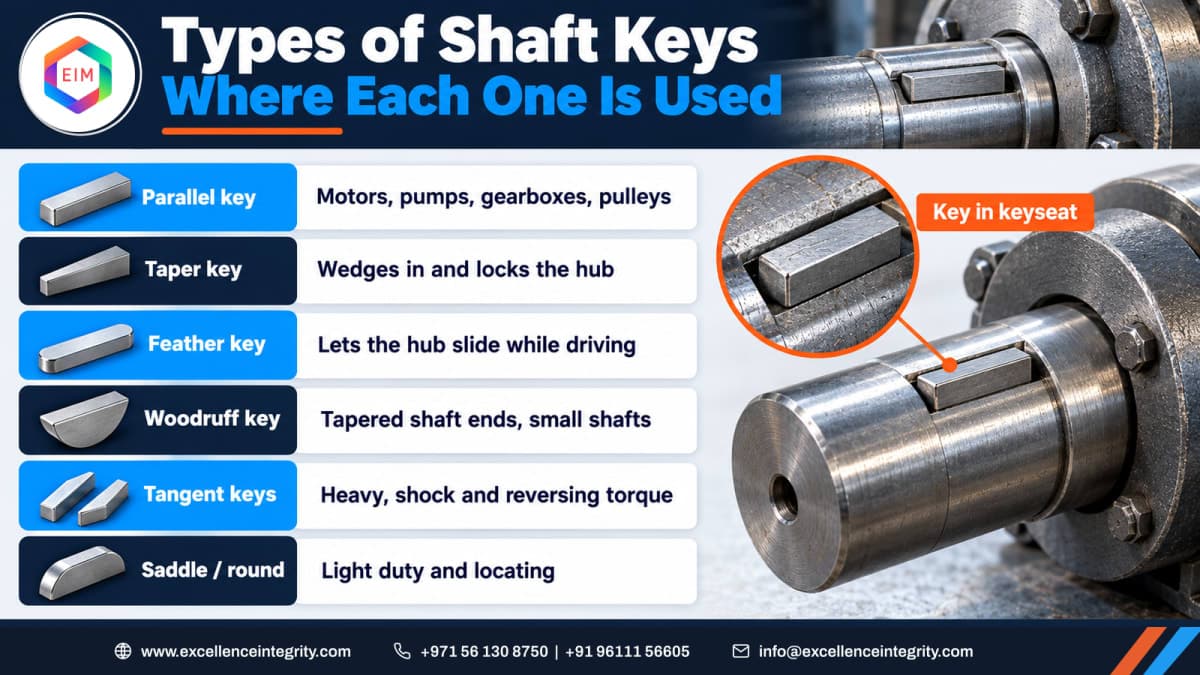
A key is one of the cheapest parts in a machine and one of the most annoying to get wrong. It is a small piece of steel sitting half in the shaft and half in the hub, and every newton-metre the motor sends to the pump goes through it. When it is the wrong type or badly fitted, you get a hub that creeps on the shaft, a keyway that slowly wallows out, or a sheared key and a coupling spinning free at three in the morning.
This article goes through the common types of shaft keys, what each one is actually for, how to size one with two simple checks, and what to look for when you pull a coupling or a pulley off during maintenance.
What a shaft key does
A key transmits torque between a shaft and whatever sits on it: a coupling hub, a gear, a pulley, a sprocket or an impeller. The shaft and the hub each have a slot cut in them, the keyseat in the shaft and the keyway in the hub, and the key fills both. When the shaft turns, it pushes on the side of the key, and the key pushes on the side of the hub.
That means the key works in two ways at once. It is in shear across the line where shaft and hub meet, and its sides are in compression (bearing) against the walls of the slots. Most key failures are one of those two: the key shears through, or the sides crush and the slots deform until the fit is loose.
Some keys do more than transmit torque. A taper key also locks the hub axially, a feather key lets the hub slide, and a pin can locate a part as well as drive it. Choosing the type is really choosing which of these jobs you need.
Parallel keys: square and rectangular
Most machinery keys are parallel keys: the same height from end to end, with no taper. You will often see "square key", "rectangular key" and "parallel key" listed as three separate types, but they are one family in two sections.
- Square section, where width equals height. Inch practice (ASME B17.1) uses square keys on smaller shafts.
- Rectangular section, where the key is wider than it is tall. Metric practice (ISO 773, DIN 6885) uses this shape for most sizes, which keeps the keyseat shallower and the shaft stronger.
Parallel keys are what you find on electric motor shafts, pump couplings, gearbox input and output shafts, pulleys and sprockets. They are easy to make, easy to replace from stock, and they do not push the hub off centre. The ends may be square or rounded to match a keyseat cut with an end mill.
The catch is that a parallel key does not hold the hub in place along the shaft. Something else must do that: a set screw over the key, a locknut, a shoulder, a clamp hub or an interference fit.

Taper and gib head keys
A taper key has a sloped top, usually 1 in 100, and is driven in so it wedges between the bottom of the shaft keyseat and the sloped top of the hub keyway. That wedge grips the hub firmly against the shaft and stops it moving axially, so no extra locking is needed.
The wedge also has a downside: it pushes the hub to one side, so the hub runs slightly off centre. On a slow, heavy pulley or a flywheel that hardly matters. On a high-speed coupling it can add vibration, which is one reason taper keys are less common on modern rotating equipment.
A gib head key is a taper key with a head on its outer end. The head lets you drive the key out from the same side you drove it in, which is useful on heavy machinery where you cannot reach the far end of the hub. Two points for the shop floor: never leave a protruding gib head unguarded on a rotating shaft, and never hammer a taper key so hard that you crack the hub.
Feather keys and sliding hubs
A feather key is a parallel key fixed to one part, usually screwed into the shaft keyseat, with a sliding fit in the other. The hub can move along the shaft while torque is still being transmitted. You find them on sliding gears in gearboxes, on clutch members, and on machine-tool spindles and feeds.
Because the hub moves under load, wear is the thing to watch. The keyway sides polish and open up, and the screws holding the key can loosen. If a sliding gear starts to clunk on reversal, check the feather key before blaming the gear.
Woodruff keys
A Woodruff key is a half-disc that sits in a semicircular seat cut into the shaft with a special cutter. Because it can rock slightly in its seat, it lines itself up with the hub keyway, which makes it a good choice on tapered shaft ends, such as small motor shafts, automotive crankshafts and some machine tools.
The price is a deep seat. A Woodruff seat removes more metal from the shaft than a parallel keyseat, so it weakens the shaft more and is used mainly on smaller shafts and lighter loads. Sizes follow ASME B17.2 in inch practice and DIN 6888 in metric.

Saddle, tangent and round keys
These three are less common, but you will meet them on older plant and specialist machines.
| Key | How it works | Where it is used |
|---|---|---|
| Saddle key | Sits only in the hub keyway. The underside is curved (hollow saddle) or flat (flat saddle) against the shaft, and torque passes by friction | Light duty, where cutting a keyseat in the shaft is not wanted. Rare in modern heavy equipment |
| Tangent key | A pair of taper keys driven in opposite directions, fitted tangentially to the shaft. Two pairs are set about 120 degrees apart | Large shafts with heavy, shock or reversing torque: rolling mills, large flywheels, heavy crushers |
| Round key (pin) | A cylindrical pin in a hole drilled along the joint line, half in the shaft and half in the hub | Locating parts and light to moderate torque, often near a shaft end |
How to size a key: two quick checks
Key width and height come from the standard table for the shaft diameter. For a 50 mm shaft, DIN 6885 gives a key 14 mm wide and 9 mm high. What you choose is the length, and two checks tell you whether it is enough.
For a torque T on a shaft of diameter d, with key width w, height h and effective length L:
- Shear in the key: shear stress = 2T / (d × w × L)
- Bearing (crushing) on the side: bearing stress = 4T / (d × h × L), taking half the key height in the hub
A worked example: a pump coupling carrying 500 N·m on a 50 mm shaft with a 14 × 9 key, 50 mm long.
- Shear: 2 × 500,000 / (50 × 14 × 50) = 28.6 MPa
- Bearing: 4 × 500,000 / (50 × 9 × 50) = 88.9 MPa
Bearing stress is three times the shear stress here, and that is typical. Keys more often fail by crushing their sides and loosening than by shearing clean through. Compare both figures with the allowable stresses for the key material and the hub, from the design code or the equipment maker, and remember that start-up torque, shock loads and reversals can be well above the running figure.
What to check during maintenance
Every time a coupling, pulley or impeller comes off, the key and keyway are worth two minutes:
- Wallowed keyway: rounded, polished or flared slot edges mean the key has been working loose under load. A new key in a worn keyway will not stay tight.
- Crushed or stepped key sides: a step worn into the side of the key shows where the shaft and hub met.
- Cracks at the keyseat end or corners: the keyseat is a stress raiser, and fatigue cracks on shafts often start there. Use dye penetrant or magnetic particle testing if in doubt.
- Fit: a parallel key should be a close fit on its sides and have a little clearance on top. A key that is tight on top can lift the hub off centre.
- Make-do repairs: a key filed down to fit, a key made from soft bar stock, or a set screw sitting on a key that has been peened over. Replace them with the correct material and size.

Fretting rust (fine red-brown powder) around the key is an early sign of movement. Catching it then is far cheaper than finding a cracked shaft at the next overhaul. More on keeping rotating equipment healthy is in why rotating equipment maintenance matters and pump cavitation and NPSH.
Choosing the right key: a quick summary
| If you need | Use |
|---|---|
| General torque transmission on motors, pumps, gearboxes, pulleys | Parallel key (square or rectangular) |
| A hub locked axially by the key itself, at low speed | Taper key, or gib head key for removal from one side |
| A hub that slides along the shaft while driving | Feather key |
| A key on a tapered shaft end, smaller shafts | Woodruff key |
| Heavy, shock or reversing torque on large shafts | Tangent keys |
| Location plus light torque | Round key (pin) |
Keys, couplings and fits are part of everyday work in pump, compressor and gearbox maintenance. If you look after rotating equipment, our rotating equipment maintenance and troubleshooting course covers the practical side, and inspectors checking rotating equipment at the vendor's works can look at the API SIRE source inspector certification preparation. Questions about a specific machine? Get in touch.
Enjoyed the question? See more practice for API SIRE Source Inspector Rotating Equipment