Pump Cavitation and NPSH, Explained for Maintenance Engineers
Why pumps cavitate, how to calculate NPSH available, what NPSH3 and margin ratio mean, and the field checks that fix cavitation. Worked example included.
EIM Editorial Team15 Oct 20267 min read
Cavitation is one of the most common reasons a centrifugal pump in a refinery, gas plant or water injection system fails early. It sounds like gravel passing through the casing, it shakes bearings and seals loose, and it eats the impeller from the inside. Almost always, the root cause is the same: the liquid entering the impeller does not have enough pressure above its vapour pressure. That margin is measured as net positive suction head (NPSH).
This article explains NPSH in plain terms, works through a calculation, and gives a field checklist for when a pump starts to cavitate.
What cavitation actually is
As liquid enters the impeller eye, it speeds up and its pressure drops. If the local pressure falls below the liquid's vapour pressure, vapour bubbles form. A moment later, as pressure rises along the vane, the bubbles collapse. Each collapse fires a tiny high-pressure jet at the metal. Millions of them pit the vane, usually on the low-pressure side near the inlet edge, until the impeller looks like a sponge.
The symptoms come before the visible damage: lower head and flow, a crackling noise, vibration, and seal and bearing failures from the shaking.
NPSH available vs NPSH required
- NPSH available (NPSHA) belongs to the system. It is the absolute pressure at the pump suction minus the liquid's vapour pressure, expressed in metres of liquid. Tank pressure, liquid level, temperature and suction-line losses all change it.
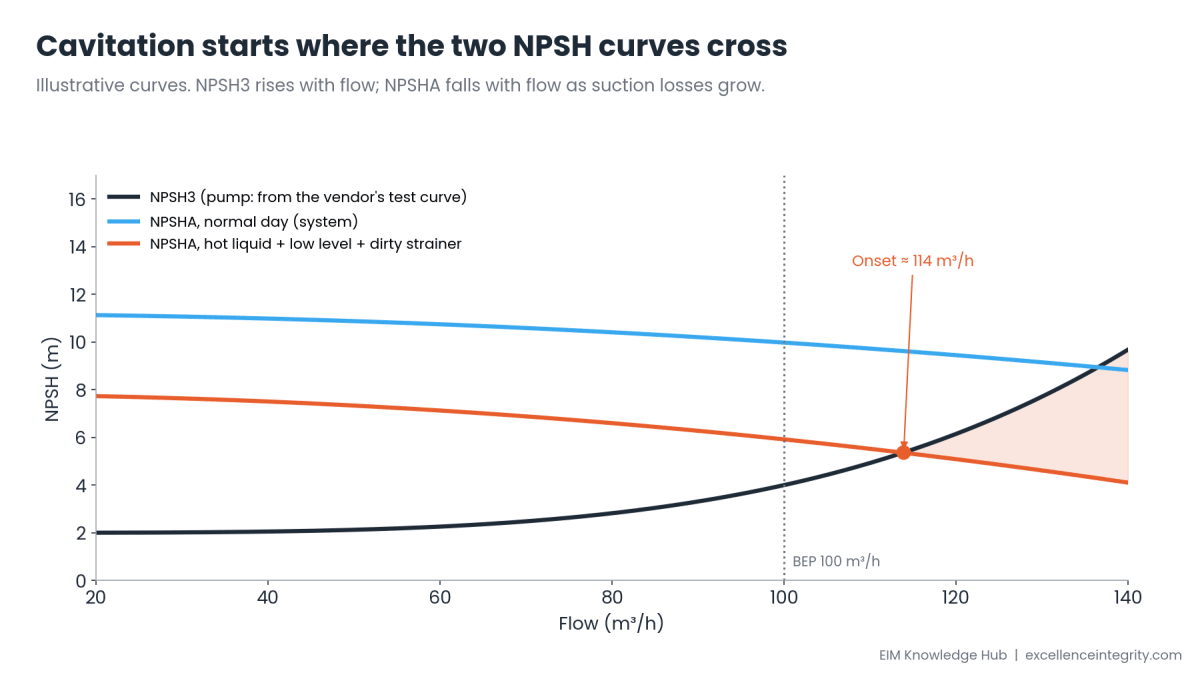
- NPSH required belongs to the pump. The vendor measures it on a test stand and plots it against flow. Today it is usually reported as NPSH3: the NPSHA at which the pump's first-stage head has dropped by 3%. By that point the pump is already cavitating, so NPSH3 is a limit, not a safe operating point.
The rule is that NPSHA must exceed NPSH3, with a margin. The Hydraulic Institute's guideline ANSI/HI 9.6.1 expresses this as the NPSH margin ratio (NPSHA divided by NPSH3) and gives recommended values by application. They range from just above 1 for low-energy pumps to around 2.5 for high-suction-energy pumps. Use the current HI 9.6.1 table for your service rather than one rule of thumb.
How to calculate NPSH available
For a pump drawing from an open tank, NPSHA in metres of liquid is:
NPSHA = Ha − Hvp + Hs − Hf
- Ha: pressure on the liquid surface (atmospheric for an open tank), converted to head: P ÷ (ρ × g).
- Hvp: vapour pressure of the liquid at pumping temperature, converted to head.
- Hs: height of the liquid surface above the pump centreline (negative if the liquid is below the pump).
- Hf: friction losses in the suction pipe, strainer, valves and fittings at the actual flow.
All pressures must be absolute. Mixing gauge and absolute pressure is the most common error in NPSH calculations.
Worked example: one pump, two days
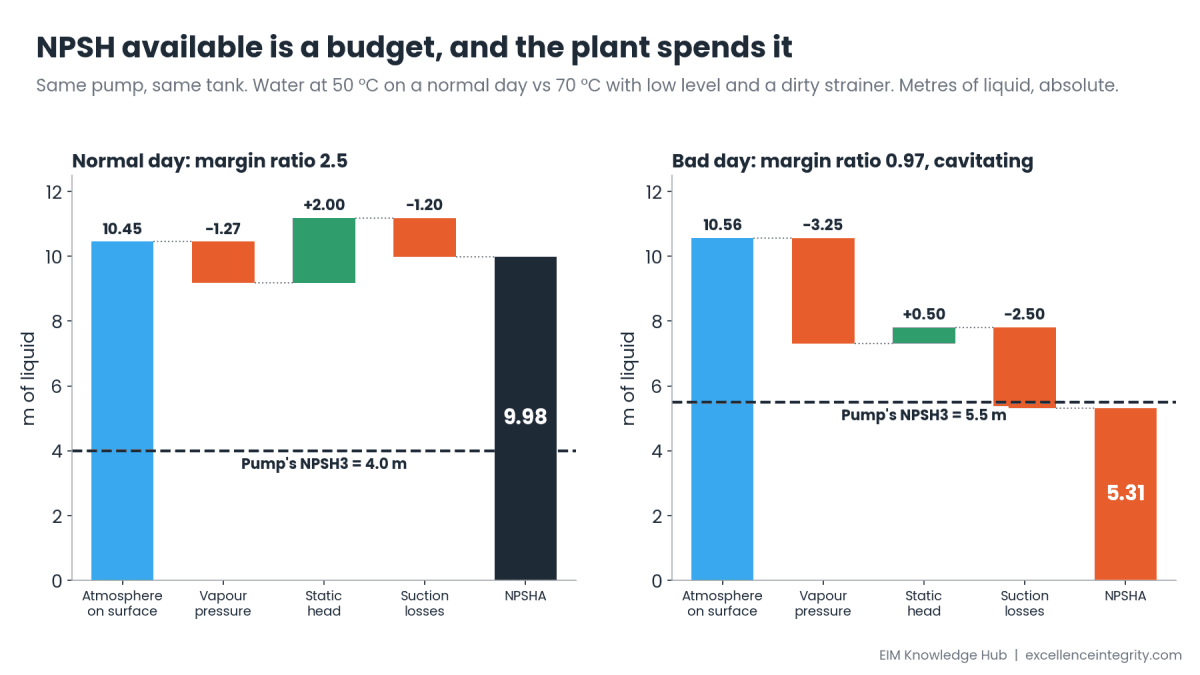
A pump draws water from an open tank at sea level (101.3 kPa). Its NPSH3 is 4.0 m at the best efficiency point (BEP) of 100 m³/h, rising to 5.5 m at 115 m³/h.
| Normal day | Bad day | |
|---|---|---|
| Water temperature | 50 °C | 70 °C |
| Density | 988 kg/m³ | 978 kg/m³ |
| Vapour pressure | 12.35 kPa | 31.18 kPa |
| Liquid level above centreline (Hs) | 2.0 m | 0.5 m (tank drawn down) |
| Flow | 100 m³/h (at BEP) | 115 m³/h (running out on the curve) |
| Suction losses (Hf) | 1.2 m | 2.5 m (strainer half blocked, higher flow) |
| Atmospheric head (Ha) | 10.45 m | 10.56 m |
| Vapour pressure head (Hvp) | 1.27 m | 3.25 m |
| NPSHA | 9.98 m | 5.31 m |
| NPSH3 at that flow | 4.0 m | 5.5 m |
| Margin ratio | 2.5 | 0.97 |
On the normal day the margin is comfortable. On the bad day no single change looks dramatic, but hotter water costs about 2 m, the low tank level costs 1.5 m, and the dirty strainer plus higher flow cost another 1.3 m. At the same time the pump needs more NPSH because it is running beyond its BEP. The ratio falls below 1 and the pump cavitates.
Not every noisy pump has classic cavitation
Several problems sound and look alike. Telling them apart saves a wasted fix.
| What you see | Likely cause | Where the damage shows |
|---|---|---|
| Noise and head loss at high flow, worse with hot liquid or low level | Classic inlet cavitation: NPSHA too low | Low-pressure side of the vanes, near the inlet edge |
| Noise and vibration at low flow, well left of BEP, even with good NPSHA | Suction recirculation | Pressure side of the vanes at the inlet, around the eye |
| Erratic flow and pressure, cloudy liquid, a vortex at the tank outlet | Air or gas entrainment (not true cavitation) | Little pitting; poor performance and seal problems |
| Pulsation at vane-pass frequency, damage at the vane tips | Discharge recirculation or too small a gap between impeller and cutwater | Vane tips at the outer diameter and the cutwater |
Field checklist when a pump starts to cavitate
- Find the operating point. Read flow and discharge pressure and place them on the vendor curve. Far right of BEP points to low NPSHA; far left points to recirculation.
- Measure suction pressure with a calibrated gauge, convert it to absolute head, and compare with NPSH3 at the actual flow.
- Check liquid level and temperature against design. Hotter product in a Gulf summer raises vapour pressure sharply.
- Check the suction strainer differential pressure and clean it if needed.
- Make sure the suction valve is fully open. Never throttle a pump on the suction side to control flow; throttle on the discharge.
- Look for air leaks on suction joints and seals, and for a vortex at the tank outlet when the level is low.
- If it persists, fix the system: raise the minimum operating level, cool the liquid, enlarge or shorten the suction line, reduce speed, add a booster pump, or select a pump with lower NPSH3 (for example a double-suction impeller or an inducer).
Rotating equipment training
These calls get easier with practice on real curves and real failures. EIM's live Rotating Equipment Maintenance & Troubleshooting course spends its first week on pumps (performance curves, BEP and cavitation), then covers compressors and mechanical seals, turbines, fans, bearings and shaft alignment, and reliability and troubleshooting to API and ISO standards. It is led by Mr. K. Riyazuddin Ahmed, Senior Rotating Equipment Consultant with more than 36 years in refinery maintenance and reliability.
Next batches: 7 to 29 November 2026, and 12 December 2026 to 3 January 2027. Saturday and Sunday, 20:00 to 22:00 UAE time.
8 sessions of 2 hours over 4 weeks, with an EIM certificate of completion. See the course
For where pump reliability meets integrity planning, see the self-paced Reliability & Asset Integrity programme.
Frequently asked questions
What is the difference between NPSHR and NPSH3?
NPSH3 is the most common way of stating NPSH required: the NPSHA at which the first-stage head falls by 3% in the vendor's test. Because head has already dropped, some cavitation is present at NPSH3.
Can a pump cavitate when NPSHA is above NPSH3?
Yes. With a small margin, bubbles still form and can damage high-energy pumps. Low-flow operation can also cause suction recirculation, which damages impellers even when NPSHA is good.
Does running the pump faster help?
No. NPSH required rises with speed, roughly with its square, so a faster pump usually cavitates more.
Why is hot liquid worse?
Vapour pressure rises steeply with temperature. In the example, water at 70 °C has about two and a half times the vapour pressure of water at 50 °C.
Is a vortex the same as cavitation?
No. A vortex draws air or gas into the suction, which hurts performance and can sound similar, but the cure is different: raise the level or fit a vortex breaker.
Sources
- Hydraulic Institute: ANSI/HI 9.6.1 Rotodynamic Pumps Guideline for NPSH Margin
- Water vapour pressure and density: standard steam-table values.
- Worked example and curves prepared by EIM for illustration. Checked 7 October 2026.