API 577 Welding Inspection and Metallurgy: Complete Guide for Engineers & Inspectors
API 577 Welding Inspection and Metallurgy provides essential guidance on welding processes, welding inspection, metallurgy, weld quality, and examination techniques used in refinery and petrochemical equipment and piping. This guide explains API 577 certification, key welding concepts, WPS/PQR, welder qualification, common welding defects, NDT methods, metallurgy, and practical preparation strategies for engineers and inspectors.
EIM Editorial Team14 Oct 20269 min read
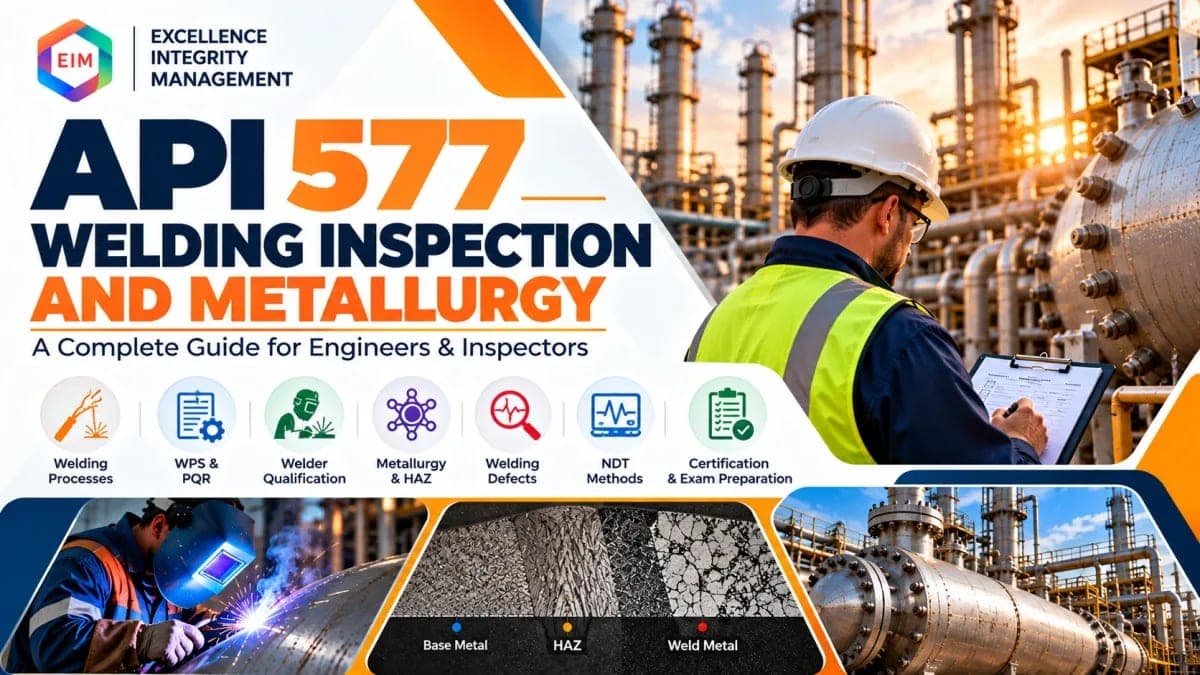
API 577 Welding Inspection and Metallurgy is an important area of knowledge for inspectors, welding engineers, metallurgists, and other professionals involved in the fabrication, inspection, maintenance, and repair of refinery and petrochemical equipment and piping.
The API Recommended Practice 577, titled “Welding Processes, Inspection, and Metallurgy,” provides guidance on welding processes, welding inspection practices, welding procedures, welder qualifications, metallurgy, and inspection techniques.
This article explains the major concepts covered under API 577 and provides a practical overview for professionals preparing for the API 577 certification.
What Is API 577?
API RP 577 is a recommended practice developed by the American Petroleum Institute (API) for welding processes, inspection, and metallurgy.
It is particularly relevant to the inspection of welded fabrication, repair, and maintenance activities involving equipment and piping used in petroleum refining and chemical processing facilities.
The standard helps inspectors understand welding operations and recognize factors that can affect weld quality, equipment reliability, and service performance.
Why Is Welding Inspection Important?
Welding creates permanent joints that can be critical to the pressure containment and structural integrity of industrial equipment. Poor welding practices or inadequate inspection can contribute to defects, premature degradation, leakage, or equipment failure.
Effective welding inspection helps verify that:
- Approved welding procedures are followed.
- Qualified welders perform the work.
- Base materials and consumables meet specified requirements.
- Preheat and interpass temperatures are controlled.
- Welding parameters remain within required limits.
- Required non-destructive examination is completed.
- Weld documentation and traceability are maintained.
Key Areas Covered by API 577
API 577 covers several technical areas that are important for inspectors and welding professionals.
- Welding processes
- Welding procedures
- Welder qualifications
- Welding metallurgy
- Heat-affected zones
- Welding discontinuities and defects
- Preheating and post-weld heat treatment
- Non-destructive examination
- Welding inspection responsibilities
- Documentation and quality control
Common Welding Processes
A welding inspector should understand the fundamentals of commonly used welding processes and their applications.
1. Shielded Metal Arc Welding (SMAW)
SMAW uses a consumable electrode with flux coating to create the weld. It is widely used for fabrication, maintenance, and repair because of its flexibility and suitability for field applications.
2. Gas Tungsten Arc Welding (GTAW)
GTAW, commonly known as TIG welding, uses a non-consumable tungsten electrode. It provides precise control and is frequently used where high-quality welds are required.
3. Gas Metal Arc Welding (GMAW)
GMAW uses a continuously fed consumable wire electrode with shielding gas. It can provide high productivity and is commonly used in fabrication environments.
4. Flux-Cored Arc Welding (FCAW)
FCAW uses a tubular flux-cored electrode and can be used with or without external shielding gas depending on the process configuration.
5. Submerged Arc Welding (SAW)
SAW uses a continuously fed electrode and granular flux. It is commonly used for long, high-production welds in suitable fabrication applications.
WPS, PQR and Welder Qualification
Understanding welding documentation is an essential part of welding inspection.
Welding Procedure Specification (WPS)
A WPS provides the required welding variables and instructions for producing a weld within an approved range.
Depending on the applicable construction code and project requirements, a WPS may address variables such as:
- Base metal
- Filler metal
- Welding process
- Joint design
- Preheat temperature
- Interpass temperature
- Welding position
- Electrical characteristics
- Shielding gas
- Post-weld heat treatment
Procedure Qualification Record (PQR)
A PQR documents the actual variables used during qualification testing and the results obtained from the required tests.
The inspector should understand the relationship between the WPS and supporting qualification documentation and verify that production welding is performed within the applicable qualified ranges.
Welder Performance Qualification
Welder qualification demonstrates that a welder has successfully demonstrated the ability to produce acceptable welds under specified conditions.
Welding Metallurgy
Metallurgy is an important component of API 577 because welding involves significant thermal cycles that can change the microstructure and properties of materials.
Important metallurgical concepts include:
- Base metal properties
- Weld metal solidification
- Heat-affected zone (HAZ)
- Grain growth
- Hardness changes
- Hydrogen-related cracking
- Heat treatment effects
- Carbon equivalent
- Material compatibility
Heat-Affected Zone (HAZ)
The heat-affected zone is the portion of the base material that does not melt but experiences changes in microstructure and properties because of the heat generated during welding.
HAZ characteristics can influence hardness, toughness, corrosion resistance, and susceptibility to certain forms of cracking or degradation.
For this reason, controlling welding heat input, preheat, interpass temperature, and post-weld heat treatment can be important for specific materials and applications.
Preheating and Interpass Temperature
Preheating involves heating the base material before welding. Depending on the material and applicable requirements, it can help reduce the risk of undesirable metallurgical effects and hydrogen-assisted cracking.
Interpass temperature is the temperature of the weld area immediately before the next welding pass is deposited.
Inspectors may be responsible for verifying that specified temperature requirements are maintained during welding.
Post-Weld Heat Treatment (PWHT)
Post-weld heat treatment is a controlled heating and cooling process performed after welding when required by the applicable code, material, thickness, service conditions, or project specification.
Depending on the application, PWHT can be used to reduce residual stresses and modify metallurgical properties.
Inspection activities can include verification of applicable procedures, temperature control, heating and cooling rates, holding time, and documentation.
Common Welding Discontinuities and Defects
Welding inspectors need to recognize common weld discontinuities and understand their potential significance.
Porosity
Porosity occurs when gas becomes trapped within the solidifying weld metal. It can appear as individual cavities or groups of cavities.
Slag Inclusion
Slag inclusions are non-metallic materials trapped within the weld metal. Poor cleaning between passes and inappropriate welding technique can contribute to their formation.
Lack of Fusion
Lack of fusion occurs when the weld metal does not properly fuse with the base metal or a previous weld pass.
Lack of Penetration
Lack of penetration occurs when the weld metal does not extend through the required joint thickness or root area.
Undercut
Undercut is a groove or depression at the weld toe or root that is not properly filled with weld metal.
Cracking
Cracking is one of the most serious welding-related discontinuities. Depending on the material and service conditions, different mechanisms may contribute to cracking, including hydrogen-assisted cracking, hot cracking, and stress-related cracking.
Non-Destructive Examination Methods
API 577 includes inspection concepts that support the use of non-destructive examination methods for evaluating weld quality.
Visual Testing (VT)
Visual inspection is commonly performed before, during, and after welding. It can identify surface conditions, weld profile issues, dimensional problems, and visible discontinuities.
Liquid Penetrant Testing (PT)
PT is used to detect surface-breaking discontinuities in suitable non-porous materials.
Magnetic Particle Testing (MT)
MT is used primarily for detecting surface and near-surface discontinuities in ferromagnetic materials.
Ultrasonic Testing (UT)
UT uses high-frequency sound waves to detect and evaluate internal discontinuities in suitable materials.
Radiographic Testing (RT)
RT uses penetrating radiation to produce an image that can reveal certain internal discontinuities within a weld or component.
Responsibilities of a Welding Inspector
A welding inspector's responsibilities can extend throughout the welding process.
Before Welding
- Review applicable drawings and specifications.
- Verify material identification and traceability.
- Review applicable WPS and qualification documentation.
- Verify welder qualification requirements.
- Check joint preparation and fit-up.
- Verify consumables and storage requirements.
During Welding
- Monitor welding practices.
- Verify preheat and interpass temperatures.
- Check welding consumables.
- Observe welding parameters where required.
- Verify interpass cleaning.
- Monitor compliance with applicable procedures.
After Welding
- Perform or coordinate visual inspection.
- Verify required NDE.
- Review repair activities when applicable.
- Verify PWHT requirements and records.
- Review documentation and traceability.
- Confirm acceptance criteria are satisfied.
API 577 and ASME Section IX
API 577 and ASME Section IX serve different but complementary purposes.
API 577 provides guidance on welding processes, inspection, and metallurgy for personnel involved in the inspection of refinery and chemical plant equipment and piping.
ASME Section IX establishes requirements related to the qualification of welding, brazing, and joining procedures and personnel under the applicable ASME framework.
Inspectors should understand how applicable codes, standards, specifications, and recommended practices interact within a project.
API 577 Certification
The API 577 certification is designed to demonstrate knowledge related to welding inspection and metallurgy for professionals working in the petroleum and petrochemical industry.
The certification is relevant to professionals such as:
- Welding Inspectors
- Welding Engineers
- Mechanical Inspectors
- Metallurgists
- QA/QC Professionals
- Inspection Engineers
- Petrochemical Industry Professionals
API's current certification information should always be checked before registration because examination requirements, reference publications, qualification requirements, and examination windows can change.
How to Prepare for the API 577 Exam
A structured preparation strategy can help candidates organize the technical material efficiently.
Step 1: Understand Welding Fundamentals
Start with the fundamentals of welding processes, terminology, joint types, welding variables, and consumables.
Step 2: Study Welding Procedures
Focus on WPS, PQR, welder qualifications, essential variables, and the relationship between procedure qualification and production welding.
Step 3: Strengthen Metallurgy
Study HAZ behavior, heat treatment, hardness, carbon equivalent, cracking mechanisms, and material-related welding considerations.
Step 4: Learn Inspection Methods
Review VT, PT, MT, UT, and RT, including their applications, capabilities, limitations, and typical weld discontinuities they can detect.
Step 5: Study Applicable References
Use the current API 577 Body of Knowledge and the reference publications specified for the applicable examination window. Avoid relying exclusively on outdated preparation material.
Step 6: Practice Questions
Practice technical questions regularly and focus on understanding why an answer is correct rather than memorizing answers.
API 577 vs Other API Certifications
| Certification | Primary Focus |
|---|---|
| API 510 | Pressure Vessel Inspection |
| API 570 | Piping Inspection |
| API 653 | Aboveground Storage Tank Inspection |
| API 571 | Damage Mechanisms |
| API 577 | Welding Inspection and Metallurgy |
| API 580 | Risk-Based Inspection |
These certifications address different technical areas and may complement each other depending on an individual's role and responsibilities.
Career Relevance of API 577 Knowledge
Knowledge of welding inspection and metallurgy can be valuable for professionals involved in equipment fabrication, maintenance, inspection, quality assurance, and asset integrity management.
Understanding welding helps professionals evaluate fabrication quality, communicate effectively with welding and NDE teams, review documentation, and identify conditions that may affect equipment integrity.
Final Thoughts
API 577 Welding Inspection and Metallurgy brings together welding technology, inspection practices, metallurgy, NDE, and quality control concepts that are highly relevant to refinery and petrochemical operations.
For professionals preparing for the API 577 certification, the most effective approach is to build a strong understanding of welding fundamentals, study the applicable API and ASME references, practice inspection scenarios, and regularly review technical questions.
Always refer to the latest API certification page, Body of Knowledge, and examination reference documents for the requirements applicable to your examination window.
About Excellence Integrity Management
Excellence Integrity Management (EIM) provides professional training and technical learning solutions for engineers and inspection professionals in the oil & gas, petrochemical, and industrial sectors.
EIM's training portfolio covers areas including asset integrity, inspection, welding, corrosion, reliability, and industry-recognized certification preparation.