API 571 Study Plan: 10 Weeks From First Page to Exam Day
A week-by-week API 571 study plan for working engineers: what to read, how to build mechanism cards, the pairs that trip people up, and a sample question.
EIM Editorial Team13 Oct 20268 min read
The API 571 Corrosion and Materials exam is not hard because the ideas are complex. It is hard because there are so many damage mechanisms, and many of them look alike on paper. Candidates who struggle usually know a lot; they just cannot separate sulfidation from naphthenic acid corrosion, or caustic cracking from amine cracking, under time pressure.
This plan gives a working engineer 8 to 10 hours a week, over 10 weeks, to go from a first read to exam-ready. It is built around API's own Body of Knowledge and lines up with EIM's next live API 571 batch, but it works just as well on its own.
What you are preparing for
From API's API 571 page and Body of Knowledge, checked 7 October 2026:
- Content: the whole of API RP 571, Damage Mechanisms Affecting Fixed Equipment in the Refining Industry, 3rd edition (2020).
- Format: 110 scored questions plus 10 unscored pretest questions, 3 hours 15 minutes, closed book. No references are available and nothing may be taken into the test centre.
- Scoring: a set passing scaled score.
- Who can sit: current API 510, 570 or 653 holders qualify automatically. Others qualify through API's education-and-experience table.
- Validity: three years.
Confirm the edition and your exam window on API's site before you start. API updates the Body of Knowledge when it adopts a new edition.
The study tool that works: one card per mechanism
API's Body of Knowledge expects you to know, for each damage mechanism, its name, a description of the damage, affected materials, critical factors, affected units or equipment, appearance or morphology, prevention and mitigation, and inspection and monitoring. That is a ready-made template. Make one card per mechanism with those fields, and add one of your own: easily confused with.
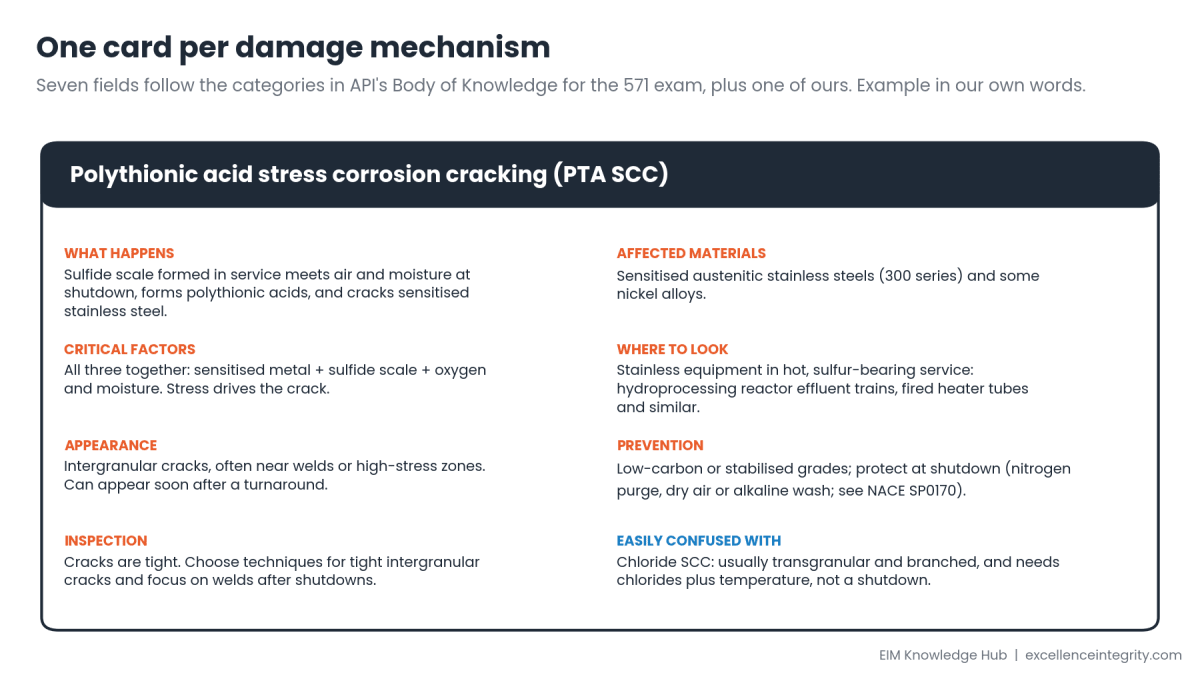
Writing the card yourself is the point. Copying the RP teaches you to recognise sentences; rewriting it teaches you the mechanism. The critical factors field matters most, because most exam questions are scenarios: given this material, this temperature and this environment, what is happening?
The 10-week plan
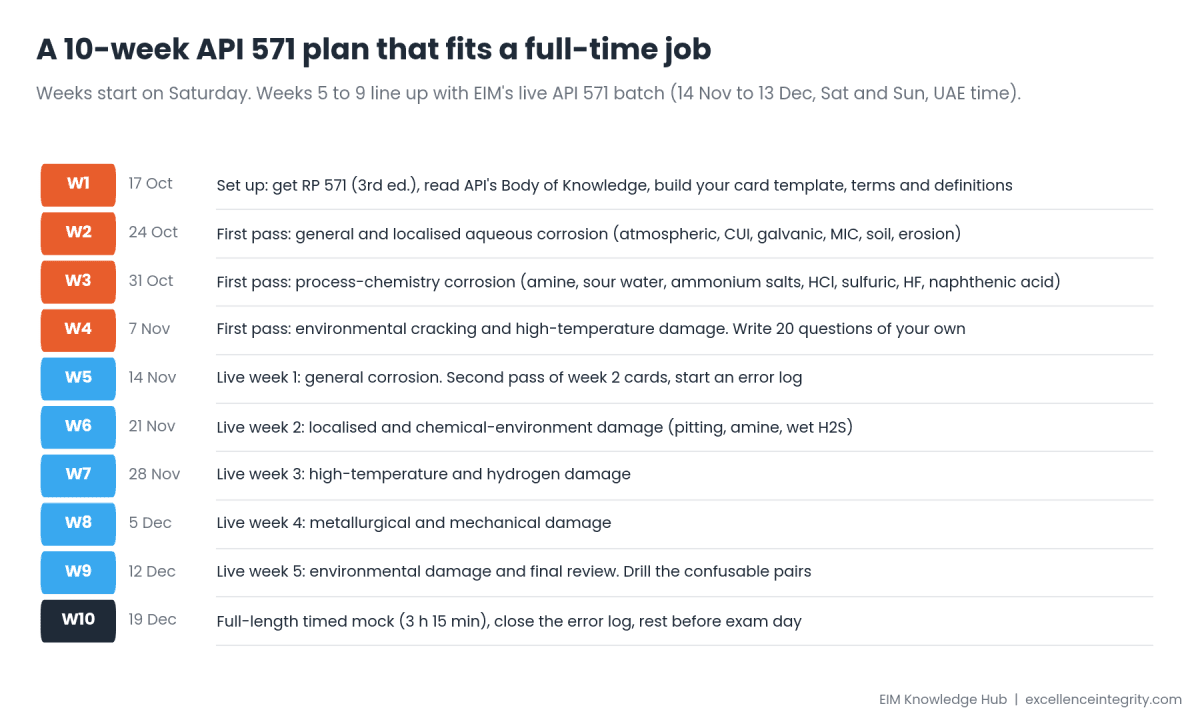
Budget 8 to 10 hours a week: four weekday evenings of about 90 minutes, plus one longer weekend block. If you join the live course, its weekend sessions replace that block in weeks 5 to 9.
Phase 1, weeks 1 to 4: first pass on your own
- Week 1: Get the correct edition of RP 571 from an authorised source. Read API's Body of Knowledge. Learn the terms and definitions. Build your card template and complete the first six cards.
- Week 2: General and localised aqueous corrosion: atmospheric corrosion, corrosion under insulation, galvanic corrosion, MIC, soil corrosion, erosion and erosion-corrosion, cooling water and boiler water corrosion.
- Week 3: Process-chemistry corrosion: amine corrosion, sour water, ammonium bisulfide and ammonium chloride, hydrochloric, sulfuric and hydrofluoric acids, naphthenic acid, caustic corrosion.
- Week 4: Environmental cracking (chloride, caustic, amine and polythionic acid SCC, wet H₂S damage, carbonate cracking, hydrogen embrittlement) and high-temperature damage (sulfidation, oxidation, carburisation, high-temperature hydrogen attack, creep). Then write 20 scenario questions of your own from your cards, and answer them a week later.
Phase 2, weeks 5 to 9: second pass, deeper
Go back through every family, this time with an error log. Every question you get wrong goes in, with the reason: did not know it, confused it with another mechanism, or misread the question. Review the log every weekend. Add metallurgical and mechanical damage in week 8: brittle fracture, temper embrittlement, 885 °F embrittlement, sigma phase, graphitisation, spheroidisation, mechanical and thermal fatigue, and dissimilar metal weld cracking. Spend week 9 drilling the confusable pairs below.
Phase 3, week 10: exam ready
Sit one full-length mock under exam conditions: 3 hours 15 minutes, closed book, no breaks you would not get on the day. Close out the error log. Stop new study two days before the exam and only review your cards.
The confusable pairs
These pairs cost more marks than any single mechanism. For each, learn the one or two facts that separate them.
| Pair | How to tell them apart (our summary) |
|---|---|
| Sulfidation vs naphthenic acid corrosion | Both attack hot hydrocarbon equipment. Sulfidation depends on sulfur content and temperature and tends to be more uniform. Naphthenic acid attack depends on acid content and is often sharply localised where velocity is high. |
| Caustic SCC vs amine SCC | Both crack carbon steel, usually near welds that were not stress-relieved. The environment decides: caustic (NaOH) service versus lean amine service. |
| HIC vs SOHIC vs SSC | All wet H₂S damage. HIC is stepwise cracking linking blisters and needs no applied stress. SOHIC is stacked cracking driven by stress, typically next to welds. SSC cracks hard zones such as hard weld metal and heat-affected zones. |
| Chloride SCC vs polythionic acid SCC | Both crack austenitic stainless steel. Chloride SCC is typically transgranular and branched, in hot chloride service. PTA SCC is intergranular, needs sensitised metal, and appears after shutdowns. |
| Temper embrittlement vs 885 °F embrittlement vs sigma phase | All reduce toughness after long exposure at temperature. Temper embrittlement affects low-alloy Cr-Mo steels; 885 °F embrittlement affects ferritic and duplex stainless steels; sigma forms in austenitic and duplex stainless steels at higher temperatures. |
| Graphitisation vs spheroidisation | Both change the carbides in carbon and C-0.5Mo steels. Graphitisation forms graphite nodules and can cause sudden failure along weld zones. Spheroidisation rounds the carbides and lowers strength gradually. |
| Mechanical fatigue vs thermal fatigue | Both are cyclic. Mechanical fatigue is driven by load or vibration; thermal fatigue by repeated temperature swings, often where hot and cold streams mix. |
A sample question
Written for this article, not taken from any exam or question bank.
A 304 stainless steel line in a hydroprocessing unit is found cracked shortly after a turnaround. The cracks are intergranular and run near welds. Which damage mechanism is most likely?
A) Chloride stress corrosion cracking B) Polythionic acid stress corrosion cracking C) Caustic stress corrosion cracking D) Mechanical fatigue
Answer: B. The clues are sensitised stainless steel, intergranular cracking, and timing after a shutdown, when sulfide scale meets air and moisture.
Five habits that cost marks
- Reading RP 571 once, front to back, and calling it revision. Study by family and come back to each one.
- Learning definitions but not critical factors. Most questions describe a situation and ask what is happening.
- Ignoring temperature ranges. Many mechanisms switch on or off with temperature. Know the rough ranges.
- Skipping the mechanisms you think you know. CUI and atmospheric corrosion are easy marks that people lose on detail.
- Never sitting a full timed mock. 3 hours 15 minutes is long. Practise the pace before the day.
Preparing with EIM
EIM is an independent training provider; API runs the certification and EIM helps you prepare.
API 571 Damage Mechanisms - Exam Preparation (live online), led by Mr. Deepak Rawtal, Senior Metallurgical Inspection Engineer with 45 years in metallurgical and materials testing.
10 sessions of 2 hours over 5 weeks. It covers general corrosion, localised and chemical-environment damage, high-temperature and hydrogen damage, metallurgical and mechanical damage, and environmental damage with a final review. Includes recordings, study notes, a question bank, a reference workbook and a full-length mock exam.
Batches: 14 November to 13 December 2026, and 16 January to 14 February 2027. Saturday and Sunday, 18:00 to 20:00 UAE time. See the course
Prefer to study alone? EIM's self-paced API 571 preparation includes a question bank, practice mode with explanations, timed mock tests, study notes, flashcards, and a study plan worked back from your exam date, with one year of access. See the API 571 exam page
Aiming for the January batch instead? Shift every week in this plan by nine weeks. For background on the certification itself, read our API 571 certification guide for GCC professionals.
Frequently asked questions
How long does it take to prepare for API 571?
This plan assumes 10 weeks at 8 to 10 hours a week. If you already work with damage mechanisms every day, you may need less; if RP 571 is new to you, allow more.
Is the API 571 exam open book?
No. It is closed book, with no references available during the exam.
Do I need API 510, 570 or 653 first?
No. Those certifications qualify you automatically. Otherwise you qualify through API's education-and-experience table.
Which edition of RP 571 is examined?
API's current Body of Knowledge lists the whole of the 3rd edition (2020). Check before you buy, as API updates this when a new edition is adopted.
Does EIM's API 571 prep course come with a certificate?
No. EIM's exam preparation does not include an EIM certificate. The API 571 certification is awarded by API when you pass its exam.
Sources
- API: API 571 Corrosion and Materials certification
- API: API 571 Body of Knowledge
- NACE SP0170 (protection of austenitic stainless steels from polythionic acid SCC during shutdown), cited by number only.
- All checked 7 October 2026.