API 580 vs API 581: What Each Document Does, and Which One You Get Certified In
API 580 sets out what an RBI programme must contain; API 581 is a quantitative way to calculate risk. The difference, and what the API 580 exam covers.
EIM Editorial Team12 Oct 20267 min read
Search for RBI training and you will see "API 580/581" written as if it were one thing. It is not. API RP 580 sets out what a risk-based inspection (RBI) programme must contain. API RP 581 is a detailed, quantitative method for calculating the risk inside that programme. Only one of them has an API individual certification, and it is API 580.
This guide explains the difference in plain terms, shows where each document sits in a working RBI programme, and sets out what the API 580 exam covers. Exam details are from API's Individual Certification Programs pages, checked 7 October 2026.
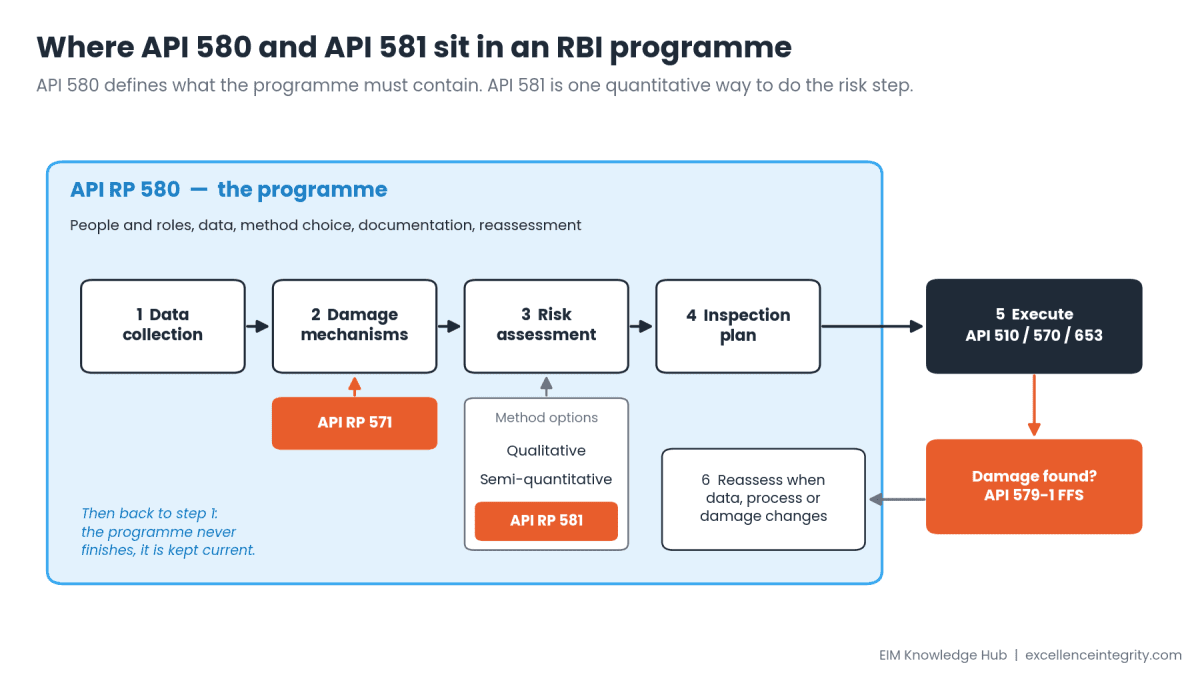
Short answer: API 580 tells you what an RBI programme needs: people, data, a method, documentation and reassessment. API 581 gives one way to do the risk calculation, with procedures for probability and consequence of failure. You can run a sound RBI programme to API 580 without using API 581. You cannot use API 581 well without the programme API 580 describes.
API RP 580 in one paragraph
API RP 580, Elements of a Risk-Based Inspection Program, is in its 4th edition (August 2023), and API's 2026 Body of Knowledge for the exam includes Addendum 1 (March 2025). It covers the elements an RBI programme needs: scope and data, identifying damage mechanisms, assessing probability and consequence of failure, setting risk targets and planning inspection, roles and responsibilities, and documentation and reassessment. It deliberately does not prescribe one calculation method. Qualitative, semi-quantitative and fully quantitative approaches can all meet it.
API RP 581 in one paragraph
API RP 581, Risk-Based Inspection Methodology, is in its 4th edition (January 2025) and runs to almost 700 pages. It gives quantitative procedures for probability of failure (POF) and consequence of failure (COF) for pressure vessels, piping, storage tanks, pressure-relief devices and heat exchanger tube bundles. Risk is POF combined with COF. Because damage accumulates in service, the method projects risk forward in time and recommends an inspection of enough effectiveness before the risk target is reached.
API 580 vs API 581 side by side
| API RP 580 | API RP 581 | |
|---|---|---|
| Question it answers | What must an RBI programme contain? | How do I calculate the risk, step by step? |
| Current edition | 4th edition, August 2023 (Addendum 1, March 2025) | 4th edition, January 2025 |
| Approach | Method-neutral: qualitative to fully quantitative | Quantitative POF and COF procedures |
| Who uses it day to day | Inspection managers, RBI team leads, auditors | RBI engineers and analysts, RBI software users |
| Equipment covered | Pressure-containing fixed equipment | Vessels, piping, tanks, pressure-relief devices, exchanger bundles |
| API individual certification | Yes: API 580 Risk Based Inspection | None on API's current certification list |
How risk sets the inspection date
The main practical change RBI brings is that an inspection date is set by risk, not by a fixed calendar interval alone. As corrosion or cracking progresses, probability of failure rises, and so does risk. The owner-user sets a risk target, and the plan schedules an inspection of the right type and coverage before risk reaches it.
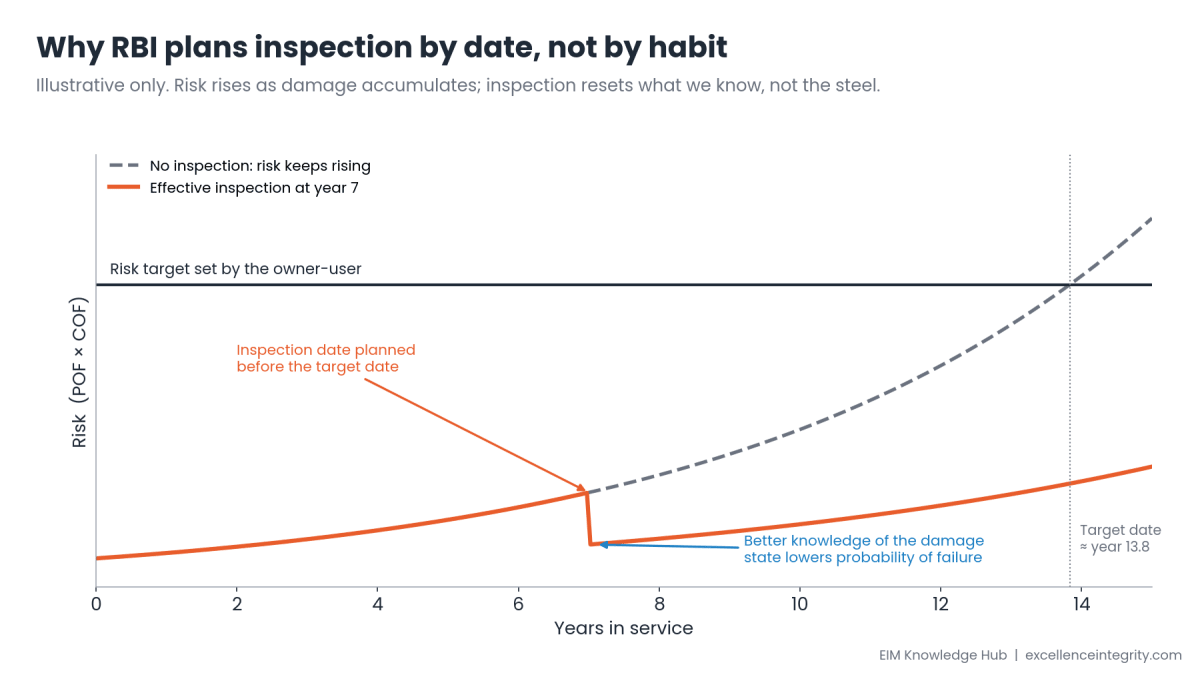
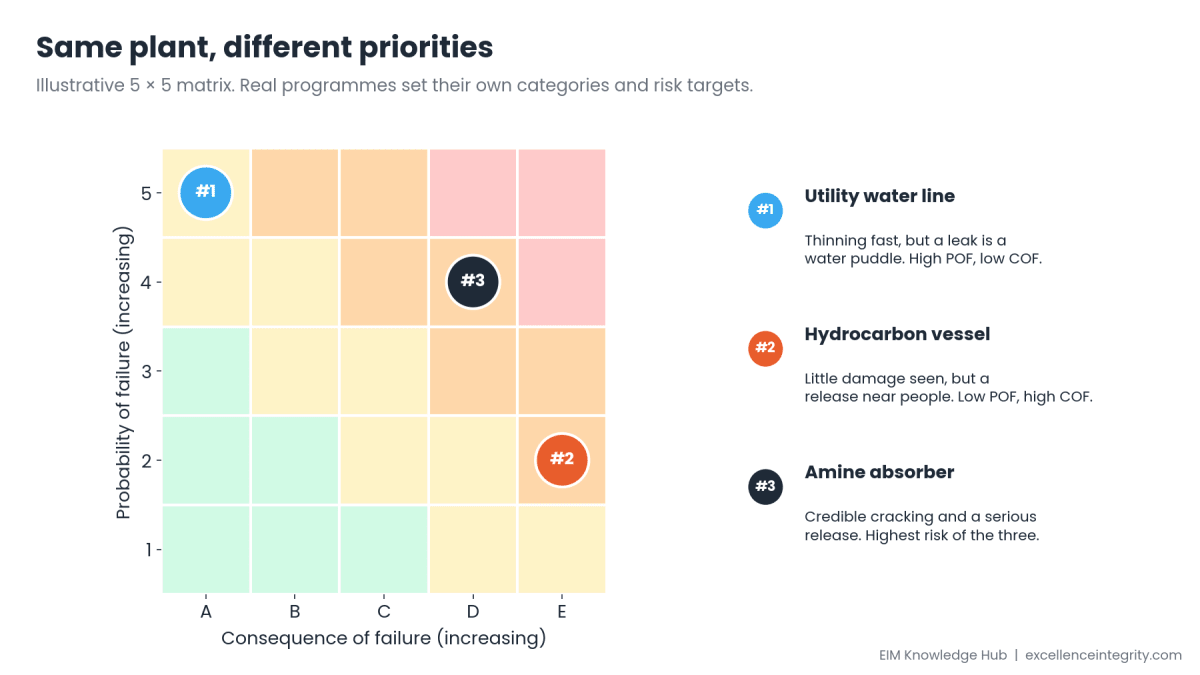
This is also why RBI does not simply mean "inspect less". For low-risk items, intervals can often be extended. For high-risk items, RBI may call for more frequent or more effective inspection than a fixed schedule would have.
What the API 580 exam covers
- Format: 90 multiple-choice questions, of which 80 are scored and 10 are unscored pretest questions. 3 hours 15 minutes. Closed book: no references are available and nothing can be taken into the test centre.
- Content: API RP 580 only. API's Body of Knowledge lists ten areas: terms and definitions, risk assessment, the RBI programme, roles and qualifications, data collection, damage mechanisms, POF, COF, risk management and RBI documentation.
- Who can sit: holders of a current API 510, 570 or 653 certification qualify automatically. Others qualify through a combination of education and industry experience from the last 10 years, set out in API's qualification table.
- Validity: three years.
Because the exam is closed book and built on API 580, you will not be working API 581 equations under exam conditions. You will be tested on concepts: what makes a consequence assessment valid, what inspection effectiveness means, when a risk assessment must be updated, and who is responsible for which step.
Example question (written for this article, not taken from any exam):
An RBI assessment was completed two years ago. The unit has since switched to a higher-sulfur crude. What is the best action?
A) Keep the existing plan until the next scheduled reassessment. B) Reassess the affected equipment, because a change in process conditions can change the active damage mechanisms and the POF. C) Extend all inspection intervals, since the unit has run without incident. D) Replace the RBI software.
Answer: B. A process change is a trigger for reassessment. RBI is meant to be kept current.
Where API 571 and API 579-1 fit
API RP 571 describes the damage mechanisms that feed the probability side of the assessment. Get those wrong and the whole calculation is wrong, which is why RBI teams need strong API 571 knowledge. API 579-1/ASME FFS-1 comes in after inspection: when damage is found, a fitness-for-service assessment decides whether the equipment can keep running, needs repair, or must be replaced, and the result feeds back into the risk assessment. If you are also preparing for API 571, see our 10-week API 571 study plan.
Three misunderstandings to avoid
- "RBI means fewer inspections." It means inspection effort goes where risk is. Some intervals get longer and some get shorter.
- "Buying RBI software gives you an RBI programme." Software runs calculations. API 580 still expects defined roles, trained people, good data, documented decisions, and reassessment when conditions change.
- "API 580 certification means I can run API 581." The certification shows you understand RBI programmes. Running quantitative assessments to API 581 needs further training and supervised practice.
Preparing for API 580 and building RBI skills
Start with API's own documents: the API 580 exam page, the current Body of Knowledge and API RP 580 itself. EIM is an independent training provider; API certifies inspectors, and EIM helps you prepare.
- Self-paced API 580 preparation: a question bank, practice mode with explanations, timed mock tests, study notes and flashcards, with one year of access. See the API 580 exam page
- Live course, Risk-Based Inspection (RBI) Techniques: led by Mr. Deepak Rawtal, Senior Metallurgical Inspection Engineer with 45 years in metallurgical and materials testing. Four 2-hour sessions (8 CPD hours) on RBI fundamentals, risk analysis and assessment methods, implementation and data management, and inspection planning for piping circuits. Includes an EIM certificate of completion.
RBI Techniques, next batches: 26 to 29 October and 7 to 10 December 2026, Monday to Thursday, 19:00 to 21:00 UAE time. See the course
For a wider introduction, read our Ultimate Guide to Risk-Based Inspection in Oil & Gas.
Frequently asked questions
Is there an API 581 certification?
API's current list of individual certifications includes API 580 Risk Based Inspection but not API 581. Some providers run combined "API 580/581" courses, but the API exam you can sit is API 580.
Do I need API 510, 570 or 653 to take API 580?
No. Those certifications qualify you automatically. Without them, you qualify through API's education-and-experience table.
Is the API 580 exam open book?
No. It is closed book, and nothing may be taken into the test centre.
Which edition is the exam based on?
API's 2026 Body of Knowledge lists API RP 580, 4th edition (August 2023) with Addendum 1 (March 2025). Check the Body of Knowledge for your exam window before you study.
Can a qualitative RBI programme comply with API 580?
Yes. API 580 accepts qualitative, semi-quantitative and quantitative approaches, provided the programme contains the required elements.
Sources
- API: API 580 Risk Based Inspection certification
- API: API 580 Body of Knowledge, 2026
- API RP 581, Risk-Based Inspection Methodology, 4th edition, January 2025 (standards-store listing).
- All checked 7 October 2026.