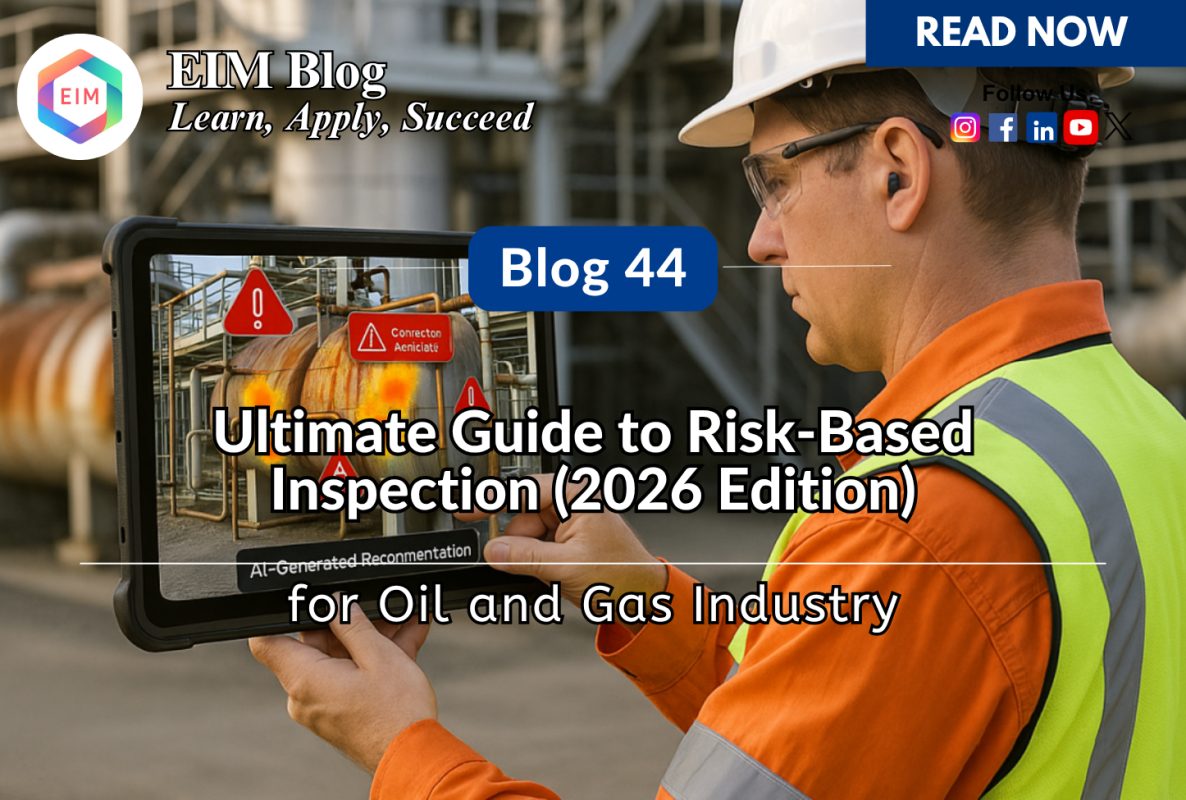
What is Risk-Based Inspection (RBI)?
Risk-Based Inspection (RBI) is an inspection planning methodology that prioritizes equipment inspection based on risk levels.
Risk = Probability of Failure (PoF) × Consequence of Failure (CoF)
Key Elements of RBI
Probability of Failure (PoF)
PoF evaluates how likely equipment is to fail due to:
- Corrosion
- Fatigue
- Material degradation
- Operational stress
Consequence of Failure (CoF)
CoF measures the impact if failure occurs:
- Safety impact
- Environmental damage
- Production loss
- Financial consequences
Types of RBI Methodologies
- Qualitative RBI → Expert judgment & risk ranking
- Semi-Quantitative RBI → Scoring-based evaluation
- Quantitative RBI (API 581) → Mathematical risk calculations
RBI Methodologies Comparison
| Method | Description | Use Case |
|---|---|---|
| Qualitative RBI | Expert-based ranking system | Small plants |
| Semi-Quantitative RBI | Scoring-based approach | Medium facilities |
| Quantitative RBI (API 581) | Data-driven mathematical calculations | Refineries & offshore assets |
Key Insight
- Qualitative RBI → Faster but less precise
- Quantitative RBI → More accurate but highly data-intensive
Best practice in modern industries is a Hybrid RBI Approach.
RBI Risk Matrix Explained
5×5 Risk Matrix Structure
| PoF \ CoF | Low | Medium | High | Very High | Severe |
|---|---|---|---|---|---|
| Very Low | Low | Low | Medium | Medium | High |
| Low | Low | Medium | Medium | High | High |
| Medium | Medium | Medium | High | High | Critical |
| High | Medium | High | High | Critical | Critical |
| Very High | High | High | Critical | Critical | Critical |
Risk Levels
- 🟢 Low → Minimal inspection
- 🟡 Medium → Scheduled inspection
- 🟠 High → Frequent inspection
- 🔴 Critical → Immediate action required
Damage Mechanisms in Oil & Gas
Corrosion Mechanisms
- CO₂ Corrosion
- H₂S Corrosion
- Naphthenic Acid Corrosion
- Microbiologically Influenced Corrosion (MIC)
Cracking Mechanisms
- Stress Corrosion Cracking (SCC)
- Sulfide Stress Cracking (SSC)
- SOHIC
High-Temperature Damage
- HTHA (High-Temperature Hydrogen Attack)
- Creep Damage
- Thermal Fatigue
Other Critical Mechanisms
- Corrosion Under Insulation (CUI)
- Erosion-Corrosion
- Mechanical Fatigue
RBI Standards & Compliance
RBI programs follow internationally recognized standards to ensure reliability and consistency.
| Standard | Purpose |
|---|---|
| API 580 | RBI Framework |
| API 581 | Quantitative RBI Methodology |
| ASME PCC-3 | Inspection Planning |
| DNV-RP-G101 | Offshore RBI |
| ISO 31000 | Risk Management |
RBI Implementation Roadmap (7 Phases)
Phase 1: Define Scope
Identify systems, equipment, and assets.
Phase 2: Data Collection
Gather design data, inspection history, and operating conditions.
Phase 3: Damage Mechanism Review
Identify applicable degradation modes.
Phase 4: Risk Analysis
Calculate Probability of Failure and Consequence of Failure.
Phase 5: Risk Ranking
Prioritize equipment based on calculated risk.
Phase 6: Inspection Planning
Define inspection intervals and NDT techniques.
Phase 7: Implementation & Review
Continuous monitoring and RBI updates.
RBI Applications: Pipelines, Offshore & Refineries
Pipeline RBI
- Corrosion management
- Leak prevention
- Pressure failure analysis
Offshore RBI
- Marine corrosion
- Structural fatigue
- Harsh environment risk assessment
Refinery RBI
- Heat exchanger monitoring
- Pressure vessel integrity
- High-temperature damage assessment
Challenges in RBI Implementation
- Poor or missing data
- High implementation cost
- Lack of skilled professionals
- Resistance to digital transformation
Solutions
- Expert-led implementation
- Custom RBI software
- Training & competency development
- Digital integration
Future of RBI (2026 & Beyond)
The next generation of RBI systems will be intelligent, automated, and predictive.
Emerging Technologies
- AI-driven risk prediction
- Machine learning corrosion modeling
- Digital twins for simulation
- Drone-based inspections
- IoT real-time monitoring
RBI is evolving from static analysis into a real-time intelligence system.
Conclusion
Risk-Based Inspection is no longer optional — it is a strategic necessity for modern oil & gas operations.
Benefits of RBI
- Safer operations
- Reduced maintenance costs
- Higher equipment reliability
- Optimized inspection intervals
- Improved asset integrity management