API 653 Annex B Tank Settlement: A Worked Example
How API 653 Annex B evaluates tank settlement: survey points, the optimum cosine fit, out-of-plane deviation and the Smax limit, worked step by step.
By Syed Hasan7 Nov 20265 min read
Every tank foundation moves. A tank can sink evenly, tilt as a whole, or settle unevenly around its shell and across its bottom. Only some of that movement is damaging, and API 653 Annex B is how inspectors tell the difference. The core of it is a piece of applied statistics: fitting a cosine curve to survey points around the shell and measuring how far the shell departs from it.
Short answer: Survey the shell at N = D/10 points (D in feet), at least eight and no more than 32 ft apart. Fit an optimum cosine curve to the elevations: it represents rigid tilt, and is valid if R² is at least 0.9. The deviation of each point from the curve is its out-of-plane settlement. Compare the largest deviation with Smax = (L² × Y × 11) / (2 × E × H). Edge settlement and local bottom settlement are checked separately.
Kinds of settlement
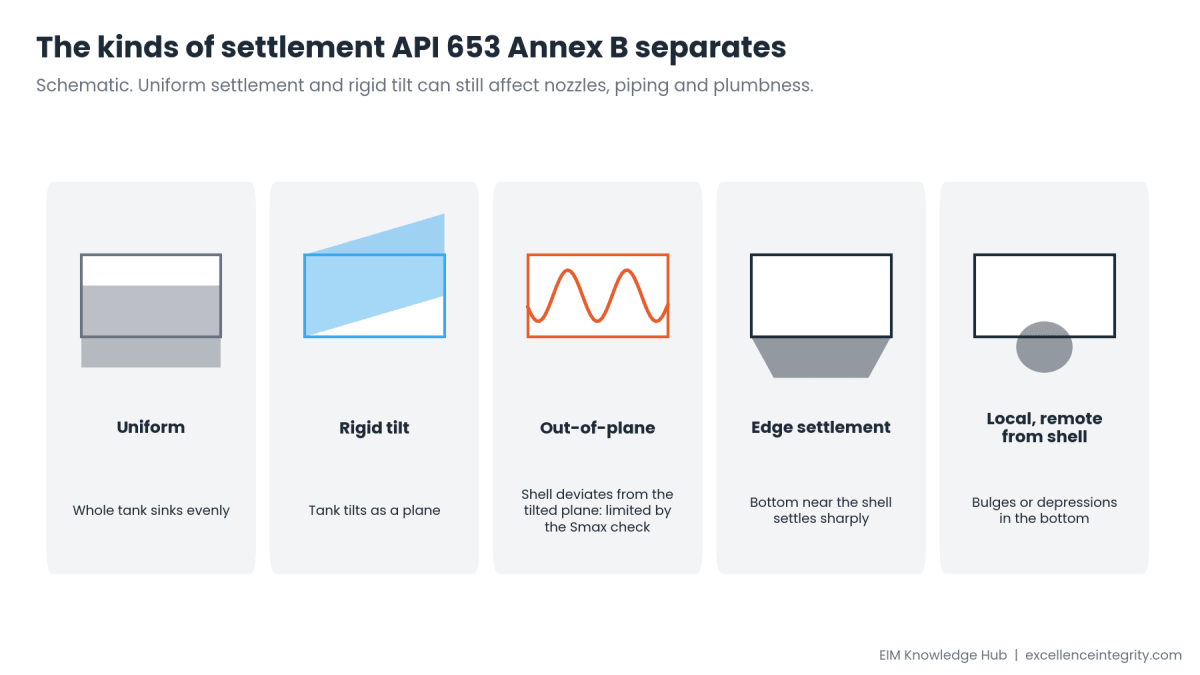
- Uniform settlement: the whole tank sinks evenly. It does not stress the shell, but can strain connected piping.
- Rigid tilt (planar tilt): the tank tilts as a plane. Again little shell stress, though it affects plumbness, roofs and nozzles.
- Out-of-plane (differential) settlement: the shell bottom departs from a plane. This is what bends the shell and is limited by the Smax check.
- Edge settlement: the bottom near the shell settles sharply, straining the bottom plates and the shell-to-bottom joint.
- Local bottom settlement remote from the shell: bulges and depressions in the bottom away from the shell.
Step 1: survey points
API 653 sets the minimum number of shell settlement points as N = D/10, with D in feet, but never fewer than eight, and with a maximum spacing of 32 ft around the circumference. For a 120 ft diameter tank, N = 12 points, spaced π × 120 / 12 = 31.4 ft apart, just under the limit.
Step 2: fit the optimum cosine curve
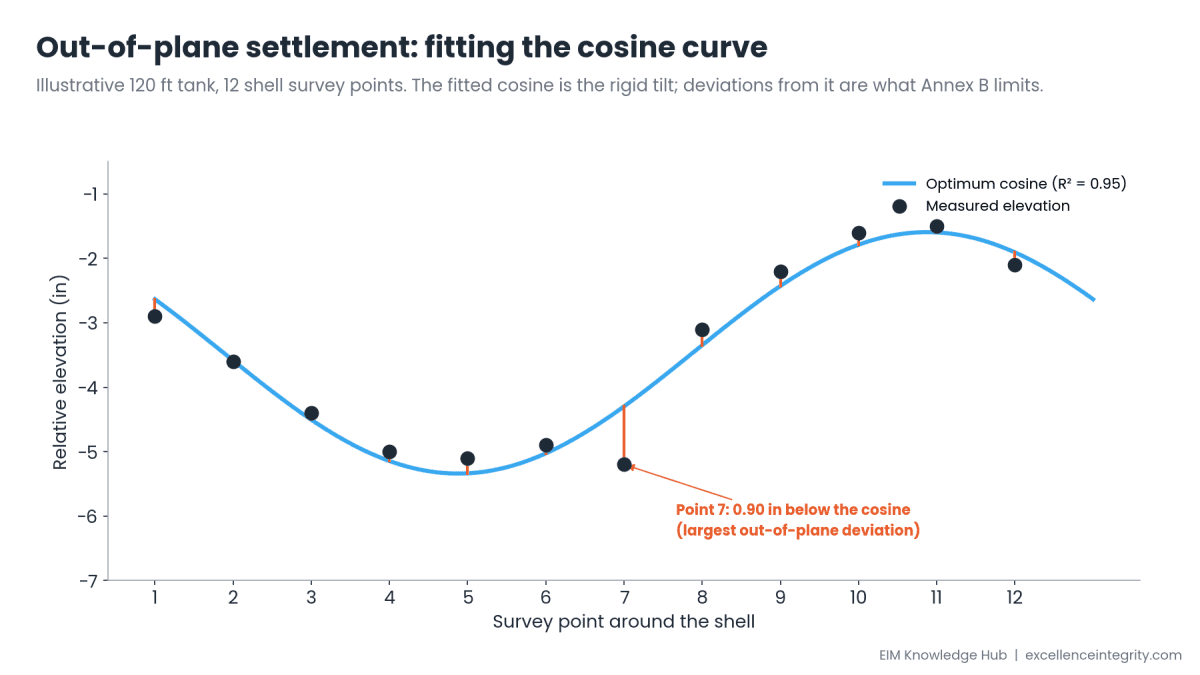
Rigid tilt of a circular tank, unrolled around its circumference, is a cosine wave. Annex B finds the cosine that best fits the measured elevations, which statistically is a least-squares fit of the form u = a + b cos θ + c sin θ to the points. The fit is valid when R², the share of variation it explains, is at least 0.9. If the settlement does not look like a tilt and the fit fails, Annex B offers an alternative arc-length method.
Step 3: calculate the out-of-plane deviation
Each point's out-of-plane settlement, Si, is its measured elevation minus the fitted cosine value at that point. In the illustration, the fit gives R² = 0.95 (valid), and the largest deviation is at point 7: 0.90 in below the curve.
Step 4: compare with Smax
Smax = (L² × Y × 11) / (2 × E × H)
- L: arc length between survey points, in feet (31.4 ft here).
- Y: yield strength of the shell material, in psi (36,000 psi for A36).
- E: Young's modulus, in psi (about 29,000,000 psi for steel).
- H: tank height, in feet (48 ft here).
- Smax: in feet.
Smax = (31.4² × 36,000 × 11) / (2 × 29,000,000 × 48) = 0.140 ft ≈ 1.68 in
The largest measured deviation, 0.90 in, is within the 1.68 in limit, so out-of-plane settlement is acceptable in this illustration. Had a point deviated by more than Smax, the next steps would be a more detailed evaluation (the arc-length method, or a fitness-for-service assessment) or remedial work such as re-levelling.
Edge and local bottom settlement
Shell survey points do not capture what happens to the bottom. Annex B evaluates edge settlement near the shell and local bottom settlement remote from the shell separately, with their own measurements and limits shown in its figures. Our tank floor inspection guide covers the bottom side.
Practical tips
- Measure at the same points every time, and record the reference datum.
- Avoid measuring near lap welds or distorted bottom edges, which can give misleading readings.
- Monitor during hydrotest on new or re-levelled foundations, when settlement can change quickly.
- Too many points can be over-conservative for the cosine method; follow Annex B's guidance on spacing.
- Check nozzles and piping even when the shell passes: tilt can overstress connections.
Preparing for API 653
Settlement calculations, including the number of survey points, edge settlement and local bottom settlement, are listed in API's Body of Knowledge for the API 653 exam. EIM is an independent training provider; EIM's self-paced API 653 preparation includes a question bank, practice mode with explanations, timed mock tests, study notes and flashcards, with one year of access. See the API 653 page
Frequently asked questions
How many settlement points does API 653 require?
N = D/10, with D in feet, but at least eight points and no more than 32 ft apart around the circumference.
What is the optimum cosine curve?
The cosine wave that best fits the measured shell elevations. It represents rigid tilt; deviations from it are out-of-plane settlement. It is valid when R² is at least 0.9.
What is the formula for Smax?
Smax = (L² × Y × 11) / (2 × E × H), with L the arc length between points in feet, Y the yield strength and E Young's modulus in psi, and H the tank height in feet. Smax is in feet.
Does API 653 limit tilt?
The Smax check limits deviation from the tilted plane, not the tilt itself. Tilt can still affect plumbness, roofs, nozzles and piping and should be evaluated for those.
What if the cosine fit fails?
Annex B offers an arc-length method, and more rigorous evaluation such as fitness-for-service is possible.
Sources
- API: API 653 Body of Knowledge, March 2027 (settlement evaluation and number of points)
- E2G: A deep dive into aboveground storage tank settlement evaluation
- API 653 Annex B, Evaluation of Tank Bottom Settlement. Formula cited; figures not reproduced.
- Worked example and regression prepared by EIM. Checked 7 October 2026.