Using AI Tools for Inspection Reports: A Safe Workflow for Engineers
How inspection engineers can use AI chat tools to draft reports safely: good uses, risks like invented clauses, and an engineer-in-the-loop workflow.
By Syed Hasan5 Nov 20265 min read
AI chat tools can turn a page of rough field notes into a tidy draft report in seconds. For inspection and integrity engineers who spend hours writing, that is a real gain. They can also, just as quickly, invent a code clause, get a unit wrong, or put a client's data somewhere it should not be. The question is not whether to use them, but how to use them without losing control of the facts.
Short answer: Use AI tools to draft, structure and summarise, never to decide. Only use tools your company has approved for the data involved. Check every fact, number, clause and unit against the source before anything goes into a report. And keep the engineering judgement, and the signature, with a person.
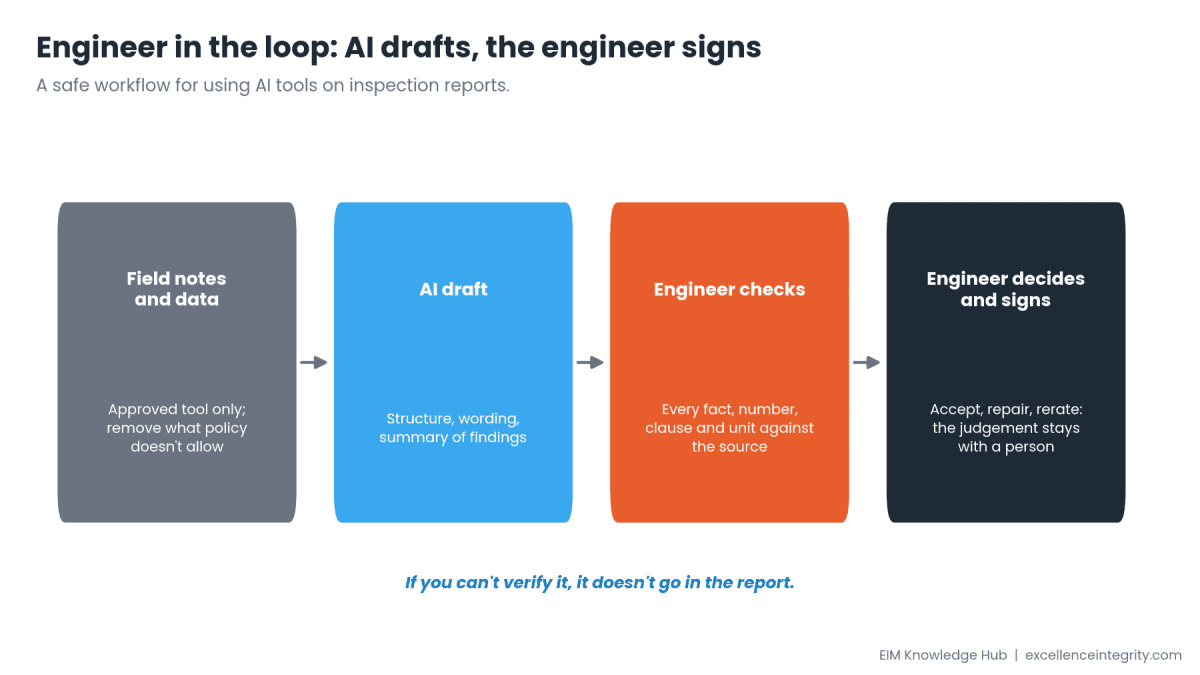
The engineer-in-the-loop workflow
- Start with the right tool and the right data. Check your company's AI and data policy. Client drawings, inspection results and plant names may not be allowed in public tools. Use an approved enterprise tool, or remove what policy does not allow.
- Give context and structure. Tell the tool the equipment, the inspection scope, the report template, and that it must not add facts that are not in your notes.
- Let it draft. Ask for a structured report, a summary of findings, or a list of open items.
- Check everything. Compare every measurement, location, clause number and recommendation with your notes and the code. Assume nothing is right until you have checked it.
- Decide and sign. Accept, repair, rerate or monitor: that judgement belongs to the engineer, under the codes and the company's procedures.
An example prompt
Example (illustrative):
"You are helping an inspection engineer draft an internal inspection report for a carbon steel vessel. Use only the facts in the notes below. Do not add measurements, code clauses or recommendations that are not in the notes. Where something is unclear, list it as a question for the engineer. Format: summary, scope, findings by location, thickness data table, open items. Notes: ..."
The instruction to use only the notes, and to list questions instead of guessing, is what keeps the draft honest.
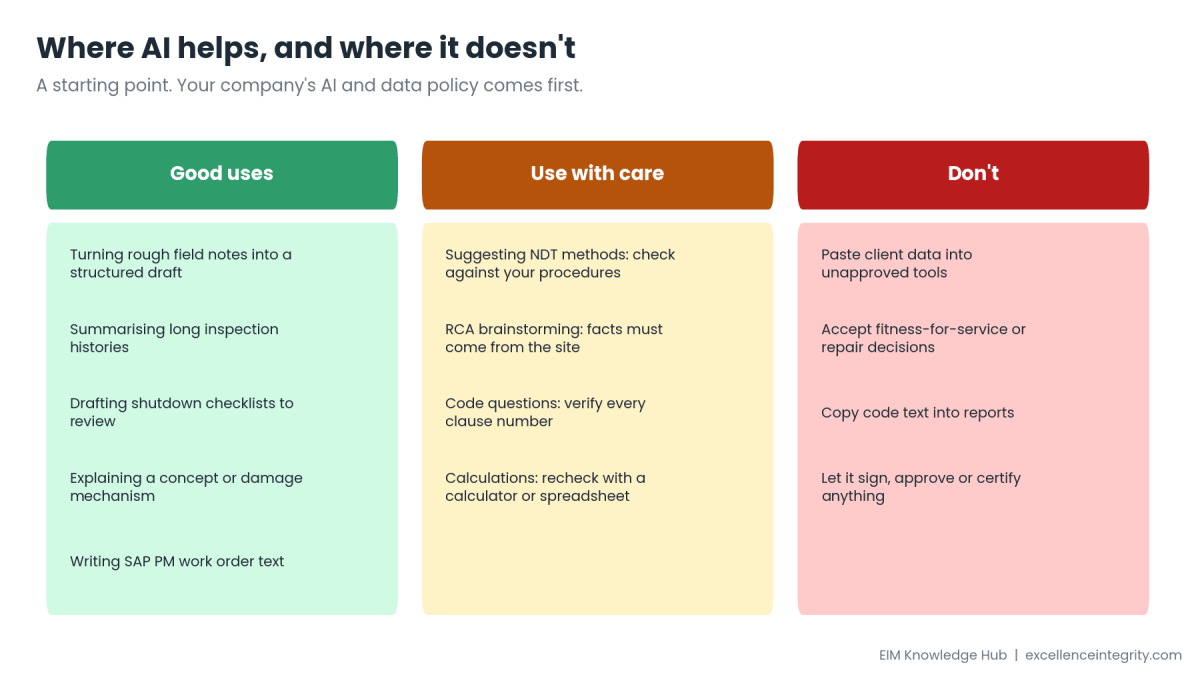
Where AI helps, and where it doesn't
Good uses
- Turning rough field notes into a structured first draft.
- Summarising a long inspection history or a set of previous reports.
- Drafting shutdown checklists, job plans and SAP PM work order text for you to review.
- Explaining a damage mechanism or a concept in plain language, for training or for a client.
Use with care
- Code and standard questions. AI tools can produce clause numbers and requirements that sound right and are not. Always check the actual edition you are working to.
- Calculations. Use them to explain a method, then do the numbers in a calculator or spreadsheet you trust, and check units.
- NDT selection and RCA. Useful for brainstorming options; the facts and the final choice must come from the site, the procedures and qualified people.
Don't
- Paste confidential client or plant data into tools your company has not approved.
- Accept fitness-for-service, repair or run decisions from an AI tool.
- Copy code or standard text into a report through an AI tool; codes are copyrighted and must be cited, not reproduced.
- Let AI sign, approve or certify anything.
The most common AI mistakes in engineering drafts
| Mistake | What it looks like | How to catch it |
|---|---|---|
| Invented references | A plausible clause number or requirement that is not in the code | Look up every reference in the actual edition |
| Wrong numbers | A thickness, rate or interval that differs from your notes | Compare every number with the source data |
| Unit slips | mm and inches, or MPa and psi, mixed in one sentence | Check units line by line |
| Overconfident wording | "The vessel is fit for service" when no assessment was done | Remove any conclusion you did not reach yourself |
| Outdated information | Requirements from an older edition | Confirm the edition on the effectivity sheet or contract |
Learn more with EIM
EIM's live course AI & LLMs for Oil & Gas Inspection, Corrosion & Asset Integrity Engineers runs over 16 sessions (32 hours) on weekends, with recordings. Its eight modules start with AI foundations and data security, then cover inspection reports from field notes and support for RBI, FFS and corrosion analysis. Later modules cover NDT selection and inspection planning, shutdown checklists, RCA and risk assessments, training content, and SAP PM work orders. The theme throughout is engineer in the loop: AI assists, the engineer signs. No batch is published at the moment; check the course page for the next date.
For a self-paced route, the Artificial Intelligence & Machine Learning for Oil & Gas programme covers what AI tools can and cannot be trusted with in integrity work, and is built for inspection and corrosion engineers, integrity leads asked for an AI policy, and data and reliability analysts. EIM is an independent training provider.
Frequently asked questions
Can AI write an inspection report?
It can draft one from your notes. The engineer must check every fact and number and remains responsible for the content and the conclusions.
Is it safe to paste inspection data into a public AI tool?
Only if your company's policy and the client's contract allow it. Many organisations require approved enterprise tools for any plant or client data.
Can AI tools answer code questions?
They can explain concepts, but they can also produce clauses that do not exist. Always check against the edition you are working to.
Should AI do my calculations?
Use it to explain a method if helpful, then do the calculation in a trusted tool and check units and inputs yourself.
Will AI replace inspection engineers?
In integrity work, accountability stays with qualified people. AI tools change how quickly engineers write and research, not who makes the decision.
Sources
- EIM course and programme descriptions (EIM website).
- Example prompt and mistakes table prepared by EIM for illustration. Checked 7 October 2026.