Cathodic protection (CP) is what keeps buried pipelines, tank bottoms, jetties, well casings and plant piping from corroding, and in the Gulf and India, with long pipeline networks, aggressive soils and seawater exposure, CP work never stops. The people who test, troubleshoot and design those systems are certified by AMPP, the Association for Materials Protection and Performance, through a four-level ladder that many job adverts still call by its old name: "NACE CP".
This guide is the full path: what each level does on the job, the exact routes into each one by education, how the exams work, whether you can skip a level, and how to plan your own climb. Requirements are taken from AMPP's pages and its training partners, checked 7 October 2026. AMPP updates its programmes, so confirm the details before you apply.
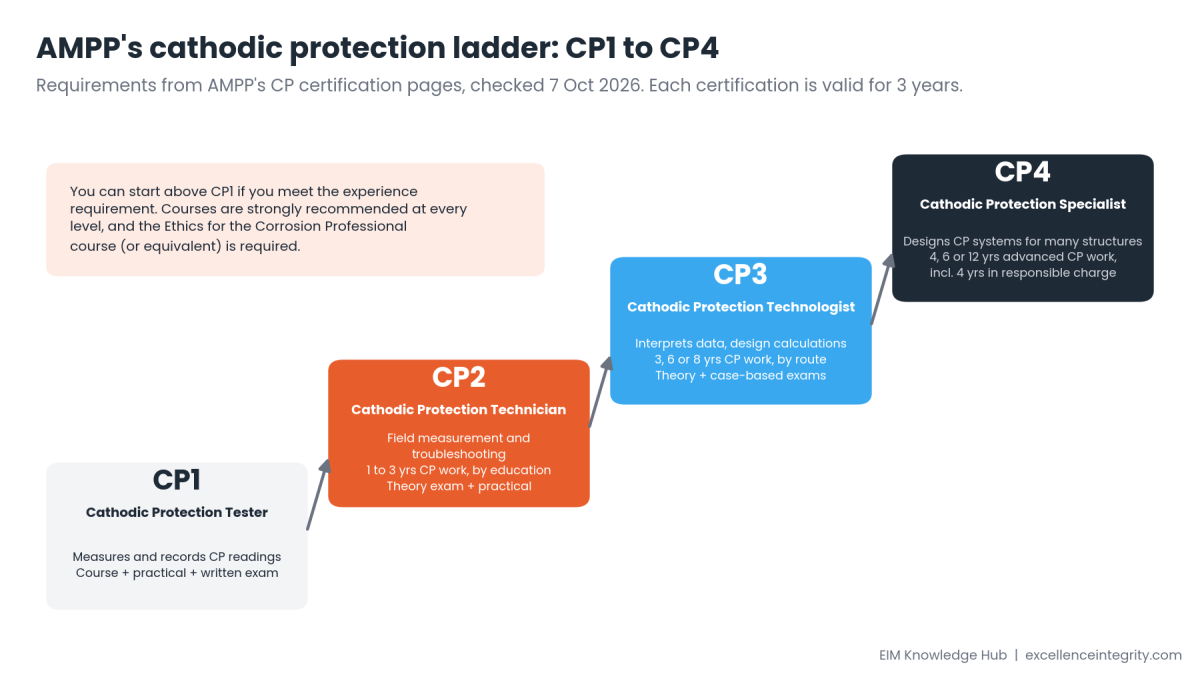
Short answer: CP1 Tester measures and records. CP2 Technician troubleshoots and evaluates. CP3 Technologist interprets data and does design calculations. CP4 Specialist designs CP systems. How many years you need depends on your education: with a relevant degree, CP2 needs 1 year of CP work and CP3 needs 3. You do not have to hold a lower level to apply for a higher one.
The four levels at a glance
| Level | What you do | Typical job titles |
|---|---|---|
| CP1 Tester | Take and record CP measurements: structure potentials, rectifier readings, current outputs | CP tester, CP field technician, corrosion technician |
| CP2 Technician | Advanced field measurements, troubleshooting, testing galvanic and impressed current systems, gathering design data | CP technician, CP supervisor, senior field technician |
| CP3 Technologist | Interpret survey data, troubleshoot whole systems, carry out design calculations | CP engineer, corrosion engineer, CP lead |
| CP4 Specialist | Design CP systems for many types of structure and take responsibility for them | CP specialist, principal corrosion engineer, CP consultant |
What each level does on the job
CP1: measurement you can trust
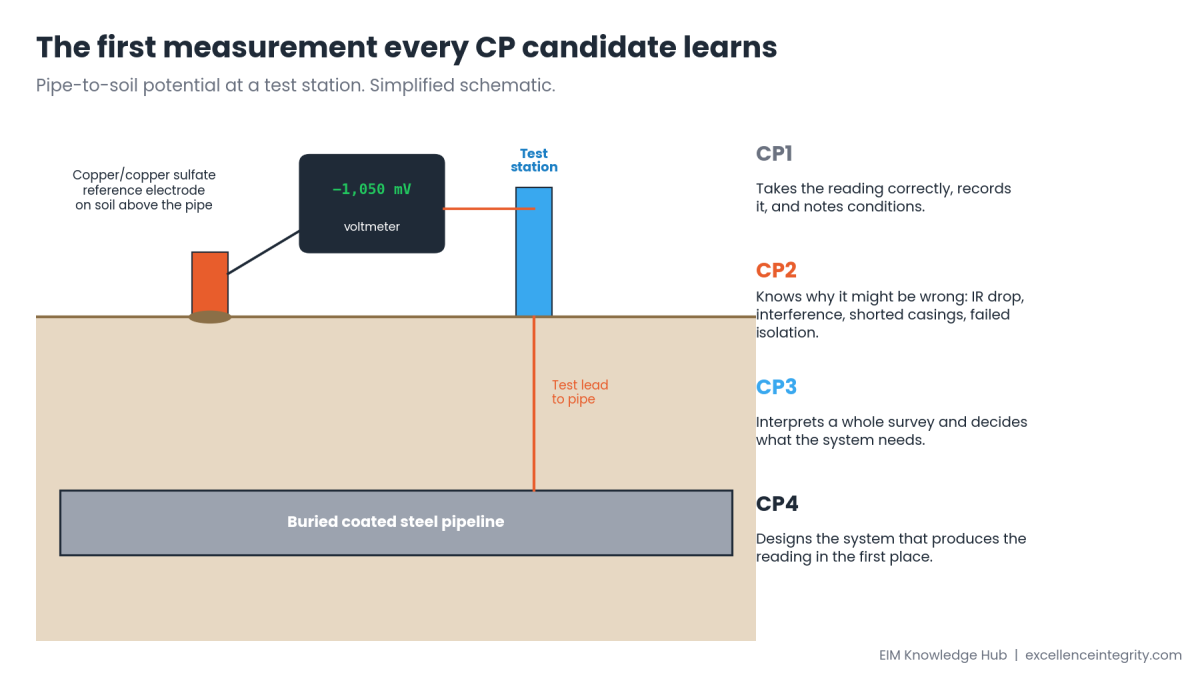
The most common CP measurement is the pipe-to-soil (structure-to-electrolyte) potential: a voltmeter between the structure, through a test station lead, and a reference electrode, usually copper/copper sulfate, placed on the soil. CP1 is about doing this correctly every time: good electrode contact, correct polarity, recording conditions, and knowing when a reading looks wrong enough to flag.
CP2: knowing why a reading is wrong
CP2 adds corrosion theory and the reasons behind the numbers. Why is this potential suspiciously positive? Is current being lost through a shorted casing or a failed isolation joint? Is a neighbouring pipeline's CP system interfering? CP2 technicians test both galvanic (sacrificial anode) and impressed current systems and collect the data designers need.
CP3: from data to decisions
CP3 is where survey data becomes a plan: interpreting long runs of readings, finding the root cause of under-protection, and doing the calculations behind current requirements and anode systems. Its case-based exam reflects this: you are tested on realistic situations, not isolated facts.
CP4: designing systems
CP4 specialists design CP for many structure types and own those designs. That is why AMPP asks for four years in responsible charge: evidence that you made and were accountable for CP decisions, not only carried them out.
The criteria behind the readings
Early in the ladder you meet the protection criteria used to judge whether a buried steel structure is protected. NACE SP0169, the long-standing standard for external corrosion control of underground and submerged piping, is the best-known source. In our words, its three commonly cited criteria for steel are:
- A potential of −850 mV or more negative with the CP current applied, measured against a copper/copper sulfate electrode, with voltage (IR) drops considered;
- A polarised potential of −850 mV or more negative, typically measured as an "instant-off" reading when the current is interrupted; and
- At least 100 mV of cathodic polarisation compared with the structure's native potential.
Why IR drop matters: with current flowing, part of the reading is a voltage drop through the soil, not the protection the steel actually has. Much of CP2's field technique, such as current interruption for instant-off readings, exists to separate the two. Always check the edition and criteria your project or regulator requires.
Requirements by education: the routes into each level
| Level | Relevant degree route | Technical training route | Work experience route |
|---|---|---|---|
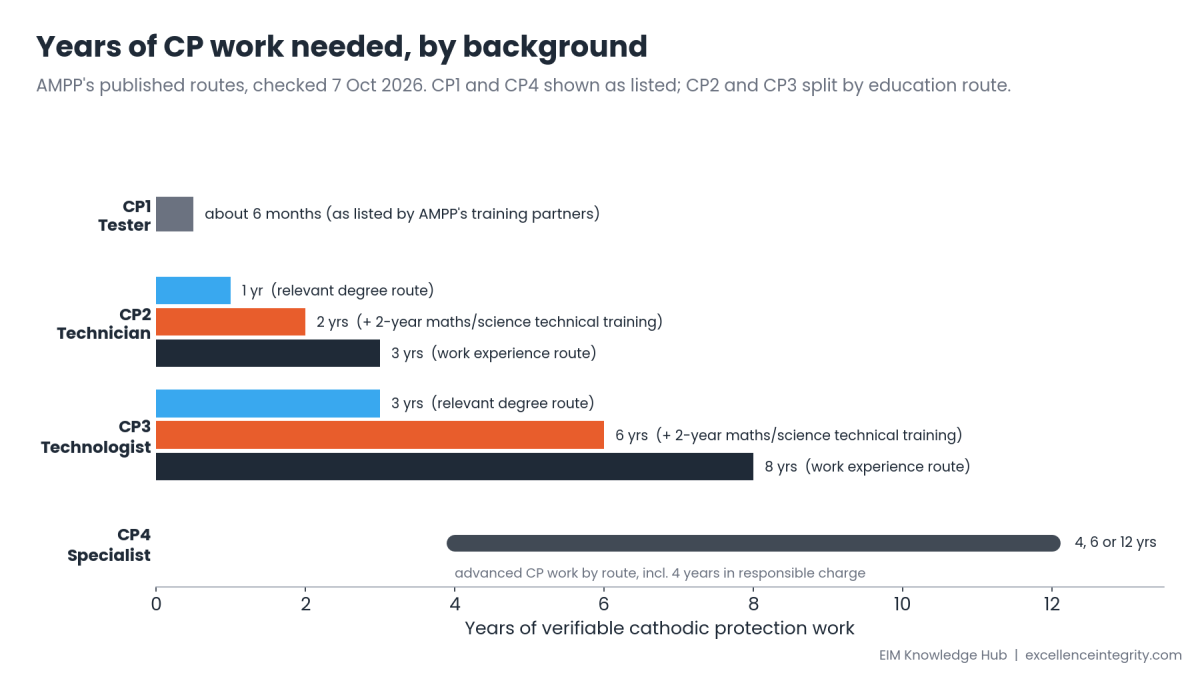
| CP1 Tester | About 6 months of CP work, as listed by AMPP's training partners | Same | Same |
| CP2 Technician | 1 year of CP work | 2 years of CP work + 2 years of post-high-school maths or science technical training | 3 years of CP work |
| CP3 Technologist | 3 years of CP work | 6 years of CP work + 2 years of post-high-school maths or science technical training | 8 years of CP work |
| CP4 Specialist | 4, 6 or 12 years of advanced CP work, depending on the route, including 4 years in responsible charge |
Requirements that apply at every level:
- Verifiable experience. AMPP checks what you claim. Keep survey reports, logs and names of supervisors who can confirm your work.
- Ethics. The Ethics for the Corrosion Professional course, or an approved equivalent.
- An approved application, ideally submitted before the exam so AMPP can verify your experience.
- Four years to finish. Candidates have four years to complete all requirements for a level.
- Courses are strongly recommended. AMPP lists its course for each level as strongly recommended, and for CP3 it also strongly recommends holding CP2 first.
How the exams work
| Level | Exams |
|---|---|
| CP1 | Written exam plus a practical exam given as part of the course |
| CP2 | Theory exam (computer-based, through Pearson VUE) plus a practical exam at the end of the course |
| CP3 | Theory exam and a case-based exam |
| CP4 | Computer-based exam; check AMPP's current exam preparation guide, as the format has been revised |
Two practical consequences. First, because the CP1 and CP2 practicals are tied to the course, plan to attend; AMPP's licensee notes that failing the CP2 practical means retaking the course. Second, the theory exams are booked separately, so leave time between the course and the exam to revise, but not so long that you forget the practical techniques.
Can you skip a level?
Yes. AMPP's licensee FAQ is explicit that you do not need CP1 to attempt CP2 or higher, as long as you meet the experience and education requirements for the level you apply for. A graduate engineer with a year of CP work, for example, can go straight to CP2.
Skipping is not always wise, though. CP2 assumes you are fluent in field measurement. AMPP offers a pre-assessment quiz to gauge your readiness before you book a CP2 course; take it honestly. And CP2 is strongly recommended before CP3 for good reason: the technologist level builds directly on technician skills.
Planning your route
An engineering graduate
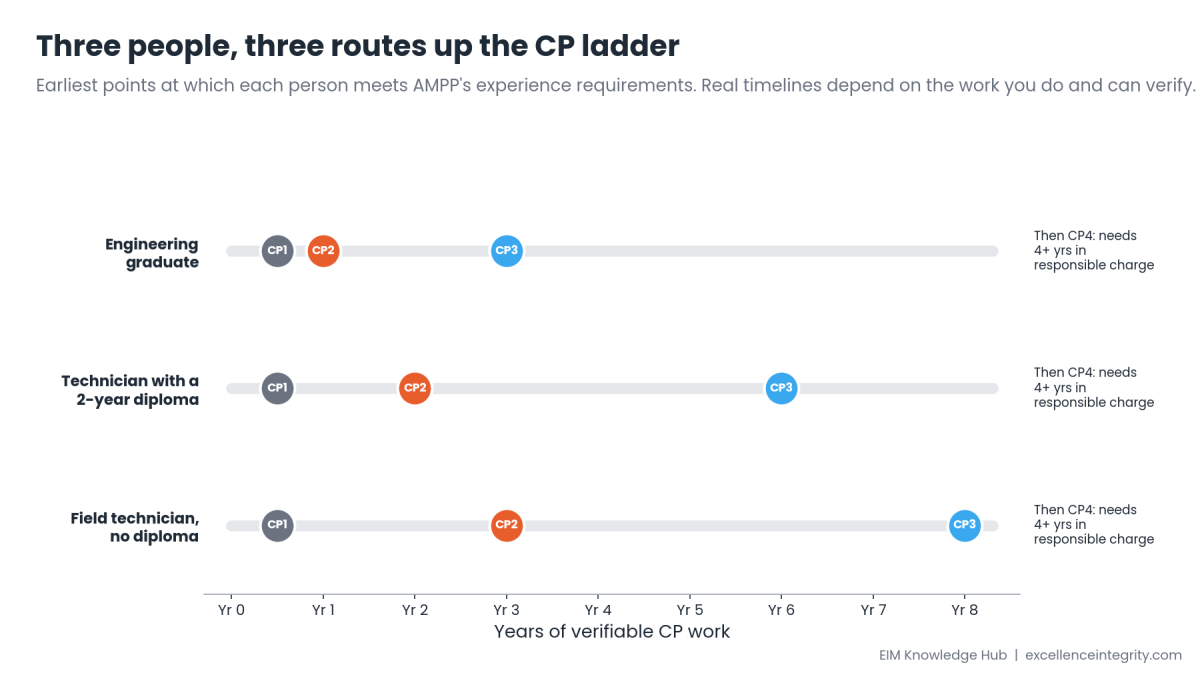
With a relevant degree, CP2 is open after one year of verifiable CP work, and CP3 after three. Many graduates skip CP1 and start at CP2. The limit on reaching CP4 is not total years but getting four years of genuine responsibility for CP decisions.
A technician with a two-year technical diploma
Two years of post-high-school maths or science training brings CP2 down to two years of CP work and CP3 to six. CP1 early gives you a credential while you build towards CP2.
A field technician without formal training
The work-experience route takes longest: three years for CP2, eight for CP3. It is a respected route, and many experienced CP technicians follow it. Start CP1 early, keep meticulous records of your work, and use CP2 to move into troubleshooting roles.
Common mistakes
- Counting general corrosion or coating work as CP experience. AMPP asks for verifiable cathodic protection work.
- Weak documentation. "Worked on CP systems" is not evidence. List systems, measurements, surveys and who supervised you.
- Booking the theory exam too late after the course, and losing the practical techniques that it tests.
- Skipping to CP2 or CP3 without the fundamentals. Use the pre-assessment quiz.
- Letting the certification lapse. Renewal needs work experience in the most recent period, so a long gap from CP work can make renewal difficult.
Keeping your certification
Every CP certification is valid for three years. Renewal is through AMPP's certification portal: AMPP's training partners describe the work requirement as one and a half years of work within the most recent three-year period, plus professional development hours, with extra responsible-charge requirements for some certifications. Log your PDHs as you earn them, not at the deadline.
Beyond the CP ladder
CP certifications also count towards other AMPP credentials. One of the two routes to the Corrosion Technologist (CTech) certification credits an active CP1, CP2, CP3 or CP4; see our guide to CTech vs SCT. And if job adverts confuse you with old NACE names, read NACE Is Now AMPP.
Preparing with EIM
EIM is an independent training provider; the CP certifications belong to AMPP. EIM's CP exam pages explain CP1 to CP4 in full. For CP3, EIM's self-paced preparation is built, with a question bank, practice mode with explanations, timed mock tests, study notes, flashcards and a study plan worked back from your exam date, with one year of access.
To see where CP fits among pipeline threats, EIM's self-paced Pipeline Integrity Management programme covers threat assessment, inline inspection, defect assessment and repair. For the inside of the pipe, the Internal Corrosion Management programme covers monitoring and inhibition.
Frequently asked questions
Do I need CP1 before CP2?
No. If you meet CP2's experience and education requirements, you can apply for CP2 directly. AMPP recommends its pre-assessment quiz before you book the CP2 course.
How many years for CP2 with an engineering degree?
AMPP lists a route with 1 year of verifiable CP work for candidates on the education-plus-experience route. Check that your degree meets AMPP's definition.
How many years for CP3?
3, 6 or 8 years of verifiable CP work, depending on your route: relevant degree, 2 years of maths or science technical training, or work experience only. CP2 certification is strongly recommended first.
What does CP4 require?
4, 6 or 12 years of advanced CP work depending on the route, including 4 years in responsible charge. CP3 training and certification are strongly recommended.
Are the CP exams computer-based?
The theory exams are computer-based, booked through Pearson VUE. CP1 and CP2 also have practical exams given at the end of the course.
Is NACE CP2 the same as AMPP CP2?
Yes, it is the same credential lineage. AMPP took over NACE's certifications when NACE and SSPC merged in 2021.
Sources
- AMPP: Cathodic Protection Technician (CP2)
- AMPP: Cathodic Protection Technologist (CP3)
- AMPP: Cathodic Protection Specialist (CP4)
- AMPP: Cathodic Protection Tester (CP1)
- Australasian Corrosion Association (AMPP licensee): CP2 course and FAQ
- NACE SP0169, Control of External Corrosion on Underground or Submerged Metallic Piping Systems. Criteria summarised, not quoted.
- All checked 7 October 2026.