Types of Gears and Where They Are Used: A Maintenance View
Ten types of gears from spur and helical to hypoid and planetary: where each is used, what goes wrong with it and what to check when you inspect a gearbox.
By Harish Haseeb22 Nov 20268 min read
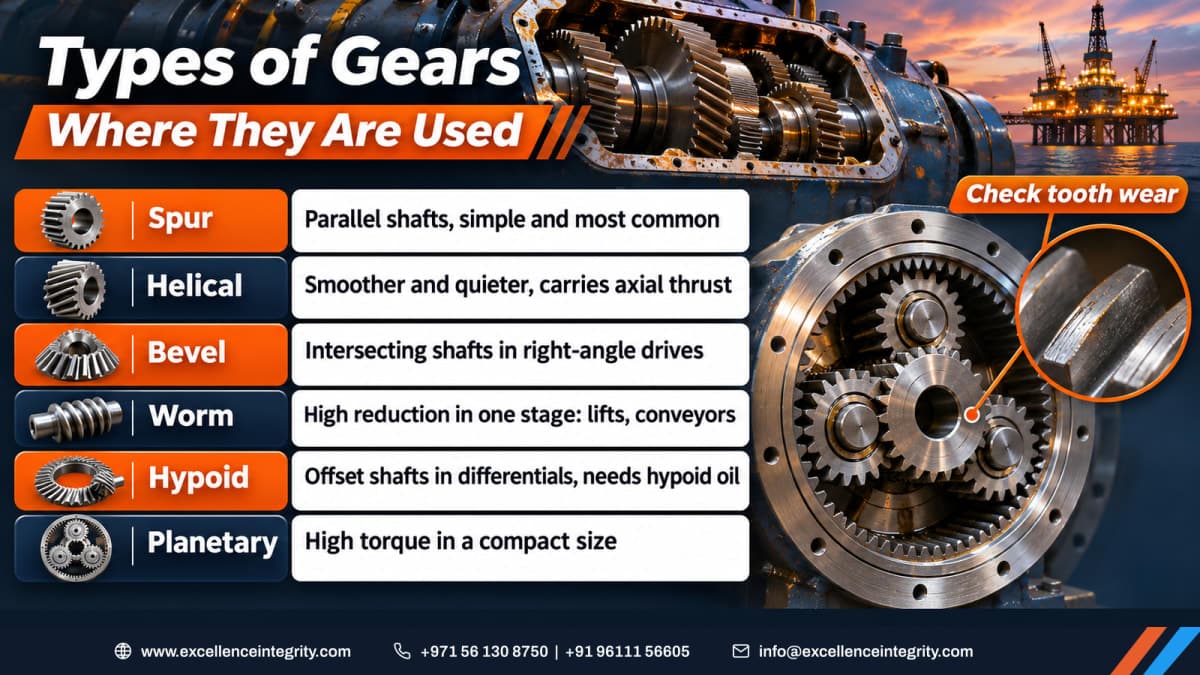
Most gear catalogues tell you what each gear looks like. That is useful the first time and not much use after. In a plant, the questions are different: which type is in this gearbox, what usually goes wrong with it, and what should I check before it turns into a breakdown?
This post goes through the ten common types of gears from a maintenance engineer's point of view. For each one you get what it does, where you find it, the trouble it tends to give, and what to look at during an inspection. At the end there is a short guide to reading gear wear, which is where most of the useful evidence is.
What every gear has in common
All gears transmit power by meshing teeth, and in doing so they change speed and torque: a small gear driving a large one slows the output and raises the torque. What separates the types of gears is how the shafts are arranged (parallel, intersecting, or offset), how the teeth engage, and how much sliding happens at the contact. Sliding matters because it decides how hard the lubricant has to work and how the teeth wear.
Three things keep nearly every gear set healthy: the right lubricant in the right condition, correct alignment and mounting, and the right backlash, which is the small clearance between meshing teeth. Too little backlash and the gears bind and run hot; too much and they knock under reversing loads.
Gears for parallel shafts
1. Spur gears
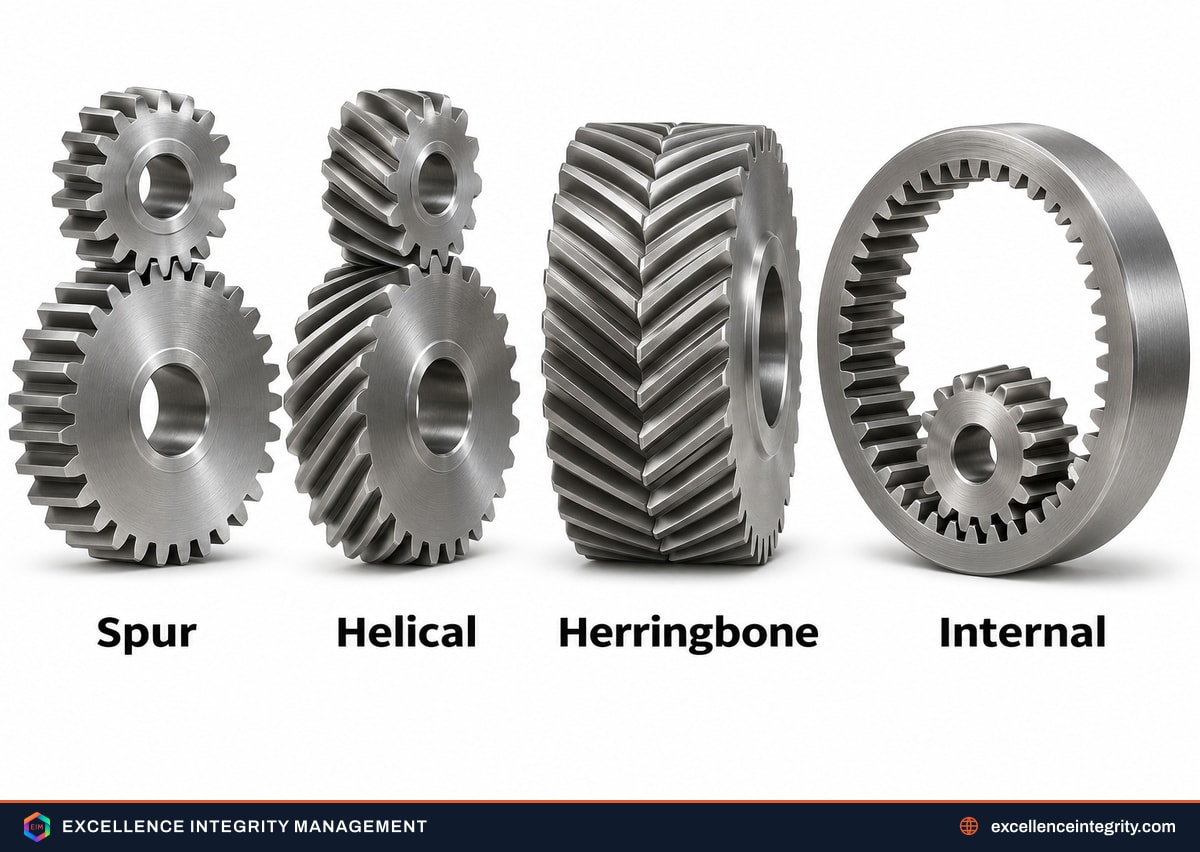
Straight teeth cut parallel to the shaft. Spur gears are the simplest and most common type, used wherever two parallel shafts need a fixed speed ratio. Because each tooth engages along its full width at once, they are noisier than helical gears at speed. They produce no axial thrust, which keeps the bearings simple. In service, watch for noise rising with speed and for pitting near the pitch line.
2. Helical gears
Teeth cut at an angle to the shaft. Each tooth engages gradually, so helical gears run smoother and quieter than spur gears and handle higher speeds. The angle creates axial thrust, so the bearings must carry it. When a helical gearbox develops end float or a thrust bearing problem, the tooth contact pattern shifts, which is one of the first things to check.
3. Herringbone gears
Two opposite helices side by side, forming a V. The axial thrust of each half cancels the other, so herringbone (double helical) gears carry heavy loads smoothly without large thrust loads on the bearings. They are found in heavy industrial and marine drives. Alignment between the two halves matters; uneven wear on one side of the V points to a mounting or alignment problem.
4. Internal gears
Teeth cut on the inside of a ring, with a pinion running inside it. The arrangement is compact and both gears turn the same way. Internal gears are the outer ring in most planetary systems. Inspection is harder because the teeth are inside, so oil analysis and vibration readings carry more of the load.
Gears for intersecting and offset shafts
5. Bevel gears
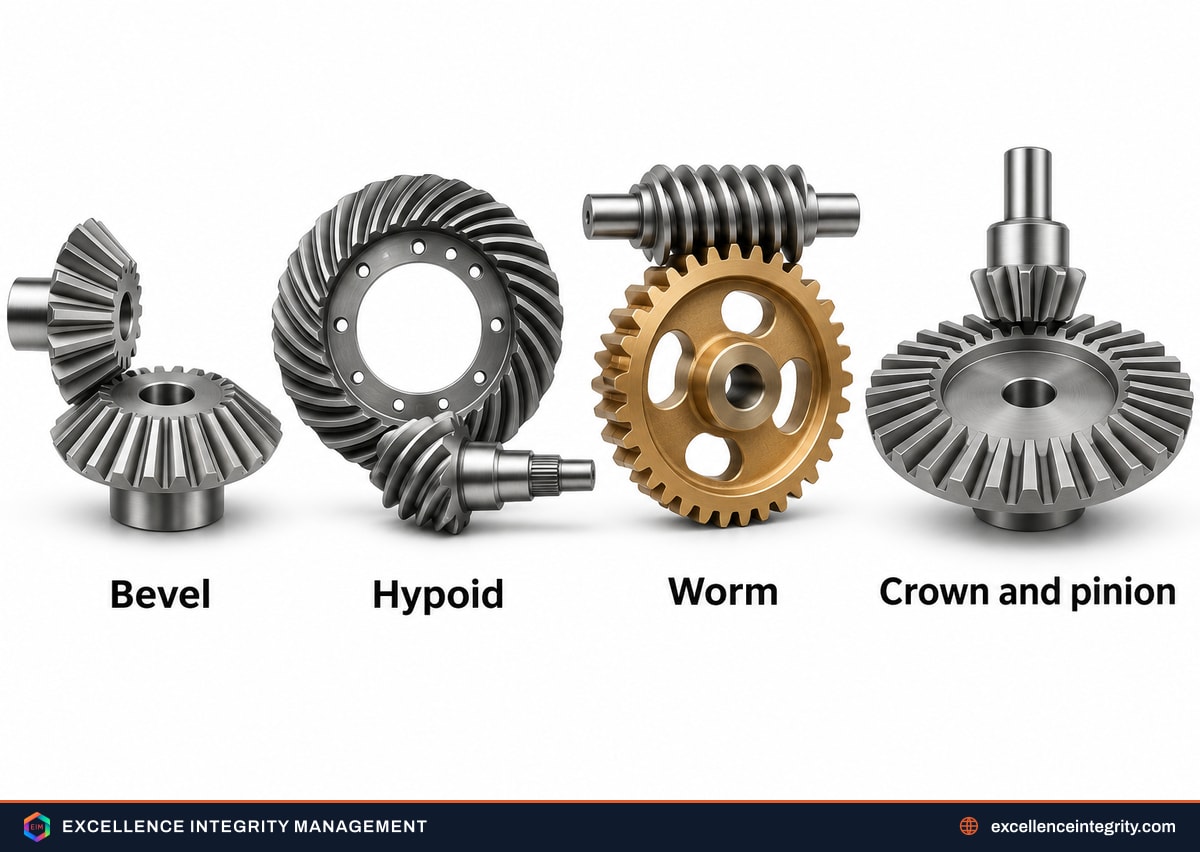
Cone-shaped gears that connect shafts which intersect, usually at 90 degrees. They turn a drive through a right angle in machine tools, industrial drives and many gearboxes. Bevel gears are sensitive to their mounting position: if either gear sits slightly too far in or out, the tooth contact moves toward the toe or heel of the tooth and wears it early. Contact pattern checks after assembly are standard practice.
6. Hypoid gears
Similar in look to spiral bevel gears, but the pinion axis is offset from the gear axis, so the shafts do not intersect. This allows a larger, stronger pinion and is why hypoid gears are used in automotive differentials. The offset produces much more sliding between the teeth than a bevel gear, so hypoid gears need a hypoid-grade lubricant with extreme-pressure additives. Using an ordinary gear oil in a hypoid set is a classic cause of scuffing and rapid wear.
7. Worm gears
A screw-like worm drives a wheel at right angles to it. Worm gears give a high speed reduction in one stage and run smoothly and quietly, which is why lifts, conveyors and many slow drives use them. Some designs resist being driven backward. The contact is almost entirely sliding, so worm gears run warm and depend on the correct lubricant and good cooling. Rising oil temperature and bronze particles in the oil are the early warnings.
8. Crown gear and pinion
A crown gear has its teeth at right angles to its face, like a crown, meshing with a pinion to give a right-angle drive. Crown gears are used in lighter right-angle drives and some instruments. The pinion's axial position needs care for correct contact.
Gears that change the type of motion or pack in torque
9. Rack and pinion
A round pinion meshes with a straight toothed bar, the rack, turning rotary motion into straight-line motion or the reverse. Steering systems, machine slides and automation equipment use it. Wear tends to concentrate on the most-used length of the rack, and dirt on an exposed rack is the main enemy, so cleaning, lubrication and guarding come first.
10. Planetary gears
A central sun gear drives several planet gears that run inside an internal ring gear, with the planets mounted on a carrier. Because the load is shared between several planets, a planetary set delivers high torque in a compact size. You find them in automotive transmissions, robotics, aerospace drives and industrial gearboxes. They are harder to inspect without dismantling, so vibration monitoring and oil analysis are especially valuable, and the planet bearings are a common weak point.
Quick reference: types of gears compared
| Gear type | Shaft arrangement | Where you find it | Watch for |
|---|---|---|---|
| Spur | Parallel | General drives | Noise at speed, pitting |
| Helical | Parallel | Higher-speed gearboxes | Thrust bearing condition |
| Herringbone | Parallel | Heavy and marine drives | Uneven wear across the V |
| Internal | Parallel, compact | Planetary rings | Hard to see; use oil and vibration |
| Bevel | Intersecting | Right-angle drives | Contact pattern, mounting distance |
| Hypoid | Offset | Vehicle differentials | Correct hypoid lubricant |
| Worm | Right angle, offset | Lifts, conveyors | Heat, bronze wear particles |
| Crown and pinion | Right angle | Light right-angle drives | Pinion position |
| Rack and pinion | Rotary to linear | Steering, slides | Dirt, local rack wear |
| Planetary | Coaxial | Compact high-torque gearboxes | Planet bearings |
Reading gear wear patterns during an inspection
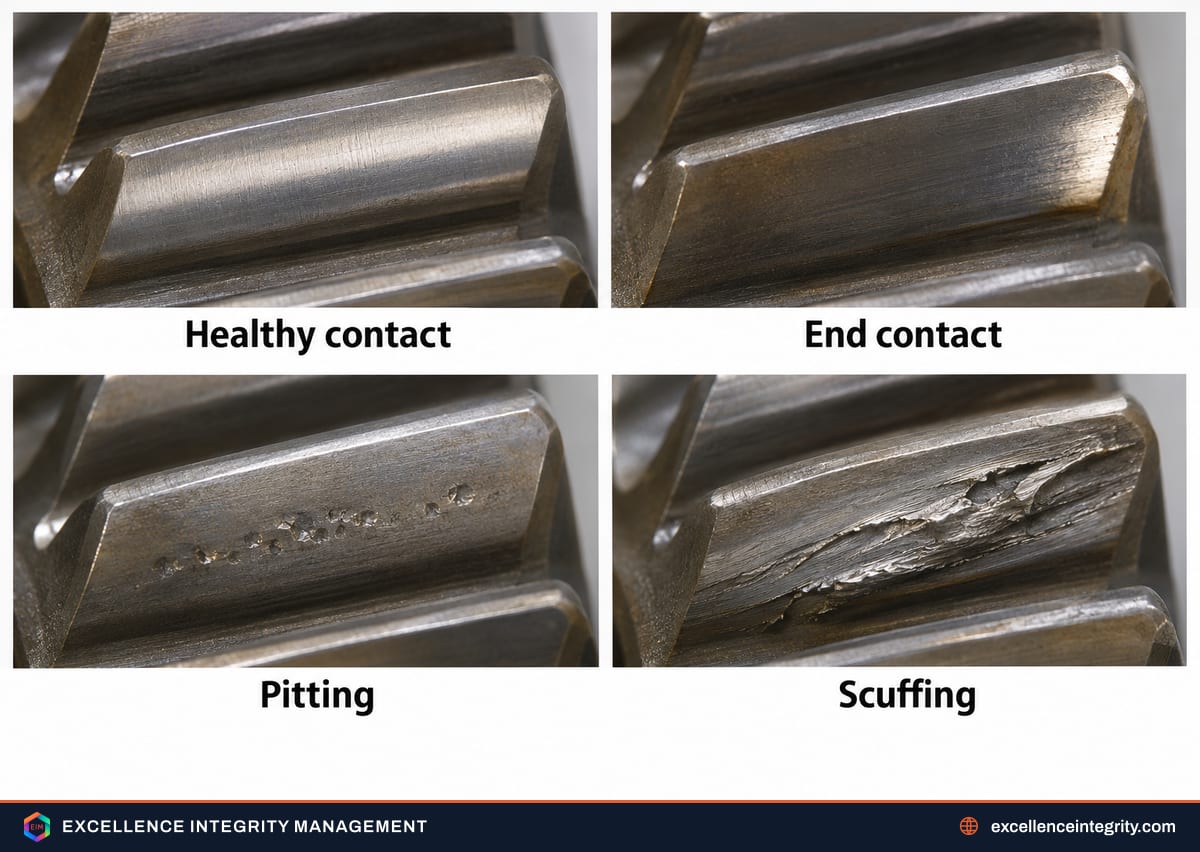
When you open an inspection cover, the tooth flanks tell you most of what you need to know:
- Even, polished contact across most of the face means a healthy, well-aligned set.
- Contact at one end of the tooth points to misalignment, a bearing problem or shaft deflection.
- Small pits near the pitch line are surface fatigue. Light early pitting can stabilise; spreading pits mean the load or lubrication needs attention.
- Scuffing or scoring, a torn, dragged look, means the lubricant film broke down, from the wrong oil, too little oil or overheating.
- A broken tooth usually points to overload, shock or a fatigue crack at the root; examine the fracture surface before fitting new gears.
Between inspections, oil analysis tracks wear metals and contamination, and vibration analysis picks up gear mesh problems and bearing defects. Both catch trouble that a visual check would only find much later.
Why gears matter in maintenance
Gears set the speed and torque of a large share of plant machinery, and a gearbox failure usually stops the whole train. Most of those failures are preventable with correct lubrication, sound alignment, the right backlash and early detection. The maintenance work is not exotic; it is doing the basics consistently and reading the evidence when something changes.
Frequently asked questions
What is the most common type of gear?
Spur gears are the simplest and most common type. Their straight teeth are cut parallel to the shaft, and they are used wherever two parallel shafts need a fixed speed ratio. They produce no axial thrust, which keeps the bearings simple, but they get noisier than helical gears as speed rises.
What is the difference between spur and helical gears?
Spur gear teeth are straight and engage along their full width at once, so they are noisier at speed. Helical gear teeth are cut at an angle and engage gradually, so they run smoother and quieter and handle higher speeds. The angle creates axial thrust, which the bearings of a helical gearbox must carry.
Why do worm gears get hot?
The contact between the worm and the wheel is almost entirely sliding, so worm gears run warm by nature and depend on the correct lubricant and good cooling. Rising oil temperature and bronze particles in the oil are the early warnings that the set is wearing and needs attention.
What causes pitting on gear teeth?
Small pits near the pitch line are surface fatigue. Light early pitting can stabilise, but spreading pits mean the load or the lubrication needs attention. Oil analysis and vibration readings between inspections help you see whether the damage is growing before a tooth breaks.
Where to go from here
Gearboxes connect to the rest of the drive through couplings and sit on bearings and seals, so gear problems often show up in those parts first. The rotating equipment maintenance and troubleshooting course covers gearbox inspection and failure analysis hands-on, and rotating equipment maintenance in oil and gas gives the wider picture. For shaft fixing to gears and hubs, see types of shaft keys. Engineers moving into reliability roles can take this further with the SMRP CMRP exam preparation.
Exam preparation
Preparing for SMRP CMRP?
Practise with exam-style questions, timed mocks and study notes. 1,448 questions in the bank.