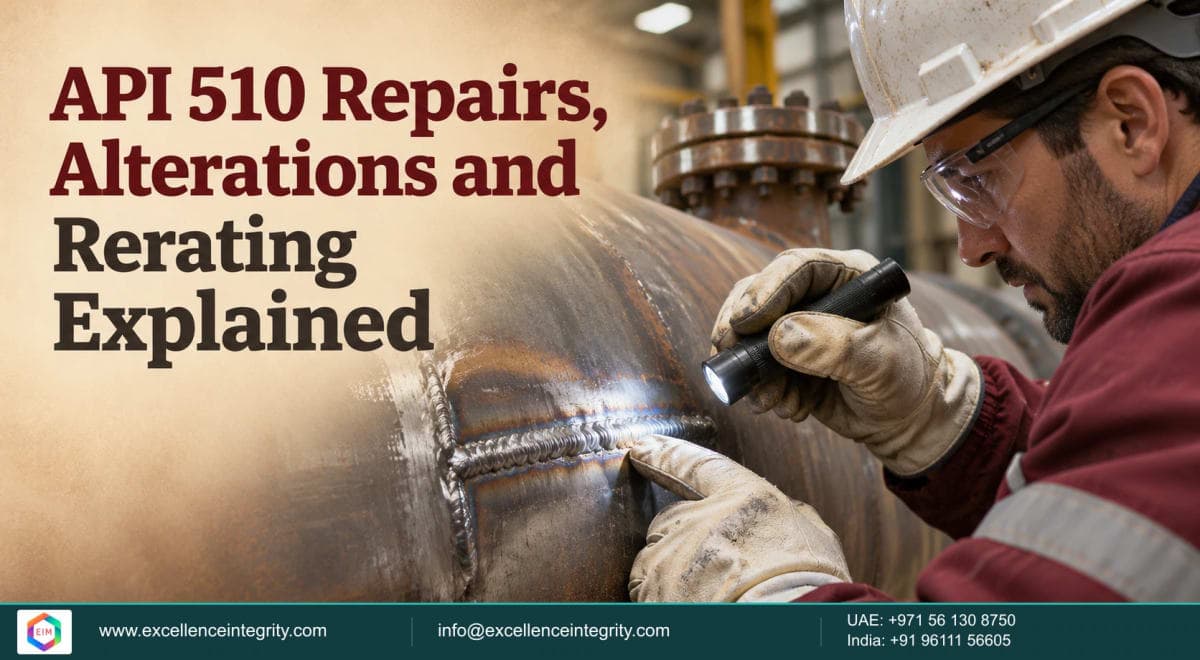
API 510 Repairs, Alterations and Rerating Explained
How API 510 treats repairs, alterations and rerating of pressure vessels: definitions, authorisation, welding and PWHT alternatives, testing and records.
By Syed Hasan22 Nov 20262 min read
Part 4 of our API 510 cluster covers what happens when inspection finds a problem. Whether the work is called a repair, an alteration or a rerating decides who must approve it, what engineering is needed, and what testing follows. Getting the label right is the first step.
Short answer: A repair restores a vessel to a safe condition at its existing design. An alteration is a physical change with design implications for pressure-containing capability. A rerating changes the MAWP, design temperature or MDMT. All repair and alteration work is authorised by the inspector before it starts, alterations need engineering review, welding follows qualified procedures (with approved alternatives to PWHT in some cases), the work is examined and tested, and records and the nameplate are updated.
Three labels
The workflow
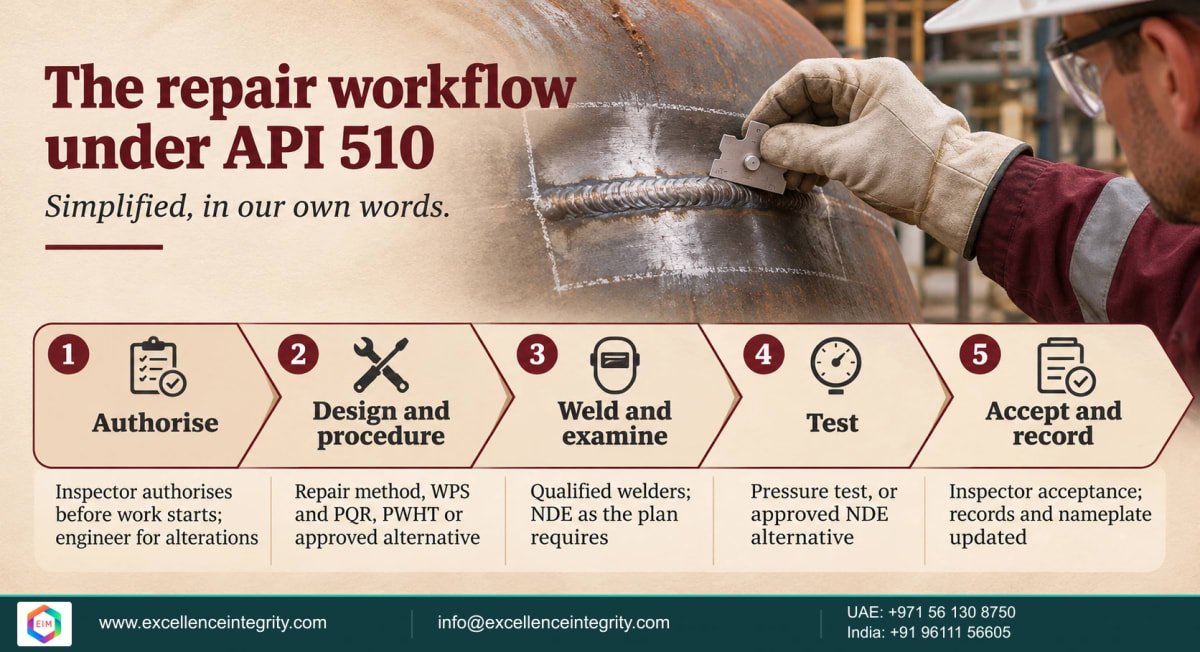
Welding and PWHT
- Qualified procedures and welders to ASME Section IX; see our WPS and PQR review.
- PWHT as required by the construction code, or approved alternatives such as preheat or controlled-deposition (temper bead) welding where the code and an engineer allow.
- Material compatibility and toughness for the new parts.
- Hydrogen service: consider bake-out before welding; see hydrogen embrittlement.
Rerating
- Calculations by the manufacturer or an engineer show the vessel suits the new conditions.
- Inspection confirms the current condition supports the rerating.
- Testing, by pressure test or an approved alternative.
- Documentation: records updated and an additional nameplate or stamping showing the new rating.
Temporary repairs
Temporary repairs, such as some fillet-welded patches or clamps, may be allowed with engineering assessment and a plan for permanent repair at a suitable opportunity. They must be documented and tracked so they do not quietly become permanent.
Learn more with EIM
EIM is an independent training provider; API certifies pressure vessel inspectors. Our API 510 exam page explains the certification, eligibility, exam day and codebooks; read API exam day, hour by hour before you sit. The EIM Calculator includes MAWP, retirement thickness, corrosion rate and remaining life tools. For operators, EIM's inspection services include in-service inspection and turnaround support.
Frequently asked questions
What is the difference between a repair and an alteration?
A repair restores the vessel to a safe condition at its existing design. An alteration changes the vessel in a way that has design implications for its pressure-containing capability.
What is a rerating?
A change to the MAWP, design temperature or MDMT of a vessel, supported by calculations, inspection, testing and documentation.
Who authorises repairs under API 510?
The inspector authorises repair and alteration work before it starts; alterations also need engineering review.
Can PWHT be avoided?
In some cases, approved alternatives such as preheat or controlled-deposition welding can be used with engineering approval.
Is a pressure test required after a repair?
At the inspector's discretion; it is normally required after an alteration.
Sources
- API 510, Pressure Vessel Inspection Code (repairs, alterations and rerating). Summarised, not quoted.
- ASME Section IX (welding qualifications). Cited, not quoted.
- Checked 7 October 2026.
Exam preparation
Preparing for API 510?
Practise with exam-style questions, timed mocks and study notes. 2,549 questions in the bank.