WPS and PQR Review: A Welding Inspector's Checklist
What a WPS, PQR and welder qualification are, how they connect under ASME IX and ISO, essential variables explained, and an eight-point review checklist.
By Syed Hasan16 Nov 20265 min read
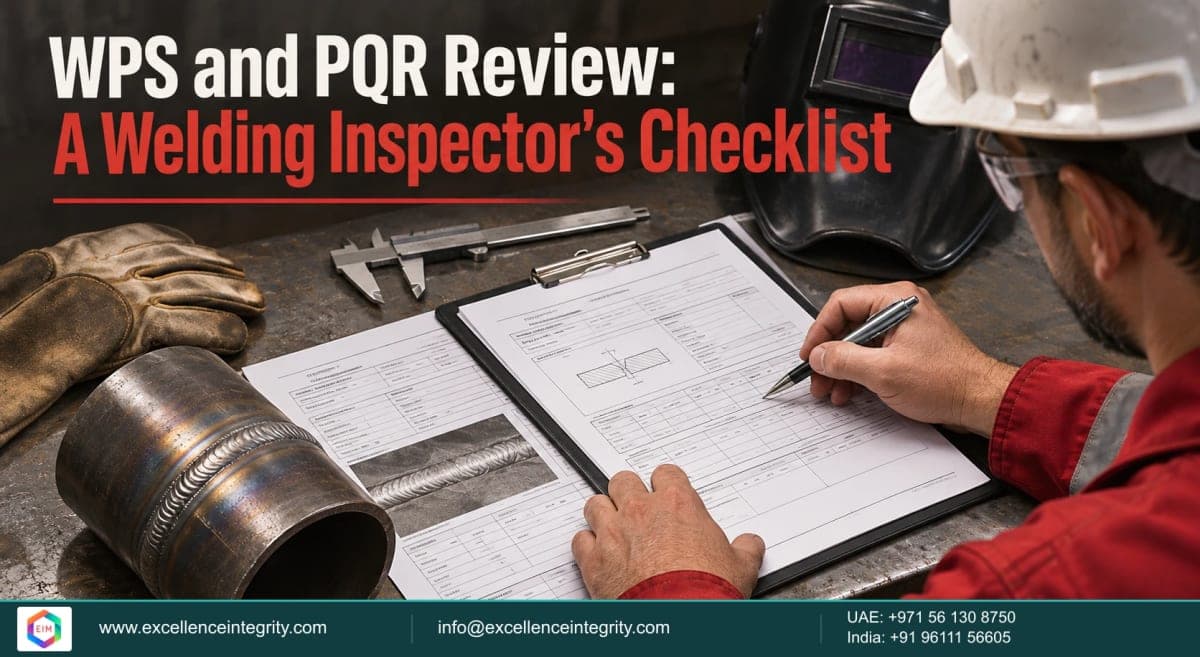
Before a single production weld is made on a pressure vessel or a process pipeline, three documents should already be in place: a welding procedure specification, the qualification record that proves it works, and evidence that each welder is qualified to use it. Reviewing them is one of the welding inspector's most important jobs, and a whole paper of the CSWIP 3.1 exam is devoted to it. Getting it wrong means welds made to a procedure that was never proven.
Short answer: The PQR is the record of a test weld and its results. The WPS is the instruction to the welder, with ranges of variables supported by one or more PQRs. The welder's qualification proves that person can make a sound weld within the qualified ranges. Review checks that the job falls inside what the PQR qualifies, and that the welder is qualified for it.
How the three documents fit
- PQR (procedure qualification record): what was actually done on a test coupon: material, thickness, process, filler, preheat, heat input, PWHT and the test results (tensile, bend, and impact or hardness where required). It is a record of fact and is not edited afterwards.
- WPS (welding procedure specification): the instruction for production welding. It gives ranges for each variable, and every range must be supported by the PQRs it references.
- WPQ (welder performance qualification): proof that an individual welder has made an acceptable test weld, qualifying them for a range of positions, thicknesses, processes and other variables.
Essential, supplementary essential and nonessential variables
ASME Section IX sorts welding variables into categories, and the category decides what happens when a variable changes:
- Essential variables affect the mechanical properties of the weld. Changing one beyond the qualified range requires a new PQR. Examples include base metal grouping (P-number), filler metal grouping (F-number), the welding process, and certain thickness and PWHT changes.
- Supplementary essential variables become essential when notch toughness (impact testing) is required. Heat input is a typical example.
- Nonessential variables can be changed by revising the WPS without requalification, such as some joint design details.
ISO 15614 uses a similar idea through its ranges of qualification. In both systems, the qualified ranges are set out in tables in the code; always work from those tables, not from memory.
The review checklist

- Base metal. Do the material groupings and thicknesses on the job fall within the PQR's qualified ranges?
- Process. Is every welding process on the WPS qualified on a supporting PQR?
- Filler metal. Do the filler groupings or classifications match, and is the deposited weld metal thickness covered?
- Preheat and PWHT. Are preheat, interpass temperature and PWHT consistent with the PQR and the service?
- Impact and heat input. If toughness is required, was impact testing done on the PQR, and is heat input controlled on the WPS?
- Service extras. Are there hardness limits for sour or caustic service, or client specification requirements beyond the code?
- Test results. Do the PQR's test results meet the acceptance criteria?
- Signatures and revision. Is the WPS current and approved, and does it reference the correct PQRs?
Then check the welders: each welder's qualification must cover the process, position, thickness and other variables of the work they will do, and must be current under the code's continuity rules.
Common review mistakes
- Accepting a WPS without reading its PQRs. The WPS is only as good as the qualification behind it.
- Missing toughness requirements. Where impact testing is required, supplementary essential variables such as heat input matter.
- Ignoring service requirements. A code-compliant WPS can still be unsuitable for sour, amine or caustic service without hardness control or PWHT.
- Lapsed welder qualifications, or welders working outside their qualified positions or thicknesses.
- Repairs welded to the wrong procedure, or without a qualified repair procedure.
Learn more with EIM
EIM is an independent training provider. Reviewing welding procedures and welder certificates is examined directly in CSWIP 3.1, whose second theory paper covers them; EIM's self-paced preparation for CSWIP 3.0, 3.1 and 3.2 includes a question bank, practice mode with explanations, timed mock tests, study notes and flashcards, with one year of access. Choosing your route? Read CSWIP 3.0 or 3.1 first and CSWIP 3.1 vs AWS CWI.
EIM's live Welding Repair and Inspection course with Mr. Deepak Rawtal covers welding quality, defects and their causes, inspection and repair techniques; check the course page for the next batch. Our API 577 exam page explains API's welding inspection and metallurgy certification.
Frequently asked questions
What is the difference between a WPS and a PQR?
The PQR records what was actually done on a qualification test weld and its test results. The WPS is the production instruction, with ranges of variables that must be supported by one or more PQRs.
What is an essential variable?
A variable that affects the mechanical properties of the weld. Under ASME Section IX, changing it beyond the qualified range requires a new procedure qualification.
When do supplementary essential variables apply?
When notch toughness (impact testing) is required. They then act like essential variables.
Can one PQR support several WPSs?
Yes, and one WPS can be supported by several PQRs, as long as every range on the WPS is covered.
What are the ISO equivalents?
ISO 15609 for welding procedure specifications, ISO 15614 for procedure qualification (WPQR), and ISO 9606 for welder qualification.
Sources
- ASME Boiler and Pressure Vessel Code, Section IX, Welding, Brazing, and Fusing Qualifications. Concepts summarised, not quoted.
- ISO 15609, ISO 15614 and ISO 9606. Cited by number.
- TWI Certification: CSWIP-WI-6-92 (CSWIP 3.1 examination content)
- Checked 7 October 2026.
Exam preparation
Preparing for API 577?
Practise with exam-style questions, timed mocks and study notes. 1,547 questions in the bank.
Also relevant: CSWIP 3.1 Welding Inspector