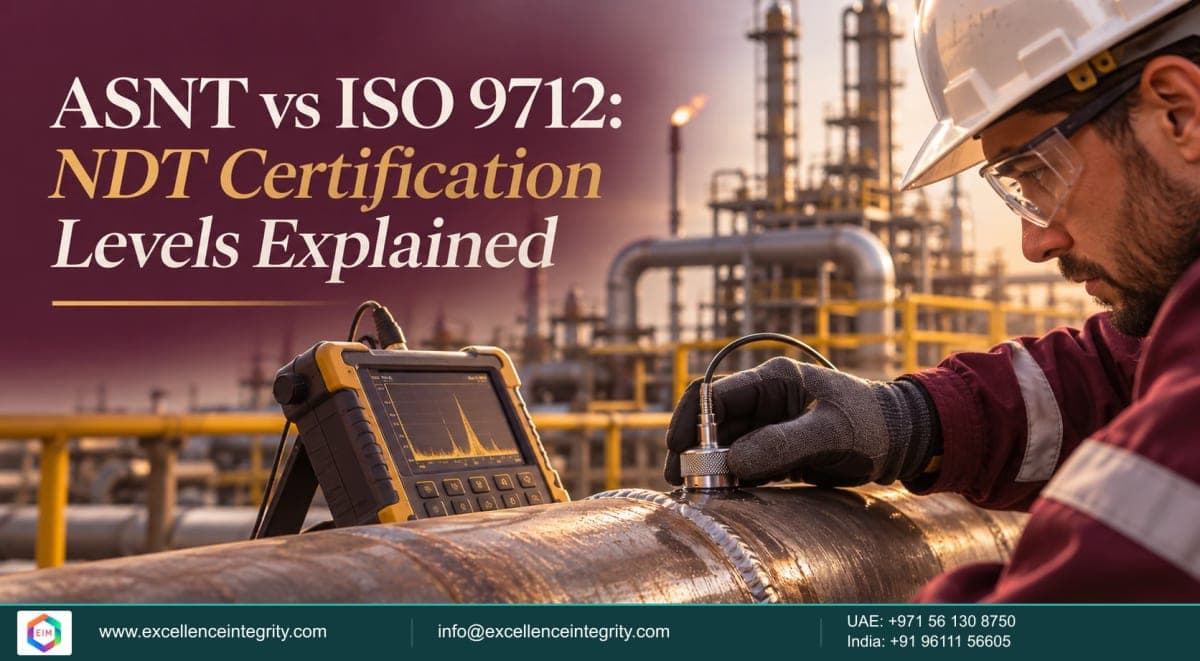
ASNT vs ISO 9712: NDT Certification Levels Explained
SNT-TC-1A, CP-189, ISO 9712 and PCN explained: employer-based vs central NDT certification, what Level 1, 2 and 3 can do, and which one Gulf jobs ask for.
By Syed Hasan15 Nov 20264 min read
"ASNT Level II UT", "PCN Level 2", "ISO 9712 Level 2": NDT job adverts in the Gulf and India use all of these, sometimes in the same line. They are not interchangeable labels for one thing. They come from two different certification systems, which differ in who certifies you, who owns the certificate, and whether it moves with you when you change jobs.
Short answer: Under employer-based schemes such as ASNT's SNT-TC-1A, your employer certifies you under its own written practice, and the certificate usually stays with that employer. Under central schemes such as ISO 9712 (applied by bodies like PCN), an independent body certifies you and the certificate is yours. Both use three levels, and certification is always per method, such as UT or RT.
Two systems
Employer-based: SNT-TC-1A and CP-189
SNT-TC-1A is ASNT's recommended practice for employers. It is a set of guidelines, not a mandatory standard: each employer writes a written practice setting out training, experience and examination requirements, approved by a Level III, and certifies its own people against it. Because the employer certifies, the certification generally lapses when you leave.
ANSI/ASNT CP-189 is a related standard that sets minimum requirements rather than recommendations. When a contract or code calls for it, the employer's written practice must meet or exceed its minimums.
Central: ISO 9712 and schemes like PCN
ISO 9712 sets out a system in which an independent certification body examines and certifies NDT personnel. The certificate belongs to the holder and is portable between employers. The UK's PCN scheme, run by BINDT, is a well-known example, certifying to BS EN ISO 9712:2022. ASNT itself also runs central programmes: an ISO 9712-based programme under CP-106, its earlier ASNT Central Certification Program (ACCP), and the ASNT NDT Level III certificate.
Even with a central certificate, the employer still authorises you to work under its own procedures.
What Level 1, 2 and 3 can do

- Level 1 carries out tests to written instructions, under the supervision of a Level 2 or 3, and records results.
- Level 2 sets up and calibrates equipment, performs and interprets tests against codes and specifications, writes instructions for Level 1, and reports results. Most field inspection roles ask for Level 2.
- Level 3 establishes techniques and procedures, interprets codes and standards, selects the method for a job, and is often responsible for examining and supervising others.
Crucially, certification is per method: UT, RT, MT, PT, ET, VT and others. "UT Level 2" says nothing about RT. Central schemes also certify per industry or product sector, such as welds or castings.
Recertification
Both systems require periodic recertification. Under SNT-TC-1A, intervals are set in the written practice and are typically not more than five years. Central schemes such as ISO 9712 also work on a five-year validity with renewal and, at set points, re-examination. Keep evidence of continued work in the method; it is usually required.
Which one do Gulf jobs ask for?
Both appear. Contractors working to US codes often run SNT-TC-1A written practices and ask for "ASNT Level II". Projects specified to ISO or EN standards often ask for ISO 9712 or PCN certification. Some specifications accept either. As with every certification choice, the reliable answer comes from reading current job adverts and client specifications in your target market.
- Write it precisely on your CV: method, level, scheme, certificate number and expiry, for example "UT Level 2, ISO 9712 (PCN), welds sector, cert. no. 000000, valid to 05/2029".
- Don't write "ASNT certified" if your certification is employer-based under SNT-TC-1A. It is certification by your employer to an ASNT recommended practice, not an ASNT certificate.
- Advanced methods such as phased array and TOFD usually need their own certification on top of conventional UT.
Where EIM can help
EIM is an independent training provider and does not certify NDT personnel. For CVs that state NDT credentials clearly, EIM's Career Navigator rebuilds inspection professionals' CVs and LinkedIn profiles; see also The Inspector's CV. For operators, EIM's inspection services include NDT surveillance.
Frequently asked questions
Is ASNT Level II the same as ISO 9712 Level 2?
Not necessarily. ASNT Level II under SNT-TC-1A is usually employer-based certification under a written practice. ISO 9712 Level 2 is central certification by an independent body. The levels describe similar responsibilities, but the systems differ.
Does my SNT-TC-1A certification transfer to a new employer?
Generally not automatically. Because the employer certifies you, a new employer must certify you under its own written practice, though it may take your previous training and experience into account.
What is PCN?
The Personnel Certification in Non-Destructive Testing scheme run by BINDT in the UK, a central certification scheme compliant with ISO 9712.
Is certification per method?
Yes. You are certified separately for each method, such as UT, RT, MT or PT, and in central schemes also for an industry or product sector.
How often do NDT certificates need renewing?
Typically at intervals of no more than five years, with requirements set by the written practice or the certification body.
Sources
Free mock tests
Preparing for an API, AMPP (NACE), CSWIP or CMRP exam?
Choose your certification and try a free mock test.
SMRP