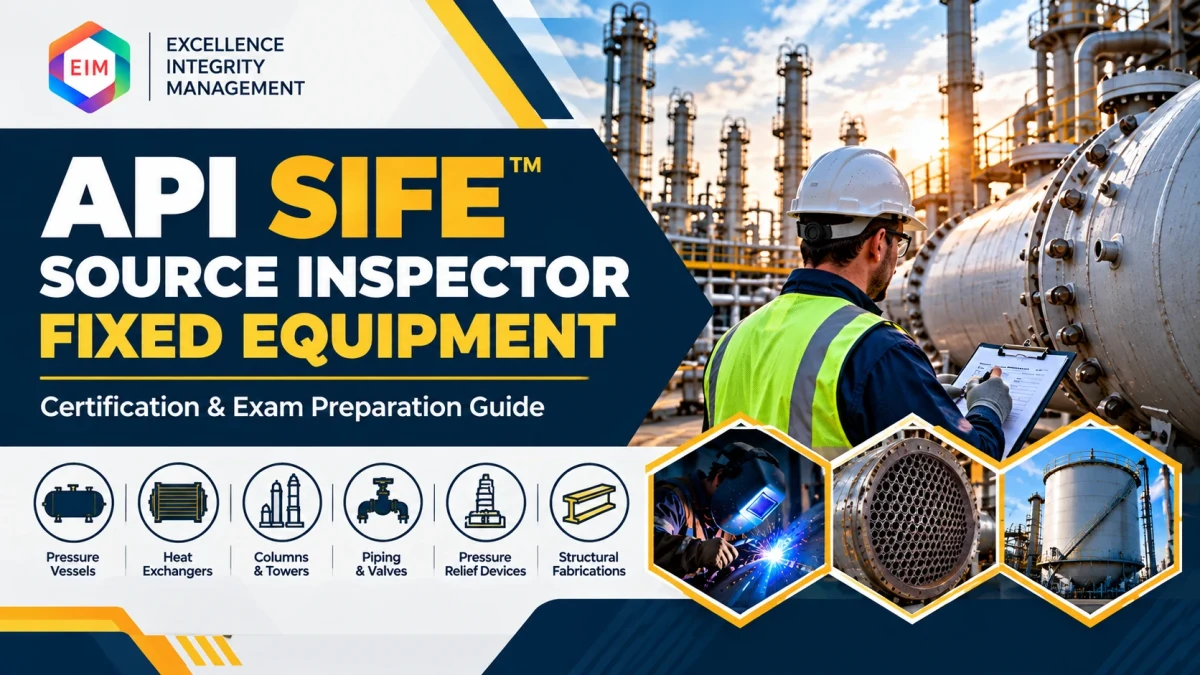
API SIFE™ Source Inspector Fixed Equipment: Complete Guide to Certification & Exam Preparation
API SIFE™ – Source Inspector Fixed Equipment is a professional certification focused on source inspection and quality surveillance of fixed equipment used in the oil, gas, and petrochemical industries.
Source Inspectors play an important role in verifying that equipment and materials supplied by manufacturers and vendors meet the applicable project, purchase, quality, inspection, and contractual requirements.
API states that the Source Inspector's responsibilities include examining fabricated and manufactured equipment and materials at a supplier's facility and confirming that the supplier's quality management system is being effectively implemented.
For fixed equipment, the API SIFE certification focuses primarily on pressure-containing and structural equipment such as vessels, columns, towers, heat exchangers, piping, valves, pressure relief devices, tubulars, and associated structural fabrications.
What Is API SIFE™?
API SIFE™ stands for API Source Inspector Fixed Equipment.
The certification is part of the American Petroleum Institute's Source Inspector certification programs. It is intended for professionals involved in quality surveillance of equipment and materials at supplier or vendor facilities.
The focus of SIFE is different from an in-service equipment inspection certification. A source inspector is primarily concerned with verifying equipment and fabrication quality during manufacturing, fabrication, testing, and other stages of the supply process.
The objective is to provide confidence that the supplied equipment meets the specified project and contractual requirements before it is accepted and delivered.
What Does an API SIFE Source Inspector Do?
A Source Inspector acts on behalf of the purchaser or end user to perform quality surveillance at the supplier's facility.
Typical responsibilities may include:
- Reviewing supplier documentation
- Monitoring manufacturing and fabrication activities
- Verifying compliance with project specifications
- Reviewing Inspection and Test Plans (ITPs)
- Witnessing required inspections and tests
- Reviewing material certificates
- Monitoring welding activities
- Reviewing NDT documentation
- Verifying dimensional inspection
- Witnessing pressure or functional tests where applicable
- Reviewing final documentation
- Reporting inspection findings to the purchaser
The source inspector does not replace the manufacturer's quality management system. Instead, the inspector provides independent surveillance to verify that the required quality activities have been properly performed.
What Equipment Does API SIFE Cover?
API SIFE primarily focuses on fixed equipment and associated structural fabrications.
The scope includes equipment such as:
1. Pressure Vessels
Pressure vessels are used to contain fluids under pressure and are widely used throughout refineries, petrochemical facilities, gas processing plants, and other industrial facilities.
Source inspection activities can involve reviewing:
- Material requirements
- Fabrication activities
- Welding
- NDT
- Dimensional inspection
- Pressure testing
- Documentation
2. Columns and Towers
Columns and towers are commonly used for separation, fractionation, absorption, stripping, and other process operations.
Inspection may involve verification of materials, fabrication, weld quality, dimensions, internals, nozzles, supports, and applicable testing.
3. Heat Exchangers
Heat exchangers transfer heat between process streams and require careful control of materials, fabrication, tube quality, welding, testing, and documentation.
4. Piping
Source inspection of piping can include examination of pipe materials, fittings, flanges, welds, dimensions, material identification, NDT, and testing requirements.
5. Valves
Valves are critical components of process systems. Source inspection may include material verification, dimensional checks, visual examination, pressure testing, functional testing, and review of inspection records.
6. Pressure Relief Devices
Pressure relief devices are important safety components designed to protect equipment against excessive pressure.
Source inspection may involve verification of materials, manufacturing requirements, testing, calibration documentation, and certification records.
7. Tubulars and Structural Fabrications
SIFE also covers tubular products and associated structural fabrications where applicable to the source inspection scope.
Source Inspection vs. In-Service Inspection
It is important to understand the difference between source inspection and in-service inspection.
| Source Inspection | In-Service Inspection |
|---|---|
| Performed during manufacturing and supply | Performed after equipment enters service |
| Focuses on supplier/vendor quality | Focuses on operating equipment condition |
| Verifies fabrication and testing activities | Evaluates deterioration and integrity |
| Reviews manufacturing documentation | Reviews inspection history and operating condition |
| Supports purchaser acceptance | Supports continued safe operation |
Both functions are important, but they address different stages of an equipment's lifecycle.
Why Is Source Inspection Important?
Equipment quality problems identified after delivery or installation can be expensive and difficult to correct.
Effective source inspection can help identify quality issues earlier in the supply chain.
Source inspection can help verify:
- Correct material selection
- Proper fabrication procedures
- Welding compliance
- Required NDT completion
- Dimensional accuracy
- Testing requirements
- Documentation completeness
- Traceability
- Compliance with project specifications
Early identification of non-conformities can reduce the possibility of costly rework, delays, rejected equipment, or problems after installation.
API SIFE Exam Structure
According to API's current SIFE certification information, the examination is 3.25 hours long and contains 110 multiple-choice questions.
Of these questions:
- 100 questions are scored
- 10 questions are pretest questions
The examination is closed-book, meaning candidates cannot bring paper references or reference materials into the examination.
API also states that the exam can currently be scheduled at in-person test centers or through remote proctoring.
The certification has a three-year term.
Exam structure and certification requirements can change, so candidates should always verify the latest information directly with API before applying.
What Does the API SIFE Exam Test?
The SIFE examination tests core knowledge required for source inspection of fixed equipment.
API indicates that the exam focuses on:
- Relevant codes and standards
- Inspection reference documents
- Source inspection practices
- Manufacturing processes
- Inspection tools and methods
The emphasis is on source inspection activities and issues rather than on detailed design or engineering calculations contained within the referenced standards.
Current API SIFE Reference Publications
For the November 2025 – July 2027 examination period, API's Publications Effectivity Sheet identifies the applicable editions of the reference documents.
API Publications
- API RP 588 – Recommended Practice for Source Inspection and Quality Surveillance of Fixed Equipment
- API RP 572 – Inspection of Pressure Vessels, Sections 3 and 4
- API RP 577 – Welding Inspection and Metallurgy
- API RP 578 – Material Verification Program for Alloy Piping Systems
- API 598 – Valve Inspection and Testing
American Welding Society
- AWS D1.1 – Structural Welding Code – Steel
ASNT
- ASNT SNT-TC-1A – Personnel Qualification and Certification in Nondestructive Testing Personnel
ASME Boiler and Pressure Vessel Code
- ASME Section II – Materials
- ASME Section V – Nondestructive Examination
- ASME Section VIII – Rules for Construction of Pressure Vessels
- ASME Section IX – Welding and Brazing Qualifications
- ASME B31.3 – Process Piping
- ASME B16.5 – Pipe Flanges and Flanged Fittings
The specific sections and editions applicable to the examination are defined by API's current Publications Effectivity Sheet. Candidates should use the effectivity sheet corresponding to their exam period.
Important Topics to Study for API SIFE
A structured preparation plan should cover the major areas tested by the examination.
1. Source Inspection Fundamentals
Understand the role and responsibilities of a source inspector, supplier quality surveillance, inspection planning, inspection notifications, hold points, witness points, and documentation.
2. Inspection and Test Plans
Learn how Inspection and Test Plans are used to define inspection activities, acceptance criteria, responsibilities, hold points, witness points, and documentation requirements.
3. Material Verification
Material identification and traceability are important aspects of source inspection.
Study topics such as:
- Material certificates
- Heat numbers
- Material traceability
- Positive Material Identification (PMI)
- Alloy verification
- Material identification records
4. Welding Inspection
Welding is a major component of fixed-equipment fabrication.
Important topics include:
- Welding procedures
- Welder qualifications
- WPS and PQR
- Welding variables
- Preheat
- Interpass temperature
- Post-weld heat treatment
- Weld visual examination
- Weld acceptance criteria
5. Non-Destructive Examination
Source inspectors need to understand the purpose and application of common NDT methods.
- Visual Testing (VT)
- Ultrasonic Testing (UT)
- Radiographic Testing (RT)
- Magnetic Particle Testing (MT)
- Liquid Penetrant Testing (PT)
The inspector should understand the applicable procedure, examination requirements, documentation, and acceptance criteria.
6. Pressure Vessel Inspection
Study the relevant portions of API RP 572 and ASME Section VIII.
Important areas include:
- Pressure vessel components
- Materials
- Fabrication
- Welding
- NDT
- Dimensional requirements
- Pressure testing
- Documentation
7. Valve Inspection and Testing
API 598 is an important reference for valve inspection and testing.
Study areas such as:
- Visual examination
- Pressure testing
- Shell testing
- Seat testing
- Test procedures
- Acceptance requirements
8. Piping and Flanges
Understand the basic requirements associated with process piping, fittings, flanges, materials, dimensions, welding, testing, and inspection.
How to Prepare for API SIFE
Successful preparation requires more than reading standards from beginning to end.
A structured approach can make preparation more efficient.
Step 1 – Understand the Exam Scope
Start with the latest API SIFE Body of Knowledge and Publications Effectivity Sheet.
These documents define the subjects and reference publications relevant to the examination.
Step 2 – Study API RP 588 First
API RP 588 is directly related to source inspection and quality surveillance of fixed equipment.
Build a strong understanding of the source inspection process before moving deeply into the supporting standards.
Step 3 – Build Welding Knowledge
Welding represents an important part of fixed-equipment fabrication.
Focus on WPS, PQR, welder qualification, welding variables, NDT, PWHT, and inspection requirements.
Step 4 – Study Materials and PMI
Understand material certificates, traceability, material identification, alloy verification, and PMI concepts.
Step 5 – Study NDT Fundamentals
Understand the purpose, limitations, procedures, and documentation associated with common NDT methods.
Step 6 – Practice Questions
Practice questions can help candidates become familiar with technical terminology and improve their ability to interpret inspection scenarios.
However, practice questions should supplement—not replace—the applicable API, ASME, AWS, and ASNT reference materials.
Step 7 – Review Mistakes
Keep a record of incorrect answers and identify the reason for each mistake.
For example:
- Concept not understood
- Standard requirement forgotten
- Question misread
- Terminology confusion
- Incorrect interpretation
API SIFE Study Strategy
A practical preparation cycle can be organized as:
Learn → Understand → Apply → Practice → Review
Instead of memorizing isolated requirements, candidates should try to understand how source inspection activities fit into the manufacturing and quality-control process.
Common Areas Where Candidates Need Strong Understanding
- Inspection and Test Plans
- Hold points and witness points
- Material traceability
- Welding documentation
- WPS and PQR
- Welder qualification
- NDT methods
- Pressure testing
- Dimensional inspection
- Valve testing
- Quality documentation
- Non-conformance reporting
- Supplier quality surveillance
API SIFE Certification and Professional Development
Source inspection is an important function within the industrial supply chain.
Professionals with knowledge of source inspection can work with equipment manufacturers, EPC contractors, inspection companies, purchasers, and end-user organizations depending on their experience and role.
SIFE knowledge can be particularly relevant to professionals involved in:
- Vendor inspection
- Supplier quality
- Quality assurance and quality control
- Mechanical inspection
- Equipment fabrication
- Project quality
- Oil and gas projects
- Petrochemical projects
- Refinery projects
- Engineering, Procurement and Construction (EPC)
API SIFE vs API 510, API 570 and API 653
| Certification | Primary Focus |
|---|---|
| API SIFE | Source inspection of fixed equipment |
| API 510 | In-service pressure vessel inspection |
| API 570 | In-service piping inspection |
| API 653 | Aboveground storage tank inspection |
These certifications address different inspection functions and equipment or lifecycle stages. The appropriate certification depends on the professional's responsibilities and career direction.
Why API SIFE Matters in Industrial Projects
Large oil and gas and petrochemical projects involve the manufacture and supply of significant quantities of equipment from specialized vendors around the world.
Source inspection provides a structured mechanism for monitoring critical quality activities before equipment reaches the project site.
This can help support:
- Equipment quality
- Specification compliance
- Material traceability
- Fabrication quality
- Testing compliance
- Documentation quality
- Supplier accountability
- Project schedule control
Final Thoughts
API SIFE™ – Source Inspector Fixed Equipment focuses on an important part of the industrial equipment supply chain: verifying quality at the source.
For professionals working with fixed equipment, supplier quality, vendor inspection, fabrication, QA/QC, and oil & gas projects, understanding source inspection principles can provide valuable technical knowledge.
Preparation should be based on the current API Body of Knowledge and Publications Effectivity Sheet, supported by a strong understanding of source inspection practices, welding, materials, NDT, pressure vessels, piping, valves, testing, and quality documentation.
Inspect at the source. Verify quality. Build confidence before equipment reaches the plant.
About Excellence Integrity Management
Excellence Integrity Management (EIM) supports engineers and technical professionals through industry-focused learning in areas including asset integrity, inspection, corrosion, materials, reliability, welding, and oil & gas engineering.
Structured preparation for certifications such as API SIFE can help professionals develop a stronger understanding of source inspection practices and the standards used in industrial equipment manufacturing and quality surveillance.
Certification requirements, examination structure, reference editions, and API policies may change. Candidates should verify the latest information directly with API before applying or preparing for an examination.