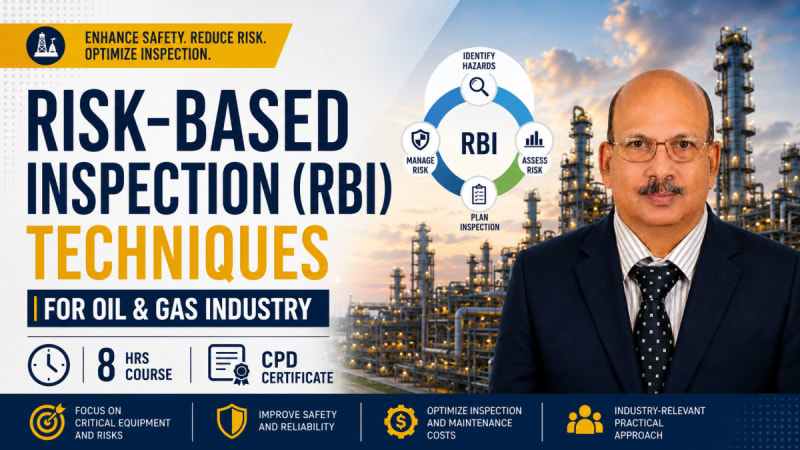
Risk-Based Inspection (RBI) is a systematic approach used to prioritize inspection activities based on the likelihood and consequences of equipment failure. This training program is designed for engineers, inspectors, maintenance professionals, and asset integrity personnel working in the oil & gas, petrochemical, refining, power generation, and process industries.
The course provides a practical understanding of RBI principles, methodologies, and implementation practices in accordance with industry-recognized standards such as API 580 and API 581. Participants will learn how to identify damage mechanisms, evaluate Probability of Failure (POF) and Consequence of Failure (COF), develop risk rankings, and optimize inspection plans to improve safety, reliability, and operational efficiency.
Through real-world examples and industry best practices, the program covers equipment risk assessment, data collection and validation, inspection planning, piping circuitization, risk mitigation strategies, and RBI documentation requirements. Participants will gain the knowledge required to establish, manage, and continuously improve RBI programs across various asset types, including pressure vessels, piping systems, storage tanks, heat exchangers, boilers, and pressure relief devices.
By the end of the training, attendees will be able to apply risk-based methodologies to prioritize inspection resources, reduce operational risks, minimize unplanned shutdowns, enhance asset reliability, and support compliance with industry standards and integrity management requirements.
Who Should Attend?
- Inspection Engineers and Inspectors
- Mechanical and Maintenance Engineers
- Corrosion and Integrity Engineers
- Reliability Engineers
- Asset Integrity Professionals
- Plant Engineers and Operations Personnel
- Risk and Safety Management Professionals
- Oil & Gas, Petrochemical, Refinery, and Power Plant Personnel
Key Benefits
- Understand RBI methodology and implementation processes.
- Learn POF and COF assessment techniques.
- Develop effective risk-based inspection plans.
- Optimize inspection intervals and maintenance resources.
- Improve plant safety, reliability, and availability.
- Support compliance with API 580 and API 581 requirements.
- Reduce operational risks and inspection costs.