ICT vs SICT: Which AMPP Internal Corrosion Certification Should You Take?
ICT or SICT? Compare AMPP's internal corrosion certifications: eligibility routes, exams, courses and which one fits your experience. Updated Oct 2026.
EIM Editorial Team10 Oct 20267 min read
Internal corrosion is the threat you cannot see from the right-of-way. It grows inside pipelines carrying wet gas, produced water and crude, and it is often the reason a line is derated or replaced early. AMPP (formerly NACE International) certifies the people who manage it through a ladder of internal corrosion credentials. The two that engineers ask about most are the Internal Corrosion Technologist (ICT) and the Senior Internal Corrosion Technologist (SICT).
This guide compares them side by side: what each one says about you, who can sit, how the exams work, and how to decide which to go for first. The requirements below are taken from AMPP's certification pages as of 7 October 2026. AMPP updates its programmes, so check its site before you apply.
Short answer: ICT shows you can monitor and assess internal corrosion control on a pipeline. SICT shows you can interpret the data, choose the mitigation and build it into an integrity programme. If you have fewer than four years of pipeline internal corrosion experience, ICT is usually your starting point.
The internal corrosion ladder at a glance
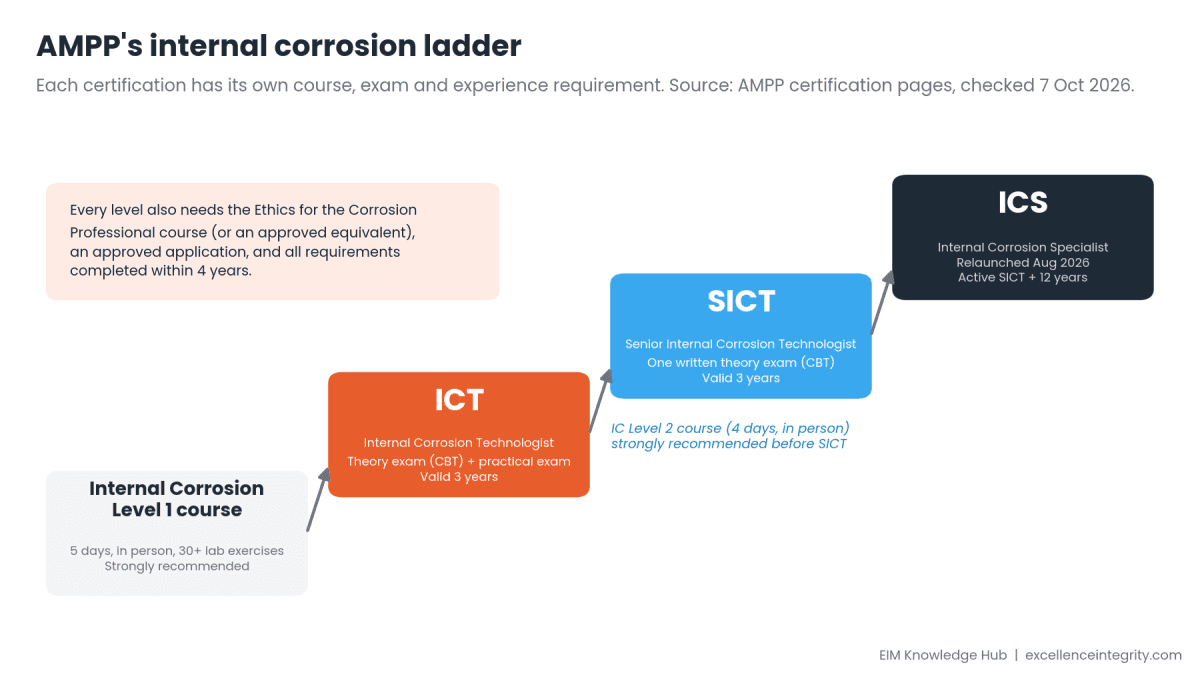
AMPP's internal corrosion pathway has three certifications, each built on the one below. Each has its own course, which AMPP strongly recommends, and its own exam.
The top tier, Internal Corrosion Specialist (ICS), was relaunched by AMPP in August 2026 after a full rewrite. It requires an active SICT and 12 years of verifiable internal corrosion work in pipelines and associated facilities. For most engineers, the practical decision is between ICT and SICT.
ICT vs SICT side by side
| ICT: Internal Corrosion Technologist | SICT: Senior Internal Corrosion Technologist | |
|---|---|---|
| What it says about you | You can recognise internal corrosion, measure it, and check that mitigation is working on liquid and gas pipelines | You can interpret corrosion data, run advanced field tests, choose mitigation and build it into an integrity programme |
| Typical holder | Corrosion technician, field inspector, chemical treatment specialist, junior integrity engineer | Pipeline integrity engineer, corrosion engineer leading a monitoring and inhibition programme |
| Recommended course | Internal Corrosion Level 1: 5 days, in person, more than 30 lab exercises | Internal Corrosion Level 2: 4 days, in person |
| Exams | Two: a written theory exam (computer-based) and a practical exam held on the last day of the Level 1 course | One written theory exam (computer-based) |
| Experience routes | Path A: bachelor's in biology, microbiology, chemistry, chemical or metallurgical engineering + 2 years. Path B: 4 years | Path A: bachelor's in physical sciences or engineering + 4 years. Path B: active ICT + 8 years |
| Also required | Ethics for the Corrosion Professional course (or approved equivalent) and an approved application | Same |
| Validity | 3 years, then renewal | 3 years, then renewal |
In both cases, "experience" means verifiable internal-corrosion work in a pipeline environment. AMPP gives candidates four years to complete every requirement, including the exam and an approved application.
How to choose: start from your experience, not the title
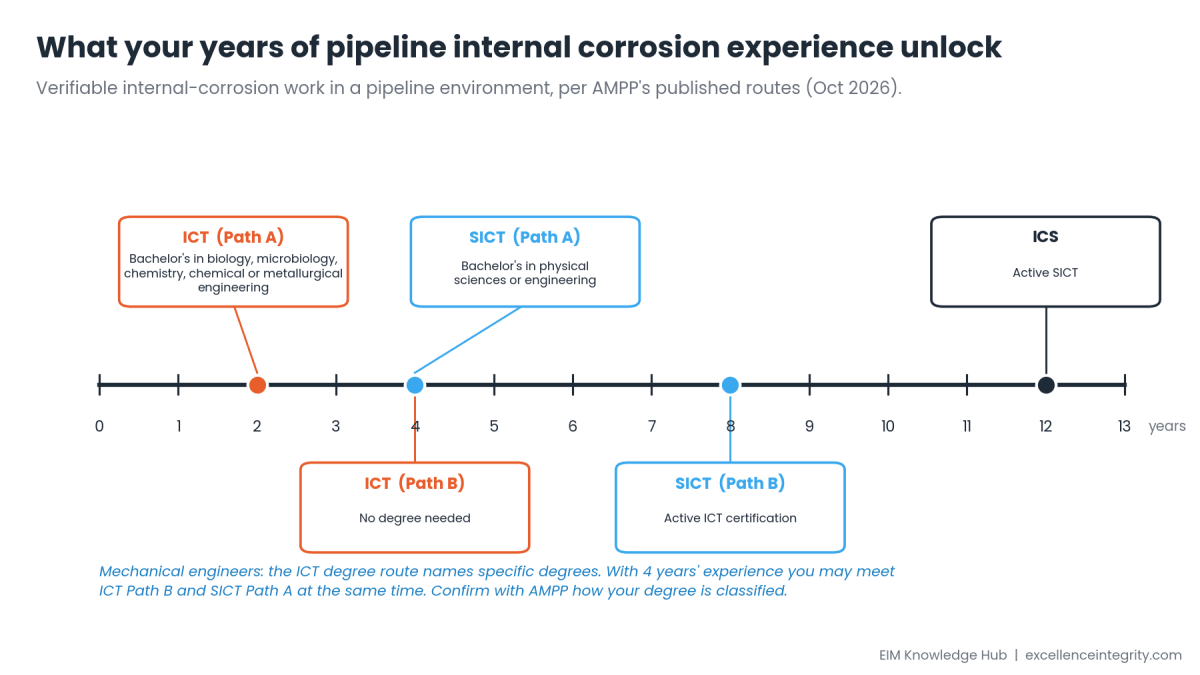
The routes look similar but reward different backgrounds. Three situations come up most often.
You have one to three years in the field
Aim for ICT. With a degree in one of the listed sciences, two years of pipeline internal corrosion work is enough for Path A. Without one of those degrees, you need four years for Path B. Use the time to build the habits the ICT practical tests: taking and reading coupons, field water analysis, and recognising what a corrosion product is telling you.
You are a mechanical engineer with four or more years
Read the degree lists carefully. The ICT degree route names specific sciences, and mechanical engineering is not one of them, so on paper you would qualify for ICT through Path B (four years). The SICT degree route accepts a bachelor's in physical sciences or engineering with four years. That means some engineers meet the SICT requirements at the same point they meet ICT.
Whether to go straight to SICT then depends on your role. If you already interpret monitoring data and recommend mitigation, SICT matches your work. Confirm with AMPP how your degree and experience will be assessed before you book.
You hold ICT and have eight years
SICT through Path B is the natural next step. It is the credential that signals you can lead a programme rather than run part of it. Once you hold an active SICT and have 12 years' experience, the relaunched ICS is the next rung.
What the knowledge looks like in practice
Both certifications deal with the same core threats found in Gulf and Indian pipeline systems: CO₂ (sweet) corrosion, H₂S (sour) corrosion, oxygen ingress in water injection, microbiologically influenced corrosion (MIC), and under-deposit corrosion where solids settle. The difference is depth.
- At ICT level the questions are practical. Where does water drop out in this line? How do you install and pull a coupon? What does a black, sulfide-rich deposit suggest? Is the inhibitor residual high enough?
- At SICT level the questions are about judgement. The ER probe and the coupon disagree: which do you believe, and why? The inhibitor programme costs more each year: can you show it is still needed? How do you turn monitoring data into a defensible inspection and mitigation plan?
If you are not sure which side of that line you sit on, look at the decisions you make each week. If you gather and report the data, start with ICT. If you decide what the data means, SICT fits.
Common mistakes when planning for ICT or SICT
- Treating the course as optional. AMPP lists the courses as strongly recommended rather than mandatory, but the ICT practical exam is held on the last day of the Level 1 course, so plan around attending it.
- Counting the wrong experience. AMPP asks for verifiable internal-corrosion work in a pipeline environment. General plant maintenance or coating inspection is unlikely to count in full. Make sure the duties your supervisor confirms are accurate and described in internal-corrosion terms.
- Forgetting the ethics requirement. Both certifications need the Ethics for the Corrosion Professional course or an approved equivalent. It is a quick step, but applications stall without it.
- Studying only definitions. The theory exams test application. Work through real monitoring data, not just terms.
Preparing for the exam
AMPP publishes an Exam Preparation Guide for each certification on its website. Make it your first document: it sets out the knowledge areas and exam format, and it changes when the exam does.
EIM is an independent training provider; the certifications belong to AMPP. To help you prepare, EIM offers self-paced preparation for both ICT and SICT, with a question bank, practice mode with explanations, timed mock tests, study notes and flashcards, and one year of access. For SICT there is also a live online preparation course.
SICT Exam Preparation, live online. Next batch: 18 October to 11 November 2026, Sunday to Wednesday, 20:00 to 22:00 UAE time.
16 sessions of 2 hours over 4 weeks, covering internal corrosion fundamentals, assessment and inspection, mitigation strategies, and prediction and prevention. See the SICT course
If you want the subject without an exam attached, EIM's self-paced Internal Corrosion Management programme covers sweet and sour corrosion, MIC, monitoring blind spots and inhibitor programmes. It is EIM training, not an AMPP credential. For the monitoring side in detail, read our guide to corrosion coupons, ER probes and LPR.
Frequently asked questions
Is ICT the same as the old NACE internal corrosion certification?
AMPP was formed in 2021 when NACE International and SSPC merged, and it now runs the former NACE programmes. Job adverts in the region often still say "NACE". Check the credential name the employer lists against AMPP's current name.
Do I need ICT before SICT?
Not always. SICT Path B requires an active ICT plus 8 years. Path A requires a bachelor's in physical sciences or engineering plus 4 years, with no ICT. Check AMPP's current requirements before you apply.
Are the exams computer-based?
The theory exams are computer-based. ICT also has a practical exam, held at the end of the Level 1 course.
How long are the certifications valid?
Both are valid for three years, after which you renew through AMPP.
Does EIM's SICT preparation course come with a certificate?
No. EIM's exam preparation is preparation only. The certification is awarded by AMPP when you meet its requirements and pass its exam.