Types of Gaskets and How to Choose One for a Flanged Joint
Types of gaskets explained: spiral wound, RTJ, kammprofile, metal jacketed, sheet and elastomer, how to choose by pressure, temperature, fluid and flange face.
By Syed Hasan23 Nov 20268 min read
A flanged joint is only as good as the gasket in the middle of it. Most flange leaks during a startup, or a hot bolting job that never seems to hold, come back to one of three things: the wrong gasket for the service, a gasket that does not suit the flange face, or a good gasket installed badly.
This post goes through the common types of gaskets used in piping and equipment, what each one is built from and where it belongs. It then sets out the four questions that decide the choice, and the reuse and installation rules that matter at a shutdown. It is written for piping, maintenance and QA/QC engineers who have to approve or fit these joints, not design them from scratch.
What a gasket actually does
Flange faces are never perfectly flat or smooth. A gasket is a softer element that the bolts squeeze into those irregularities to make a seal, and it must keep sealing as pressure tries to push the flanges apart and temperature cycles the bolts and the joint. Each of the types of gaskets below is a different trade-off between how easily it seals, how much pressure and temperature it tolerates, how chemically resistant it is, and how much bolt load it needs.
The flange face decides more than people expect
Before choosing a gasket, look at the flange face, because it narrows the field immediately:
- Raised face (RF). The most common face in process piping. Takes spiral wound, kammprofile and sheet gaskets sized to the raised face.
- Flat face (FF). Common on cast iron, some non-metallic and low-pressure equipment. Usually needs a full-face soft gasket, since a hard gasket can overload and crack a brittle flange.
- Ring type joint (RTJ). Grooved faces for a metal ring gasket, used in higher-pressure and higher-temperature service.
A gasket that does not match the face, for example a spiral wound gasket on a flat-faced cast iron flange, is a design mistake no amount of bolting can fix.
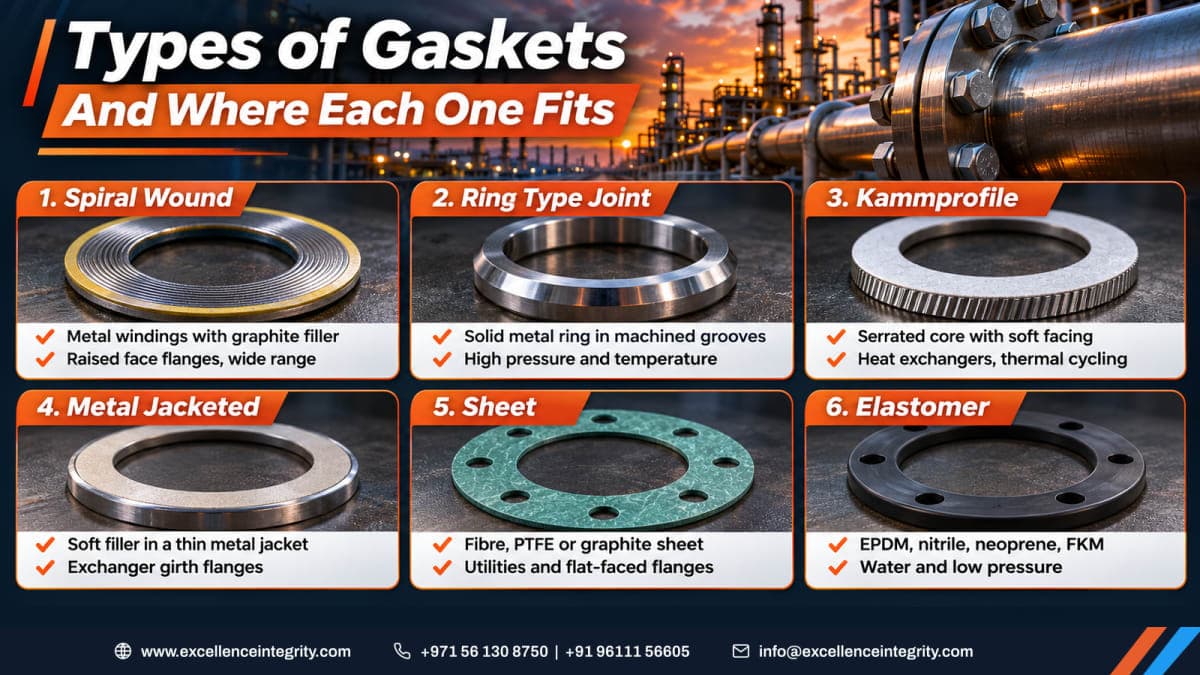
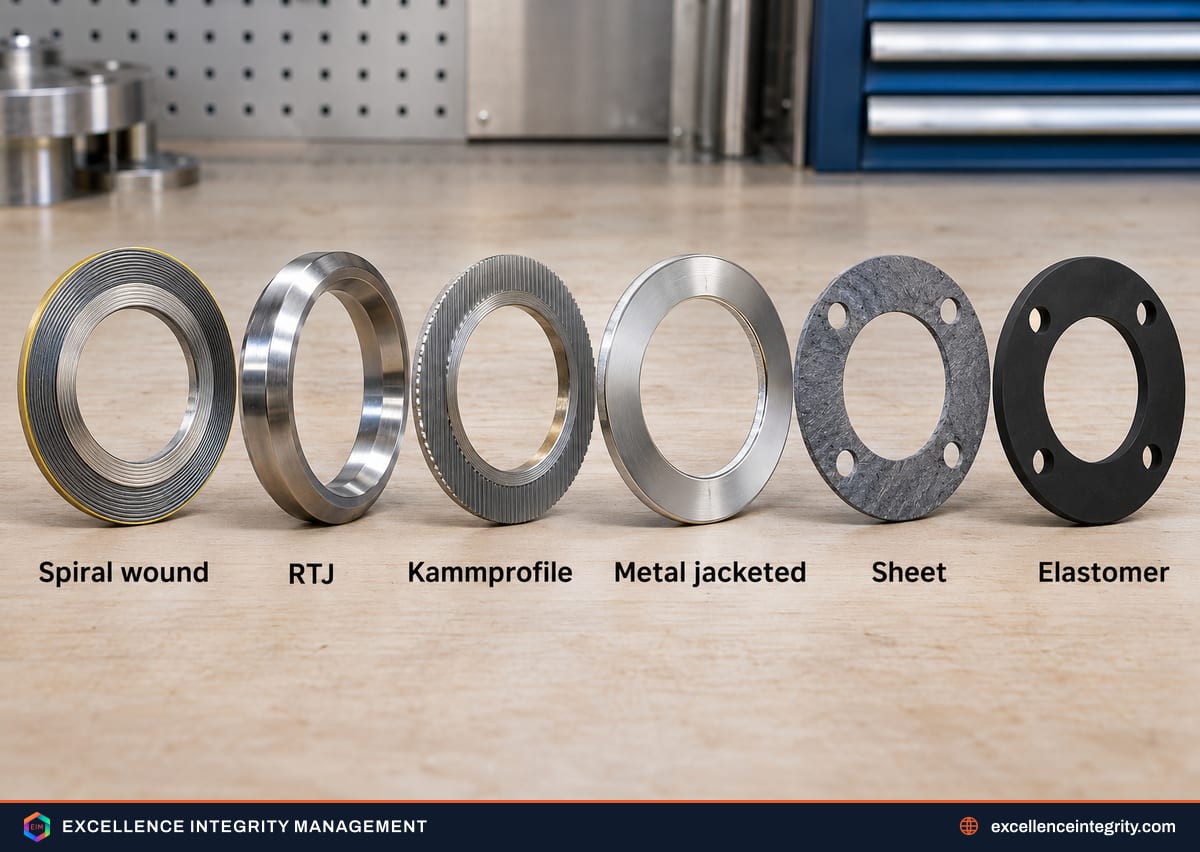
Spiral wound gaskets
A spiral wound gasket is a V-shaped metal strip wound together with a soft filler, usually flexible graphite or PTFE. Most have an outer guide ring that centres the gasket and limits compression, and many have an inner ring that protects the windings and keeps them out of the bore.
They handle a wide range of pressure and temperature and recover reasonably well when the joint moves, which is why they are the workhorse on raised face flanges in refineries and process plants. Metal gaskets of this kind, along with ring joints and jacketed gaskets, are covered by ASME B16.20. Choose the winding metal and filler for the fluid and temperature, not just the size.

Ring type joint (RTJ) gaskets
An RTJ gasket is a solid metal ring, oval or octagonal in section, that sits in matching grooves machined into both flanges. Bolting squeezes the ring into the grooves to make a metal-to-metal seal. They suit high-pressure, high-temperature service and are common on wellheads and high-pressure process lines.
The ring must be a softer material than the flange grooves, so the ring deforms and the grooves do not. Groove condition is critical: a scratched or corroded groove leaks however new the ring is, so the grooves are inspected every time the joint is broken.
Kammprofile gaskets
A kammprofile gasket has a solid metal core with concentric serrations on both faces, covered by thin layers of a soft facing such as flexible graphite or PTFE. The serrations concentrate the load so the facing seals at a modest bolt load, while the metal core gives strength and stability.
They are popular on heat exchanger joints and on flanges that see thermal cycling, where a stable, reliable seal matters. They are also used where spiral wound gaskets have given trouble.
Metal jacketed gaskets
A metal jacketed gasket is a soft filler wrapped in a thin metal jacket. The jacket protects the filler from the fluid and from high temperature. They are made in many shapes, including with pass partition bars, which is why they are a traditional choice for heat exchanger girth flanges and channel covers.
They need a good flange finish and accurate bolting, because the jacket does not flow into surface damage the way a soft gasket does.
Sheet gaskets
Sheet gaskets are cut from compressed non-asbestos fibre, PTFE or flexible graphite sheet. Nonmetallic flat gaskets of this kind are covered by ASME B16.21. They are cheap, easy to cut to shape and seal at low bolt loads, which makes them the usual choice for utilities, water, air and low-pressure process service, and for flat-faced flanges.
Each sheet material has its own pressure, temperature and chemical limits, set by the manufacturer. Check the data sheet rather than assuming one grade suits everything.
Elastomer gaskets
Rubber gaskets made from materials such as EPDM, nitrile (NBR), neoprene or fluoroelastomer (FKM) seal easily at very low bolt loads. They suit water, low-pressure air and similar services, and are common on flat-faced and non-metallic flanges.
Their weak points are temperature and chemical compatibility. A rubber that is perfect in cooling water can swell and fail in hydrocarbon, so the elastomer grade must be chosen for the fluid.
Four questions for choosing between types of gaskets
| Question | Why it matters |
|---|---|
| What pressure class? | Low-pressure joints can use sheet or rubber; higher classes move to spiral wound, kammprofile or RTJ |
| What temperature, including upsets? | Rubber and some sheet grades lose strength early; metal and graphite go much higher |
| What fluid? | Filler, facing and elastomer must resist the chemical, including cleaning and steam-out |
| What flange face and material? | RF, FF or RTJ narrows the type; brittle flanges need soft, full-face gaskets |
Your project piping specification normally answers these for every line class, so flange gasket selection on site starts with checking the gasket against the specification, not against what is in the store.
Reuse and installation rules at shutdown
Shutdowns are where gasket discipline slips, because the old gasket is in hand and the new one is in the warehouse. Hold these rules:
- Never reuse a spiral wound or RTJ gasket. Once compressed, it has done its job and will not seal reliably again.
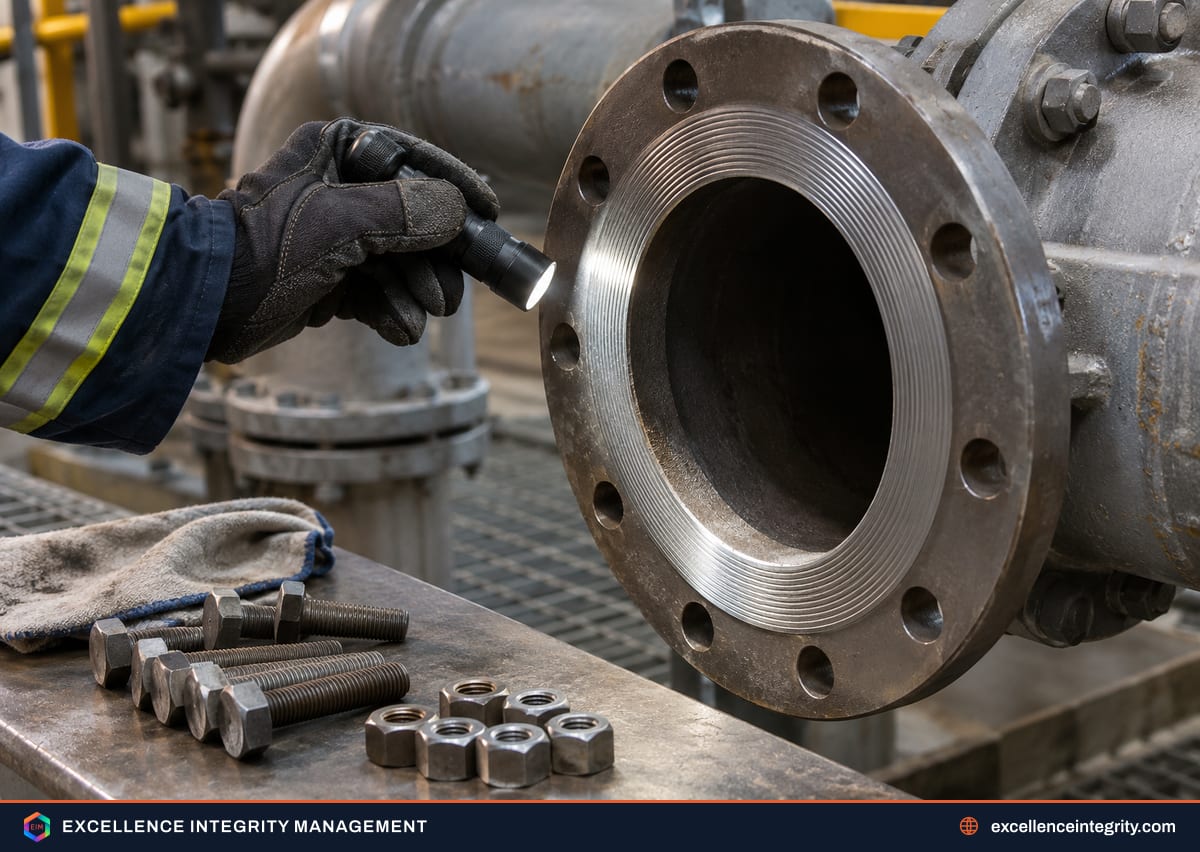
- Clean and inspect the flange faces for scratches across the seating area, pitting and corrosion. Radial scratches are the most dangerous because they make a leak path.
- Use one gasket only, of the correct size and rating. Never stack two, and do not add jointing compound unless the specification calls for it.
- Bolt in a controlled sequence to the specified load, with lubricated studs and nuts. ASME PCC-1 gives guidance on bolted flange joint assembly, and many sites base their procedures on it.
- Record the joint: gasket type, material and who tightened it. That record is what makes a later leak investigation possible.
Frequently asked questions
Which gasket is best for high pressure?
Low-pressure joints can use sheet or rubber gaskets, but higher pressure classes move to spiral wound, kammprofile or RTJ gaskets. RTJ rings give a metal-to-metal seal for high-pressure, high-temperature service such as wellheads. The final choice also depends on temperature, the fluid and the flange face, and your piping specification normally settles it for each line class.
What is the difference between a spiral wound and an RTJ gasket?
A spiral wound gasket is a V-shaped metal strip wound with a soft filler such as graphite or PTFE, and it sits on a raised face flange. An RTJ gasket is a solid oval or octagonal metal ring that seats in matching grooves machined into both flanges. RTJ joints suit higher-pressure service, and their grooves must be inspected every time.
Can you reuse a spiral wound gasket?
No. Once a spiral wound or RTJ gasket has been compressed it has done its job and will not seal reliably again. Fit a new gasket of the correct size and rating, clean and inspect the flange faces first, and never stack two gaskets to make up a gap.
What gasket do you use on a flat face flange?
Flat face flanges, common on cast iron and low-pressure equipment, usually need a full-face soft gasket, such as a sheet or elastomer gasket. A hard gasket like a spiral wound can overload and crack a brittle flange. That is a design mistake no amount of careful bolting can fix.
Where to go from here
Gaskets sit alongside bolts, flanges and pipe fittings as the parts that make a piping system hold pressure. Carbon steel piping components and types of bolts and screws cover the neighbouring parts, and types of gland packing covers sealing on valve stems and pump shafts. For inspectors, flange and gasket condition is part of in-service piping inspection, which the API 570 piping inspector certification preparation covers in depth.
Exam preparation
Preparing for API 570?
Practise with exam-style questions, timed mocks and study notes. 1,841 questions in the bank.