Types of Bolts and Screws Every Mechanical Engineer Should Know
Hex, flange, stud, anchor and U-bolts, plus machine, set, self-tapping and cap screws: where each is used, how to choose one and what to inspect.
By Syed Hasan24 Oct 20267 min read
Ask ten people on a plant floor what the difference is between a bolt and a screw and you will get ten answers, most of them half right. It matters more than it sounds. The wrong fastener in a pump baseplate, a pipe clamp or a lifting point can loosen, corrode, strip or snap, and a failed fastener is rarely the cheap part of the repair.
This article sorts out the main types of bolts and screws a mechanical engineer meets in industry, where each belongs, and what to check when you choose and inspect them.
Bolt or screw: the practical difference
The textbook line is that a bolt passes through clearance holes and is tightened with a nut, while a screw threads into a tapped hole or forms its own thread in the material. In practice the names blur: a "cap screw" is often used exactly like a bolt, and plenty of hex bolts go into tapped holes.
The more useful question is how the joint is tightened. If you hold the head and turn the nut, it is working as a bolt. If you turn the head and the thread in the part takes the load, it is working as a screw, and the strength of that internal thread, and how deep it is engaged, now matters as much as the fastener itself.

Common types of bolts
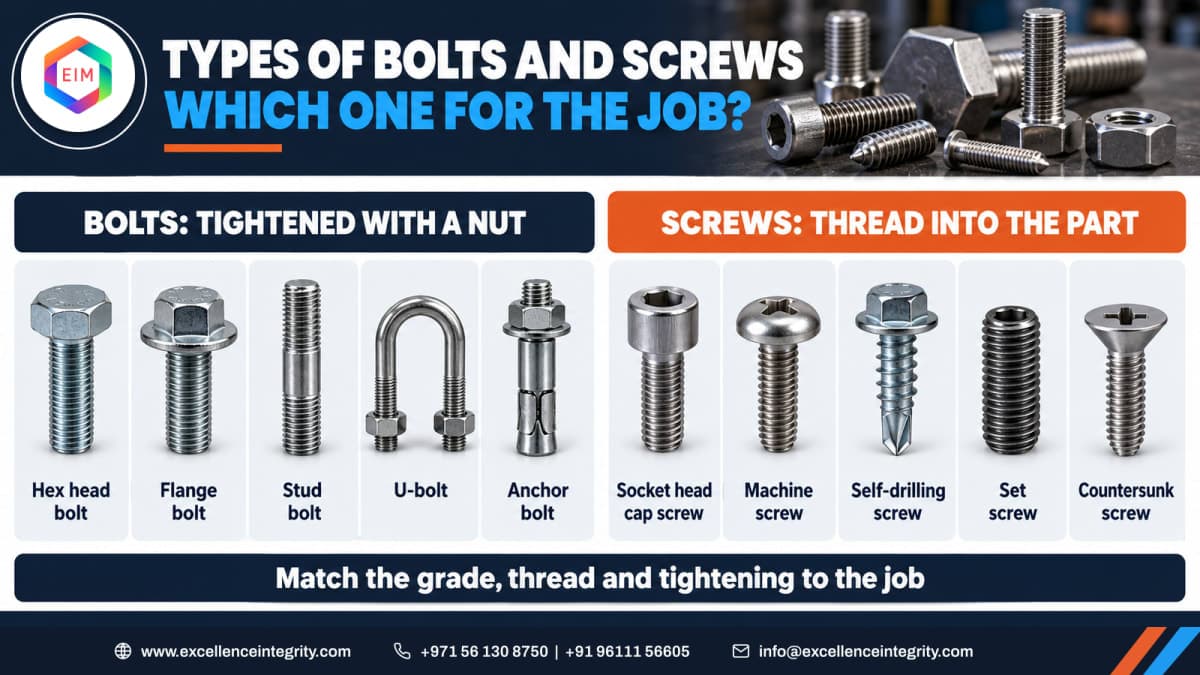
| Bolt | What makes it different | Where you see it |
|---|---|---|
| Hex head bolt | Six-sided head for a spanner or socket; the everyday workhorse | Machinery, structural steel, equipment mounting |
| Flange bolt | A built-in washer face under the head spreads the clamping load | Gearbox covers, housings, vehicles, where a loose washer is a nuisance |
| Carriage bolt | Domed head with a square neck that locks into the hole so it does not turn | Timber, guarding and some light steel assemblies |
| Eye bolt | A loop instead of a head | Lifting and anchoring, only when rated and marked for that load |
| U-bolt | Bent into a U with both legs threaded | Clamping pipes, tubes and round bars to a support |
| Stud bolt | A threaded rod with no head, a nut on each end | Pipe flanges, pressure vessel and heat exchanger joints |
| Anchor (foundation) bolt | Cast into or fixed in concrete | Pumps, compressors, structures and tanks on foundations |
A few more turn up on the infographic charts you see shared on LinkedIn: J-bolts and hanger bolts (for hanging and anchoring), T-head bolts (that slide into a T-slot on a machine table), plow and elevator bolts (flat heads that sit flush in conveyor and bucket work), machine bolts (an older name for plain square or hex bolts) and step bolts (for climbing points on poles). They are variations on the same idea: a head shaped for the job, a shank and a thread.
Why stud bolts own the flange joint
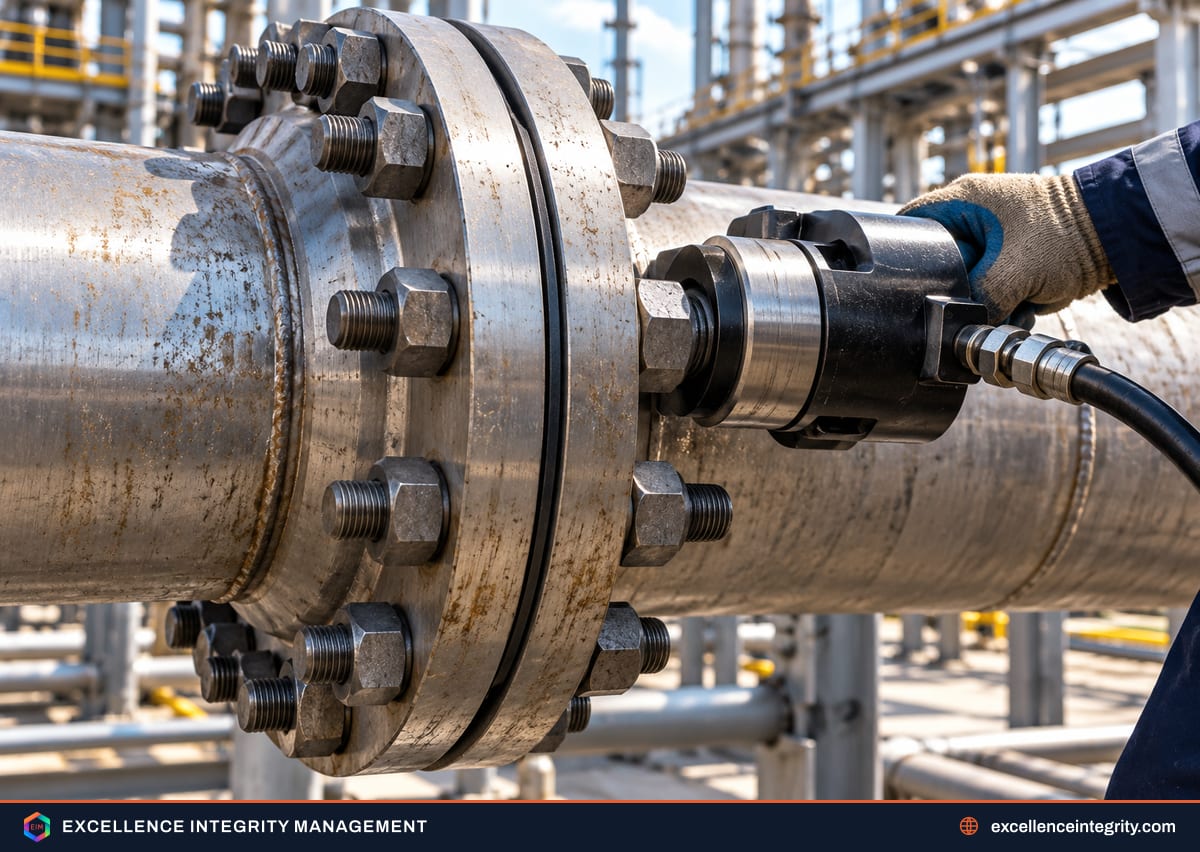
On a pressure flange you will almost always find stud bolts rather than hex bolts. A stud is threaded along its full length, so it can be tightened from either end, cut to length easily and, most importantly, tensioned evenly with hydraulic tools across the whole bolt circle. Flange studs are specified by material grade, typically to an ASTM standard for the service temperature, with matching nuts. Getting the grade or the tightening sequence wrong is one of the commonest causes of flange leaks, which is why joint assembly is treated as a skill of its own.
Common types of screws
| Screw | What makes it different | Where you see it |
|---|---|---|
| Machine screw | Uniform thread for a tapped hole or nut, usually small sizes | Panels, instruments, electrical boxes |
| Socket head cap screw | Round head with a hex socket; strong and fits where a spanner will not | Machine tools, couplings, tight assemblies |
| Self-tapping screw | Forms or cuts its own thread in a pre-drilled hole | Sheet metal, plastics |
| Self-drilling screw | A drill point on the tip drills, then threads, in one go | Cladding, roof sheeting, light steel framing |
| Set screw and grub screw | Little or no head; the tip presses on a shaft | Holding pulleys, collars and gears on shafts |
| Countersunk (flat head) screw | Cone-shaped head that sits flush with the surface | Covers, guards, anything that must not snag |
| Wood, drywall and deck screws | Coarse threads made for soft or fibrous material | Construction and site works, not machinery |
Pan head, thumb and concrete screws round out the list: a pan head is a low rounded head for general assembly, a thumb screw is turned by hand for quick access panels, and concrete screws cut their own thread in a drilled masonry hole for light fixings.
Set screws deserve a warning. A set screw on a plain shaft holds only by the point biting into the surface, and under vibration it walks. For anything that transmits real torque, a key and keyway does the job; a set screw on top of the key just stops the hub sliding along the shaft. Our guide to shaft keys covers how that works.
How to choose the right fastener
Before you pick a part off the shelf, answer these:
- Material and strength grade. Grade markings on the head (for example property classes like 8.8 or 10.9 on metric bolts, or the radial lines on inch grades) tell you the strength. Never replace a marked high-strength bolt with an unmarked one.
- Thread diameter and pitch. Coarse threads are quicker and more forgiving; fine threads give finer adjustment and more strength in thin sections. Mixing metric and inch threads that look alike is a classic trap.
- Length and thread engagement. In a tapped hole, the thread needs enough engagement for the part material. Soft metals like aluminium need more than steel.
- Load and vibration. Joints that vibrate need correct preload first, and locking methods second.
- Corrosion. Coating, stainless grade and contact with other metals all matter. Stainless against aluminium or carbon steel in wet service invites galvanic corrosion.
- Tightening. Use the torque or tension the equipment maker or the joint procedure specifies, with the lubricant it assumes. The same torque with and without lubricant gives very different bolt tension.
- Safety-critical uses. Lifting points, pressure joints and structural connections have their own rules and certified parts. Do not improvise.
Inspecting fasteners in service
In mining, refinery and heavy equipment maintenance, fasteners are checked on every round, because they are where loosening and corrosion show first. Look for:
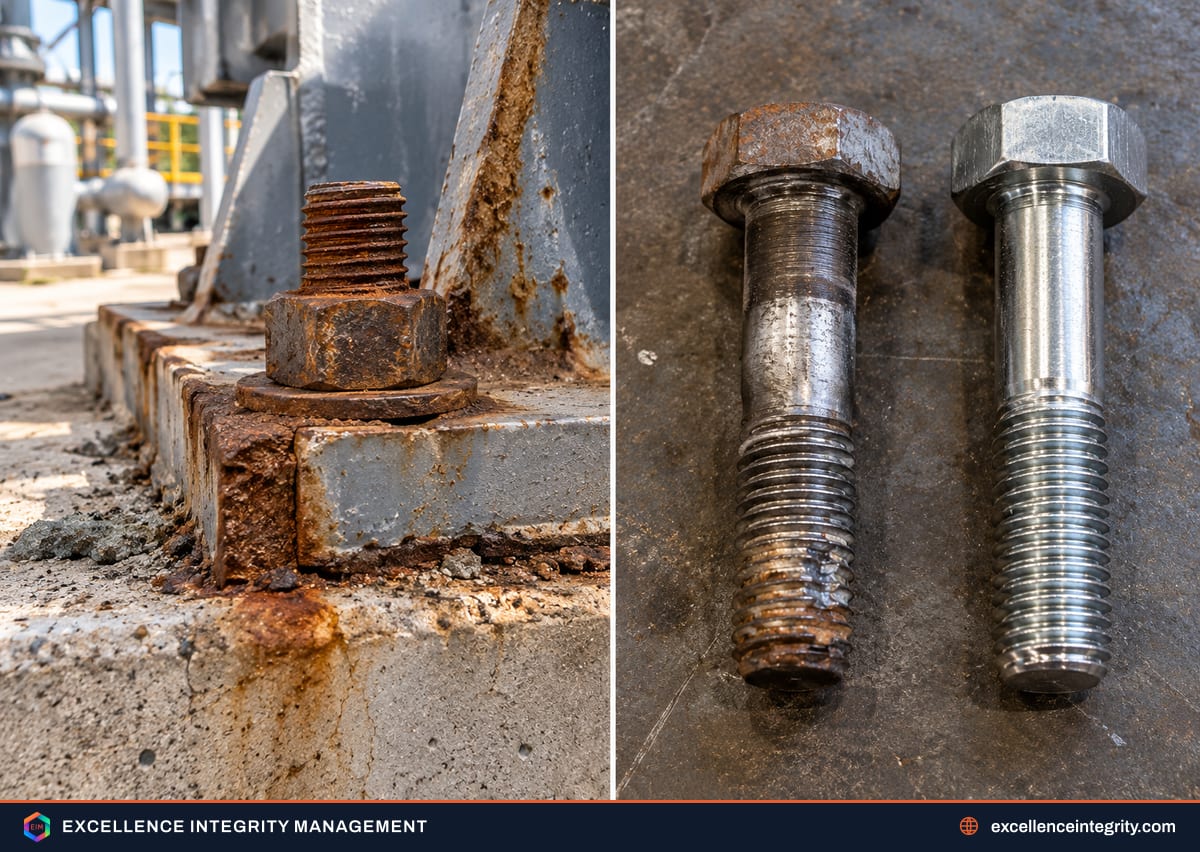
- Damaged, stretched or galled threads, and nuts that run on loosely.
- Corrosion at the thread root and under the head, especially on anchor bolts at the concrete line and on flange studs under insulation.
- Bolts that have necked down or visibly stretched after an overload.
- Witness marks that have moved, showing a nut has turned.
- Missing or mismatched fasteners, such as a lower grade bolt fitted after a repair.
Replace rather than reuse when in doubt. Many high-strength bolts and tension-controlled fasteners are designed for one tightening only.
Quick answers to common questions
Can I use a screw instead of a bolt? Only if the part has a properly tapped thread with enough engagement, and the screw's grade matches the bolt it replaces.
Are stainless steel bolts always better? No. Common stainless grades are often weaker than alloy steel bolts and can gall when tightened. They are chosen for corrosion, not strength.
Do U-bolts belong on every pipe support? No. A U-bolt clamps the pipe and can stop it moving where the design needs it to slide. See our article on types of pipe supports for when each support type is right.
Bolted joints on pressure equipment, from flange assembly to inspection, are part of our pressure vessel fabrication, inspection and lifecycle management course. If you are working out the right fastener for a specific job, get in touch.