Graphitisation of Carbon Steel: Damage Mechanism of the Week
Graphitisation explained: how long hot service turns carbides into graphite in carbon and C-0.5Mo steel, why chain graphitisation is dangerous.
By Syed Hasan24 Oct 20262 min read
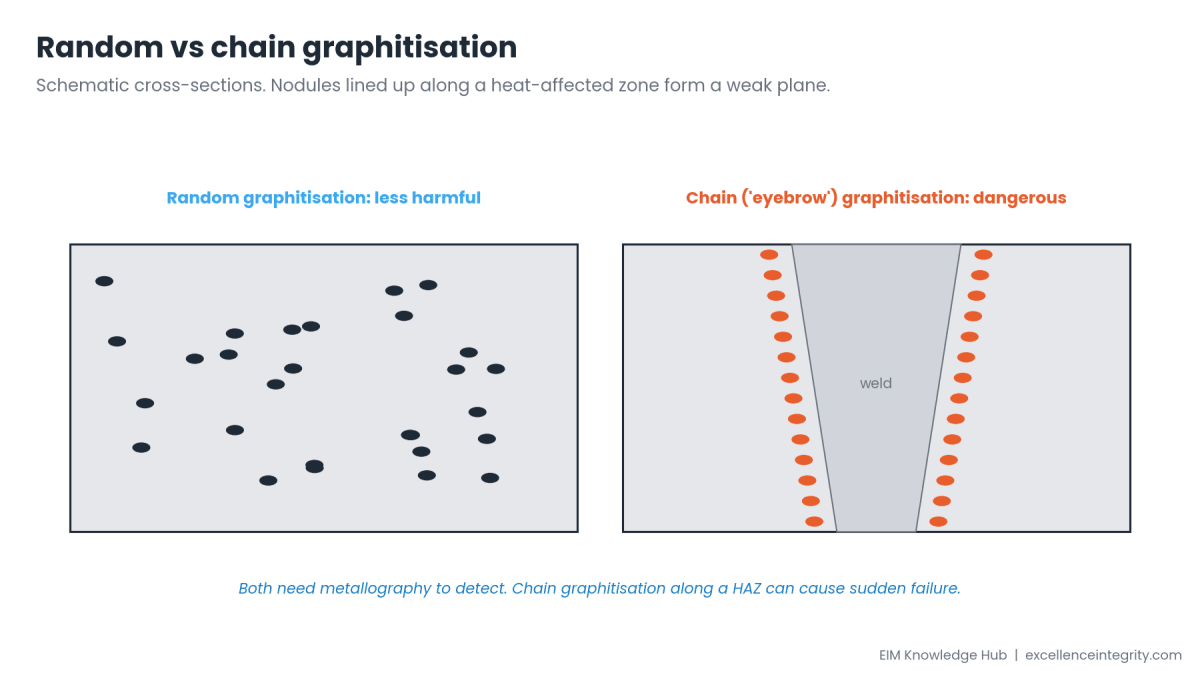
Week 8 of our Damage Mechanism of the Week series covers a slow, rare but serious mechanism. Graphitisation turns the iron carbides that strengthen carbon steel into soft graphite nodules after very long hot service. Spread randomly, the effect is modest; lined up along a weld, it can cause sudden failure.
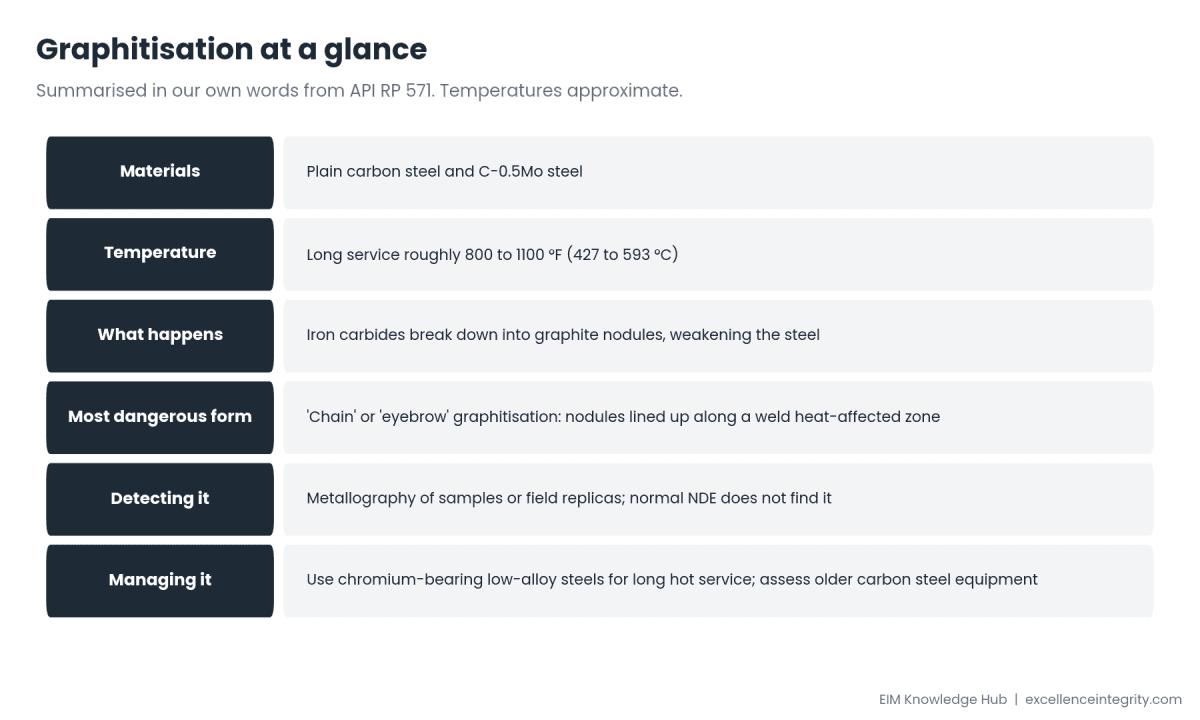
Short answer: Carbon steel and C-0.5Mo steel held for many years at roughly 800 to 1100 °F (427 to 593 °C) can see their carbides decompose into graphite. Random nodules reduce strength a little; nodules aligned along a heat-affected zone (chain or 'eyebrow' graphitisation) create a weak plane. It can only be found by metallography, and is avoided by using chromium-bearing low-alloy steels for long hot service.
At a glance
What happens in the metal
Steel's strength comes partly from iron carbide (cementite). At high temperature over long periods, cementite in plain carbon and C-0.5Mo steels is not fully stable and can break down into iron and graphite. Chromium stabilises the carbides, which is why chromium-bearing steels resist graphitisation.
Random vs chain graphitisation
Where to look
- Older carbon steel and C-0.5Mo equipment in long hot service: FCC, catalytic cracking and boiler components, hot piping.
- Weld heat-affected zones, where chain graphitisation tends to form.
- Equipment that has run above its intended temperature for long periods.
Detecting and managing it
- Metallography of samples or field replicas is the only reliable detection method.
- Screen by history: material, temperature and time in service.
- Materials: use chromium-bearing low-alloy steels for long service in the range.
- Assess older C-0.5Mo and carbon steel equipment in hot service, especially at welds.
- Related mechanism: spheroidisation, which also softens carbon steel at high temperature, is covered in API RP 571 alongside graphitisation.
Learn more with EIM
Graphitisation is one of the damage mechanisms in API RP 571 (3rd edition), the body of knowledge for the API 571 certification. EIM is an independent training provider; API certifies inspectors. EIM's self-paced API 571 preparation includes a question bank, practice mode with explanations, timed mock tests, study notes and flashcards, with one year of access, and EIM's live API 571 Damage Mechanisms - Exam Preparation course with Mr. Deepak Rawtal runs weekend batches. See the API 571 page This post is part of our weekly Damage Mechanism of the Week series.
Frequently asked questions
What is graphitisation?
The breakdown of iron carbides into graphite nodules in carbon and C-0.5Mo steels after long exposure at high temperature.
At what temperature does it occur?
Roughly 800 to 1100 °F (427 to 593 °C), over long periods of service.
Why is chain graphitisation dangerous?
Nodules lined up along a weld heat-affected zone create a weak plane that can cause sudden failure.
How is graphitisation detected?
By metallography of samples or field replicas. Normal NDE does not detect it.
Which steels resist graphitisation?
Chromium-bearing low-alloy steels, because chromium stabilises the carbides.
Sources
- API RP 571, 3rd edition: graphitisation. Summarised, not quoted.
- Checked 7 October 2026.