Types of Pipe Supports and What Each One Controls
Shoes, guides, line stops, anchors, hangers and spring supports explained: what each lets a pipe do, how they work together, and what to inspect.
By Syed Hasan22 Oct 20269 min read
Ask a new graduate what a pipe support does and the answer is usually "it holds the pipe up". That is about a third of the job. A hot line in a refinery grows by tens of millimetres between ambient and operating temperature, a compressor discharge line shakes, and a pump nozzle can only take so much force before its seal starts leaking. The supports decide where all of that goes.
This article walks through the common types of pipe supports, what each one lets the pipe do and what it stops it doing, and how they are combined on a real line. It finishes with what to look at when you are inspecting supports in the field, because a support that has stopped working rarely announces it.
What a pipe support actually has to do
Every support on a line is answering four questions at once. Does it carry the weight of the pipe, the fluid, the insulation and any valves? Which directions of movement does it allow? Which does it restrain? And how much load does it pass into the steel or concrete below it?
Thinking in terms of directions makes the whole subject easier. A pipe can move along its own axis, sideways, up and down, and it can rotate. Each support type is simply a decision about which of those movements are free and which are stopped:
| Support | Carries weight | Axial movement | Lateral movement | Vertical movement |
|---|---|---|---|---|
| Shoe (resting) | Yes | Free | Free | Upward free |
| Guide | Yes | Free | Restrained | Usually upward free |
| Line stop | Yes | Restrained | Free or restrained | Upward free |
| Anchor | Yes | Restrained | Restrained | Restrained |
| Rod hanger | Yes | Free (small swing) | Free (small swing) | Downward restrained only |
| Spring hanger | Yes | Free (small swing) | Free (small swing) | Free, with support kept |
Get the restraint wrong in one place and the stress does not disappear. It moves somewhere else, usually to an elbow, a branch connection or an equipment nozzle.
Resting supports: shoes, trunnions and rollers
Shoe supports
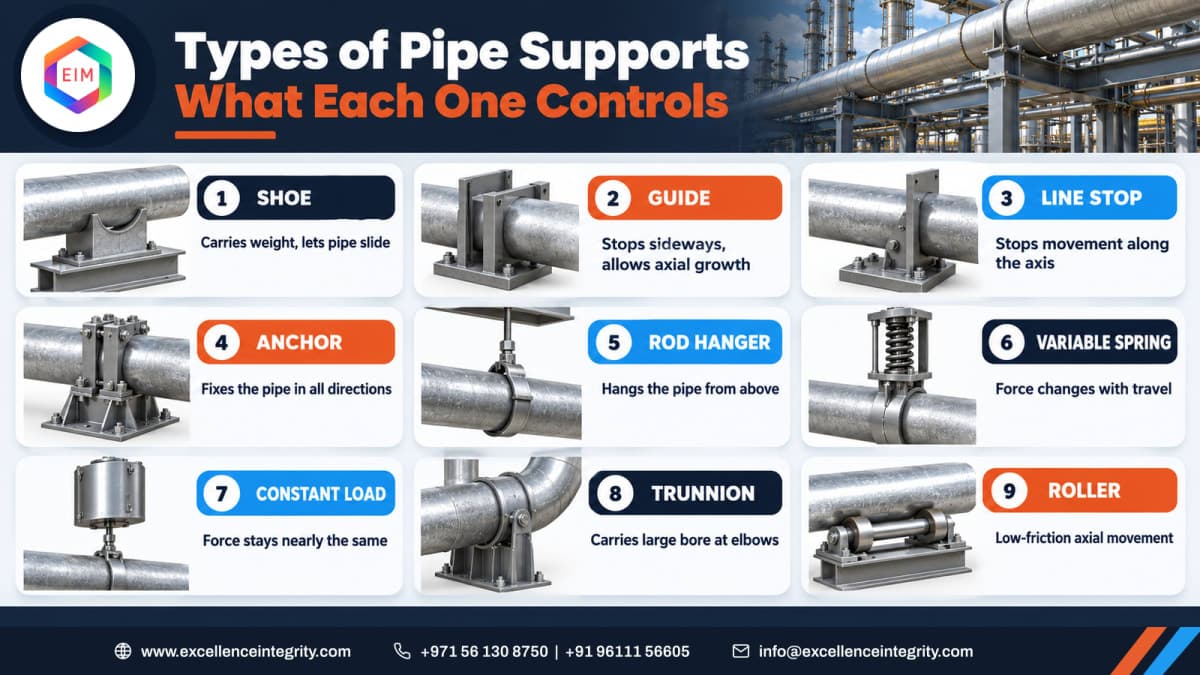
The shoe is the workhorse of every pipe rack. It is a short steel section welded or clamped to the underside of the pipe, and it is the shoe, not the pipe, that slides on the beam. That does three useful things: it lifts the pipe clear of the steel so insulation can run continuously, it spreads the load, and it keeps the pipe wall away from the wet, dirty surface of the beam.
One detail matters more than people expect. The shoe has to be long enough for the pipe's full thermal travel. A shoe that is too short walks off the edge of the beam on a hot day, and the pipe ends up sitting on its own wall.
Trunnion supports
A trunnion, often called a dummy leg, is a short length of pipe welded to the line, typically at an elbow, that carries the load down to a support below. You see them on large-bore lines and wherever a vertical run turns horizontal close to grade. Because the trunnion is welded to a pressure-retaining elbow, the attachment weld is a real stress point and gets checked during design and during inspection.
Roll supports
Where a large, heavy line has to move a long way, friction on a sliding shoe can become a load in itself. A roller lets the pipe travel axially with far less resistance, which lowers the force pushed back into anchors and equipment. Rollers need to stay clean and free to turn. A seized roller is just an expensive fixed point.

Restraints: guides, line stops and anchors
Restraints are where the piping designer actually controls the system. They are placed deliberately, and moving one, or adding one "to make the line feel solid", can undo the stress analysis.
Guides stop sideways movement while letting the pipe grow along its axis. On a long straight run they keep the line from bowing out of the rack as it expands, and they keep expansion heading towards the loops and bends that are meant to absorb it. A guide is built with a small gap either side of the shoe. Close that gap with paint build-up, debris or a well-meant shim and the guide becomes a restraint the analysis never assumed.
Line stops do the opposite job along the axis: they stop the pipe moving lengthwise at a chosen point while it may still move sideways. They are used to split a long run into sections, so that expansion from one section is not added to the next.
Anchors fix the pipe in every direction, and often against rotation too. They divide a system into pieces that can be analysed separately, and they are placed to protect sensitive points: near rotating equipment so that thermal growth does not push on a pump nozzle, or either side of an expansion joint so the joint only sees the movement it was designed for. An anchor passes large loads into the structure, so the steel or foundation has to be checked for them as well.
Hangers and spring supports
Where there is no steel underneath, the pipe hangs from above on a rod hanger: a clamp around the pipe, a threaded rod, and an attachment to the structure overhead. A rigid rod is fine as long as the pipe at that point does not move up or down much.
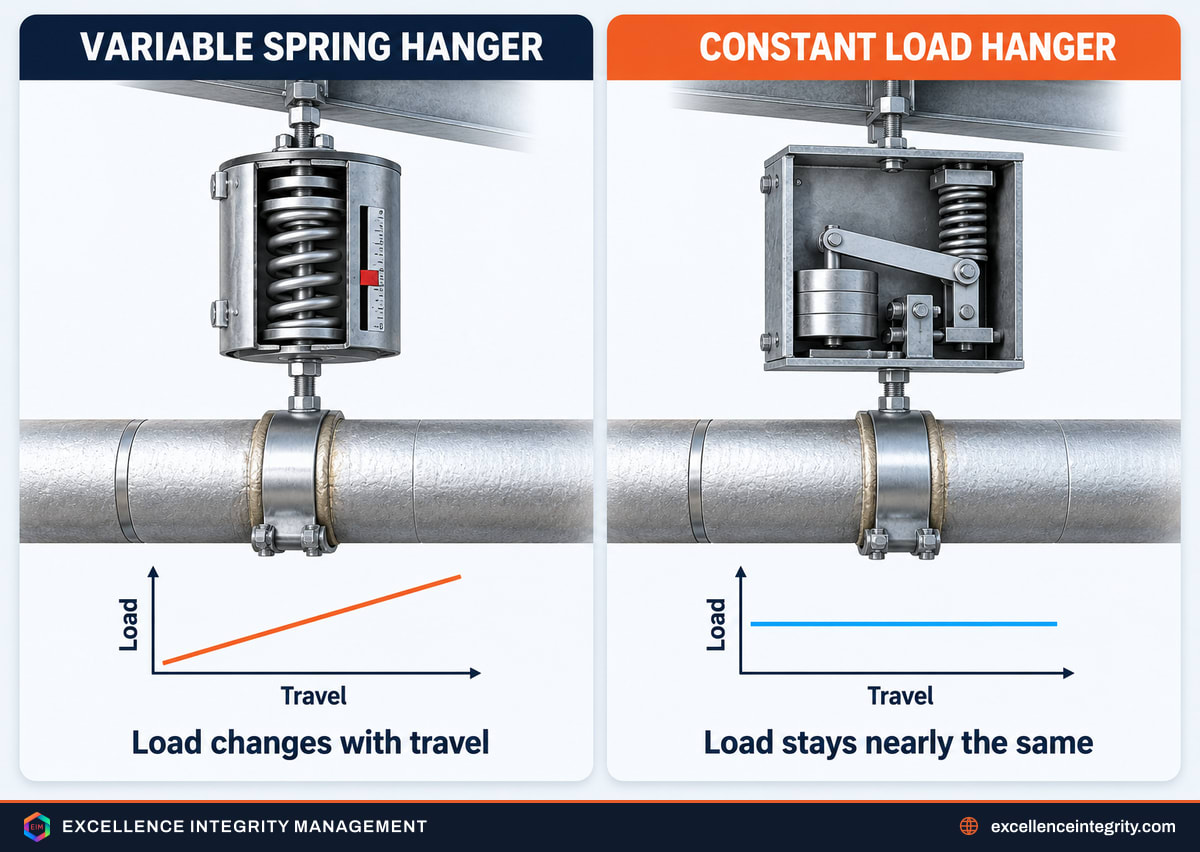
The problem comes with vertical thermal movement. If a hot line rises as it heats up, a rigid hanger goes slack and stops carrying load, and that weight is suddenly dumped on the next support or on a nozzle. If the line moves down, the rod tries to hold it up and becomes a restraint. Springs solve this, and there are two kinds worth keeping separate:
- Variable spring hangers use a coil spring. As the pipe moves, the spring compresses or extends and its force changes with travel. They are simple and economical, and the design keeps the change in load within the limit set by the project specification.
- Constant load hangers (often called constant springs) use a spring with a lever or cam mechanism so that the supporting force stays nearly the same through the whole travel. They are used where the movement is large or the system is sensitive to any change in load, for example close to turbine or compressor nozzles.
Spring hangers come with travel stops fitted for hydrotest and erection. Those stops have to be removed before start-up. A spring that still has its stop in place is a rigid hanger, and it is one of the most common findings on a new unit.
Clamps for small-bore piping
Small-bore lines, instrument tubing and utility piping are usually held with U-bolts or bolted pipe clamps. They are cheap and quick to install, which is exactly why they are sometimes treated as an afterthought. A U-bolt tightened hard onto a hot line turns into an anchor, and a loose one on a vibrating line lets the pipe hammer against the steel. If small-bore vibration is a concern on your unit, it deserves its own review rather than an extra clamp.
How supports work together on a real line
No support works alone. Picture a hot line leaving a pump and running along a rack. A typical arrangement looks like this:
- An anchor or line stop close to the pump, so the line's growth is directed away from the pump nozzle.
- Shoes on every rack beam to carry the weight and let the pipe slide.
- Guides at intervals along the straight run to keep it in line as it grows.
- An expansion loop, or an expansion joint with anchors either side of it, to take up the movement.
- Spring hangers wherever the line rises or falls enough to unload a rigid support.
Where each item goes comes out of a pipe stress analysis, carried out to the governing piping code (ASME B31.3 for most process plant piping) and the project's own specifications. Support hardware itself is commonly specified to MSS SP-58. The point for anyone in the field is that the support layout is part of the design, not a fitting choice, and a change to one support should go back to whoever owns the stress analysis.
What to check when you inspect pipe supports
Supports fail quietly. The pipe does not fall down; it just starts carrying loads it was never designed for. These are the things worth looking at on a walk-down:
- Corrosion at the contact point. Where a pipe sits directly on a beam, or where a clamp wraps it, water collects in the crevice and the wall thins out of sight. This is one of the classic places to find external metal loss on otherwise healthy piping, and it is closely related to corrosion under insulation.
- Shoes off their supports or sitting at the very end of their travel.
- Guides with no gap left, or bent guide plates that show the line has been pushing against them.
- Springs: travel stops still fitted, and the load indicator well outside its hot or cold setting, which suggests the line is not where the designer expected.
- Missing, broken or bottomed-out hangers, and rods that have been cut or shortened.
- Trunnions with cracked attachment welds, or a dummy leg full of water because it has no drain hole.
- Seized rollers and loose or over-tightened U-bolts.

A finding at a support should be recorded with the same care as a thickness reading, because both feed the condition of the circuit. If you are setting up thickness monitoring for the same lines, CML optimisation covers where readings are worth taking, and API 570 piping classes and inspection intervals explains how often a circuit should be looked at.
The short version
Choosing supports comes down to the pipe's size and weight, its operating temperature and the thermal movement that follows from it, vibration and dynamic loads, the allowable loads on connected equipment nozzles, and what the structure can carry. Pick the wrong type and you get high stress at elbows and branches, leaking flanges, nozzle damage on pumps and compressors, vibration problems, or a line that has simply walked off its rack.
Pipe supports are also part of what an in-service piping inspector is expected to assess. If you work on process piping and want to formalise that knowledge, our API 570 piping inspector certification preparation covers the code side of piping inspection, and our inspection services page explains how EIM's inspector network supports plant walk-downs. Questions about a specific line? Get in touch.
Enjoyed the question? See more practice for API 570 Piping Inspector