API SIFE vs SIRE: Which Source Inspector Exam Should You Take?
API SIFE or API SIRE? Both certify source inspection at the supplier, with the same exam format. The difference is the equipment: fixed or rotating.
Written by Syed HasanReviewed by Nilanjan Sen
Published 22 Oct 2026Reviewed 22 Oct 20262 min read
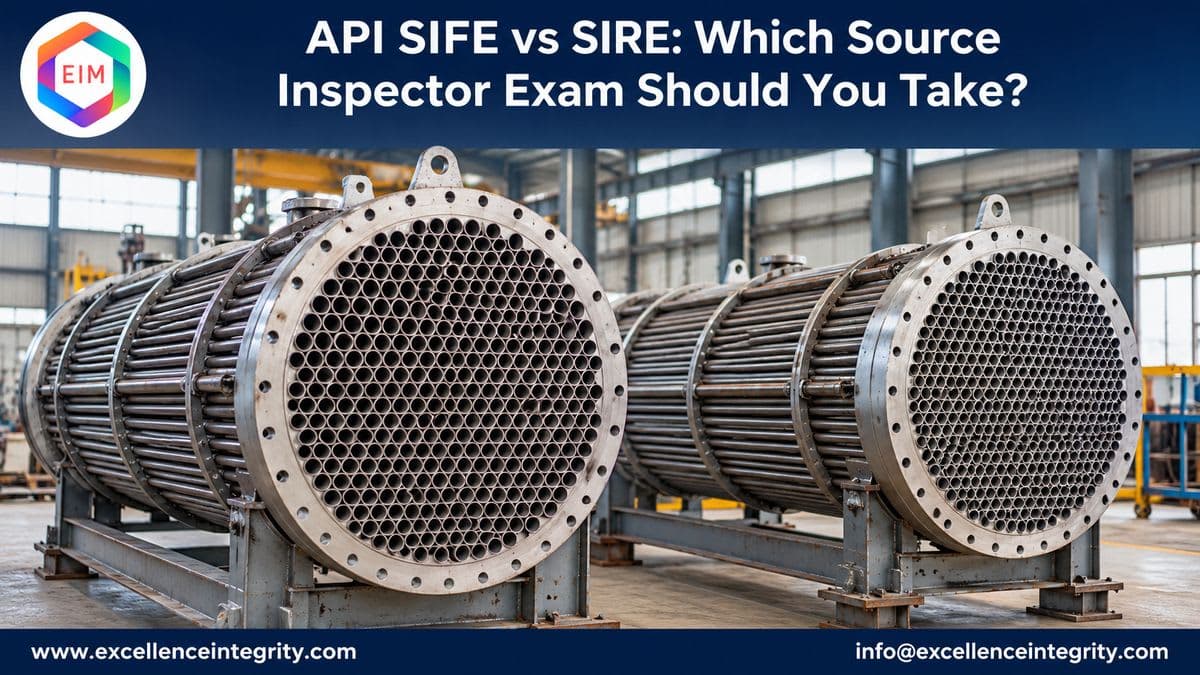
API SIFE and API SIRE are two parts of the same idea. Both certify a source inspector: someone who checks equipment at the supplier's works, and confirms the supplier's quality system is working, before the equipment ships. They share an exam format and an open eligibility. What separates them is the equipment you inspect.
Short answer: SIFE is for fixed, pressure-containing and structural equipment: vessels, columns, heat exchangers, piping, valves, pressure relief devices and tubulars. SIRE is for rotating equipment: pumps, compressors, turbines and gears. Pick the one that matches the equipment you inspect, or expect to.
What they share
- The job: supplier quality surveillance, at the manufacturing and fabrication stage, before installation. This is different work from in-service inspection under API 510, 570 or 653.
- The exam: 110 multiple-choice questions, of which 100 are scored, in 3.25 hours, closed-book with no reference material.
- Where you sit it: at a Prometric centre or by remote proctoring.
- Who can apply: anyone with experience in the petroleum and petrochemical industries, including people looking to gain industry experience for the first time. There is no prerequisite certification.
- Validity: 3 years.
Where they differ
| API SIFE (fixed equipment) | API SIRE (rotating equipment) | |
|---|---|---|
| Equipment | Vessels, columns and towers, heat exchangers, piping, valves, pressure relief devices, tubulars, structural fabrications | Pumps, compressors, turbines, gears and their appurtenances |
| Largest exam area | Manufacturing and fabrication processes (about 25%) | Pump inspection per API 610, and compressor and turbine inspection per API 617 and 618 (about 25% each) |
| Work you will not see on the other | Fabrication sequencing, welding and material traceability on pressure equipment | Mechanical run testing, performance and NPSH testing, vibration and alignment checks |
The difference is bigger than it first looks. Rotating machinery brings checks that fixed equipment never needs: run tests, vibration, bearings and seals, performance against the design curve. Someone strong in fixed-equipment source inspection cannot carry that straight across to SIRE without studying the rotating-equipment material separately.
How to choose
- You inspect fabricated pressure equipment, piping or valves at vendors: SIFE.
- You witness pump, compressor or turbine tests at the manufacturer: SIRE.
- You cover a project's full vendor list: many source inspectors hold both. Start with the one that matches most of your current work.
- You are new to the industry: both are open to you. SIFE suits a background in fabrication, welding or QA/QC; SIRE suits a mechanical or maintenance background.
Next step
To see what the SIFE job involves day to day, read what an API SIFE source inspector does. Exam details and sample questions are in our API SIFE certification guide and our API SIRE certification guide.