Polythionic Acid Stress Corrosion Cracking: Damage Mechanism of the Week
Polythionic acid stress corrosion cracking explained: why sensitised stainless steel cracks at shutdown, where it happens, and how NACE SP0170 prevents it.
Written by Nilanjan SenReviewed by Deepak Rawtal
Published 22 Oct 2026Reviewed 7 Oct 20263 min read
Week 7 of our Damage Mechanism of the Week series covers a mechanism that happens almost entirely during shutdowns. Polythionic acid stress corrosion cracking (PTA SCC) can crack stainless steel equipment in hours or days after a unit is opened, equipment that ran safely for years.
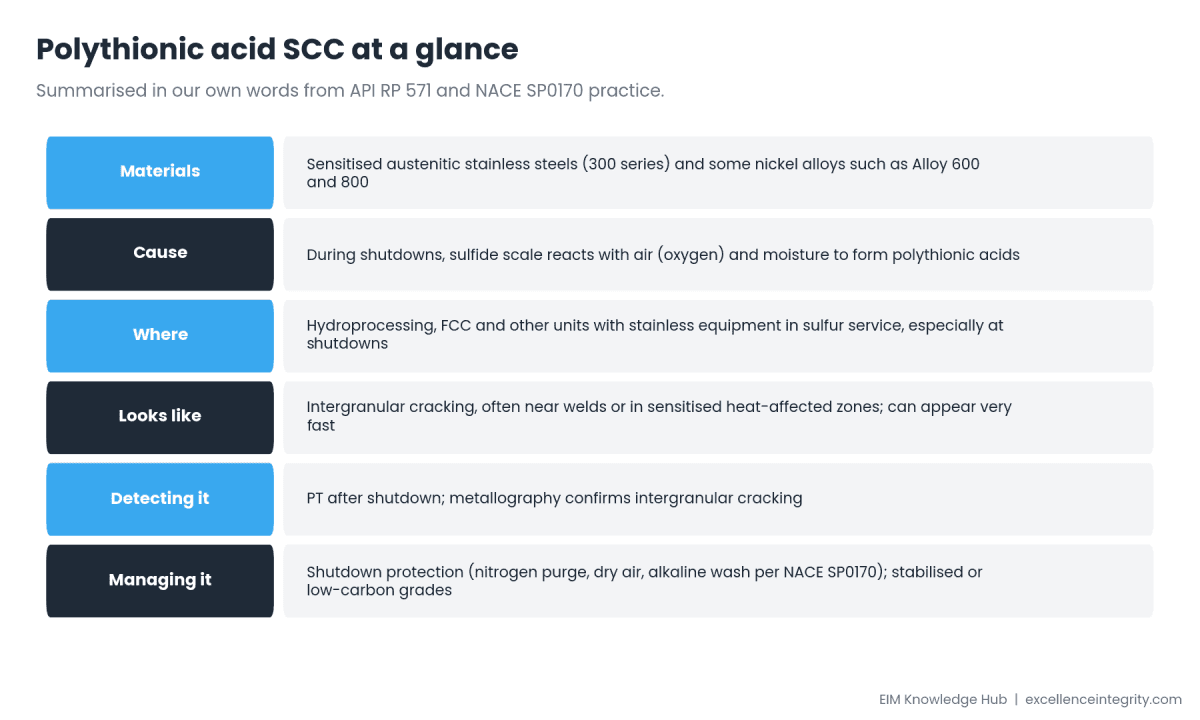
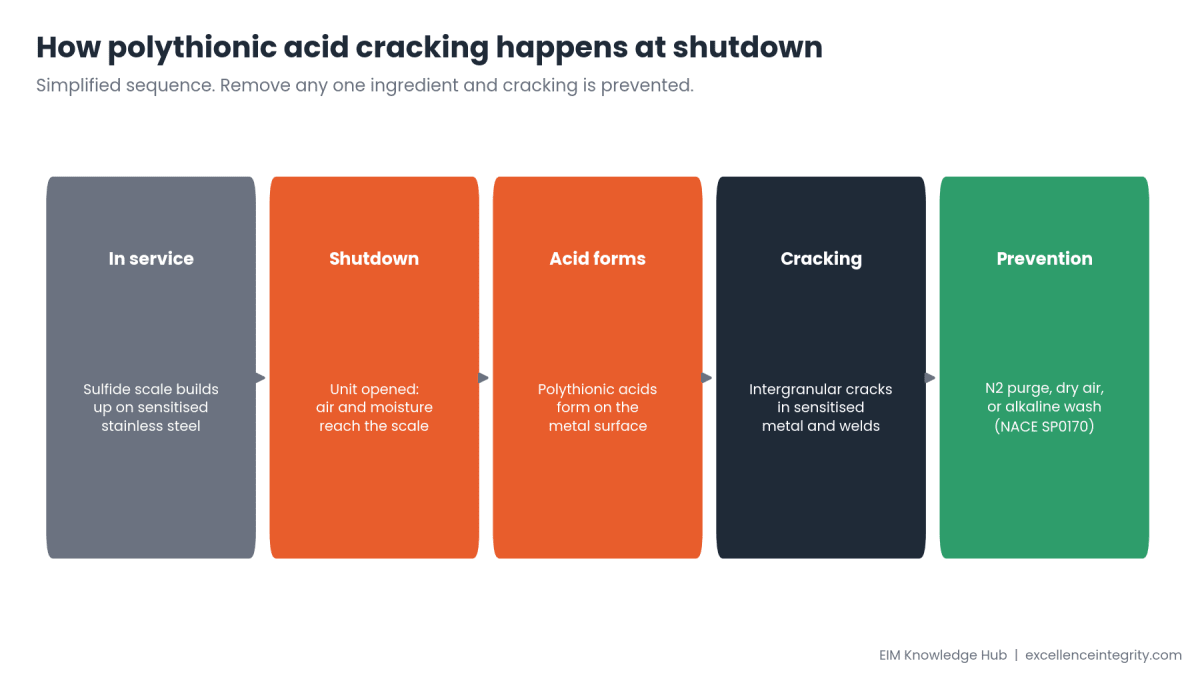
Short answer: In sulfur service, stainless steel builds up a sulfide scale. When the unit is opened and air and moisture reach that scale, polythionic acids form and attack sensitised metal along its grain boundaries. The fix is to keep air or moisture away from the scale during shutdowns, or neutralise it, as described in NACE SP0170, and to use materials less prone to sensitisation.
At a glance
Sensitisation: the precondition
Austenitic stainless steels held in a certain temperature range, during welding or long hot service, can form chromium carbides at their grain boundaries. The metal next to the boundaries loses chromium and corrosion resistance. This 'sensitised' metal is what polythionic acids attack. Low-carbon (L) grades and stabilised grades such as 321 and 347 resist sensitisation.
How it happens
Where to expect it
- Hydroprocessing units: reactor internals, heater tubes, exchangers and piping in stainless steel.
- FCC units: stainless components exposed to sulfur compounds.
- Any stainless equipment with sulfide scale that is opened to air during maintenance.
- Welds and heat-affected zones, where sensitisation is most likely.
Preventing it
- Shutdown protection per NACE SP0170: keep the equipment under nitrogen or dry air, or neutralise the scale with an alkaline (for example soda ash) wash before exposure to air and moisture.
- Plan it into the turnaround: procedures, chemicals and checks must be ready before the unit is opened.
- Materials: stabilised (321, 347) or low-carbon grades, and thermal stabilisation heat treatment where appropriate.
- Inspect after exposure: PT on susceptible welds; metallography to confirm.
Learn more with EIM
Polythionic acid SCC is one of the damage mechanisms in API RP 571 (3rd edition), the body of knowledge for the API 571 certification. EIM is an independent training provider; API certifies inspectors. EIM's self-paced API 571 preparation includes a question bank, practice mode with explanations, timed mock tests, study notes and flashcards, with one year of access, and EIM's live API 571 Damage Mechanisms - Exam Preparation course with Mr. Deepak Rawtal runs weekend batches. See the API 571 page This post is part of our weekly Damage Mechanism of the Week series.
Frequently asked questions
What is polythionic acid SCC?
Intergranular stress corrosion cracking of sensitised stainless steels caused by polythionic acids that form from sulfide scale, air and moisture, usually during shutdowns.
Why does it happen at shutdown?
In service there is no oxygen or liquid water at the scale. Opening the unit lets air and moisture in, forming the acids.
Which materials are susceptible?
Sensitised austenitic stainless steels (300 series) and some nickel alloys such as Alloy 600 and 800.
How is it prevented?
By shutdown protection under NACE SP0170 (nitrogen purge, dry air, or alkaline wash) and by using stabilised or low-carbon grades.
What does PTA cracking look like?
Intergranular cracks, often near welds or in sensitised heat-affected zones.
Sources
- API RP 571, 3rd edition: polythionic acid stress corrosion cracking. Summarised, not quoted.
- NACE SP0170, Protection of Austenitic Stainless Steels and Other Austenitic Alloys from Polythionic Acid Stress Corrosion Cracking during Shutdown of Refinery Equipment. Cited, not quoted.
- Checked 7 October 2026.