Corrosion Under Insulation (CUI): Where It Hides, Why It Happens, How to Find It
Where corrosion under insulation hides, the temperature ranges behind it in carbon and stainless steel, and how to find and prevent it.
By Siddique26 Oct 20265 min read
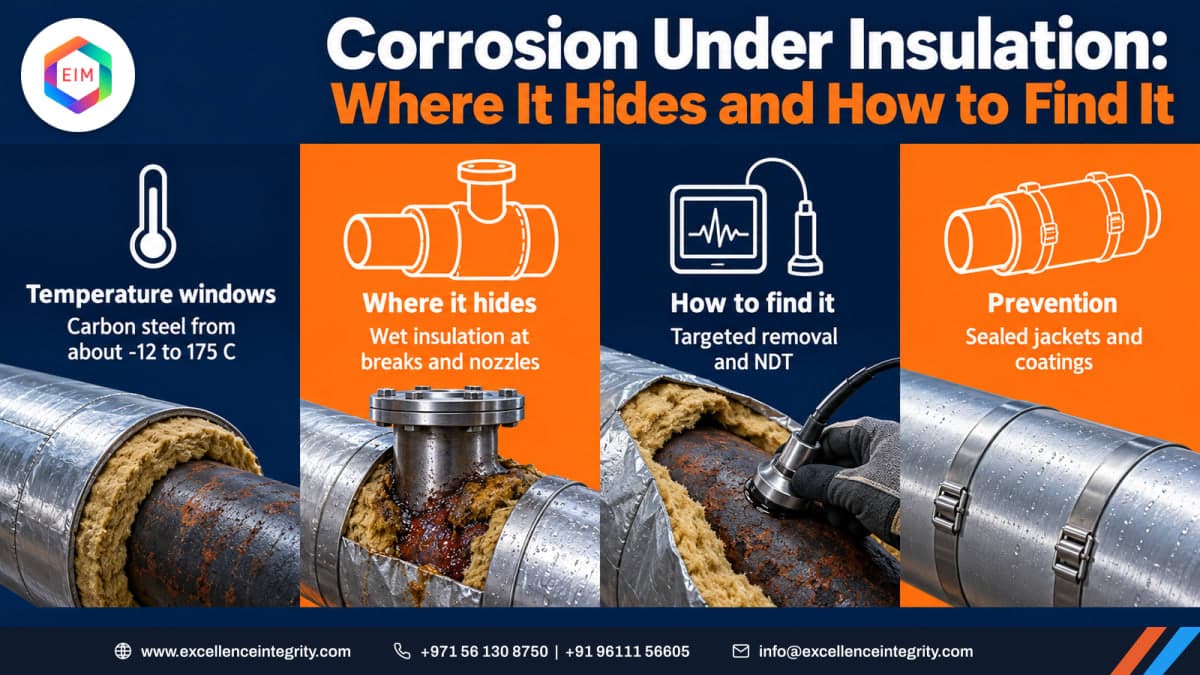
Insulation is there to save energy and protect people, but it also hides the metal. Water gets in through a damaged jacket or an unsealed penetration, sits against the steel, and corrodes it out of sight for years. By the time CUI shows itself, often as a leak, the damage is usually far worse than anyone expected.
This guide covers the temperature windows that drive CUI, the locations where it starts, the inspection methods that find it without stripping everything, and the design choices that prevent it.
Short answer: Carbon and low-alloy steel suffer CUI roughly between −12 and 175 °C; austenitic and duplex stainless steels suffer external chloride stress corrosion cracking roughly between 60 and 205 °C. CUI concentrates where insulation is interrupted: supports, nozzles, flanges, terminations, damaged jacketing and low points. Find it by risk-ranking the system, screening with NDT, and stripping only where the screening points.
Why insulated equipment corrodes
CUI needs two things: water and a metal temperature that lets the water stay wet and reactive. Water comes from rain, wash-down, deluge testing, cooling-tower drift, leaking steam tracing, or condensation on cold equipment. Once inside, insulation acts like a sponge and keeps the steel wet far longer than bare steel would stay. Contaminants such as chlorides leached from the insulation or the environment make it worse.
The temperature windows
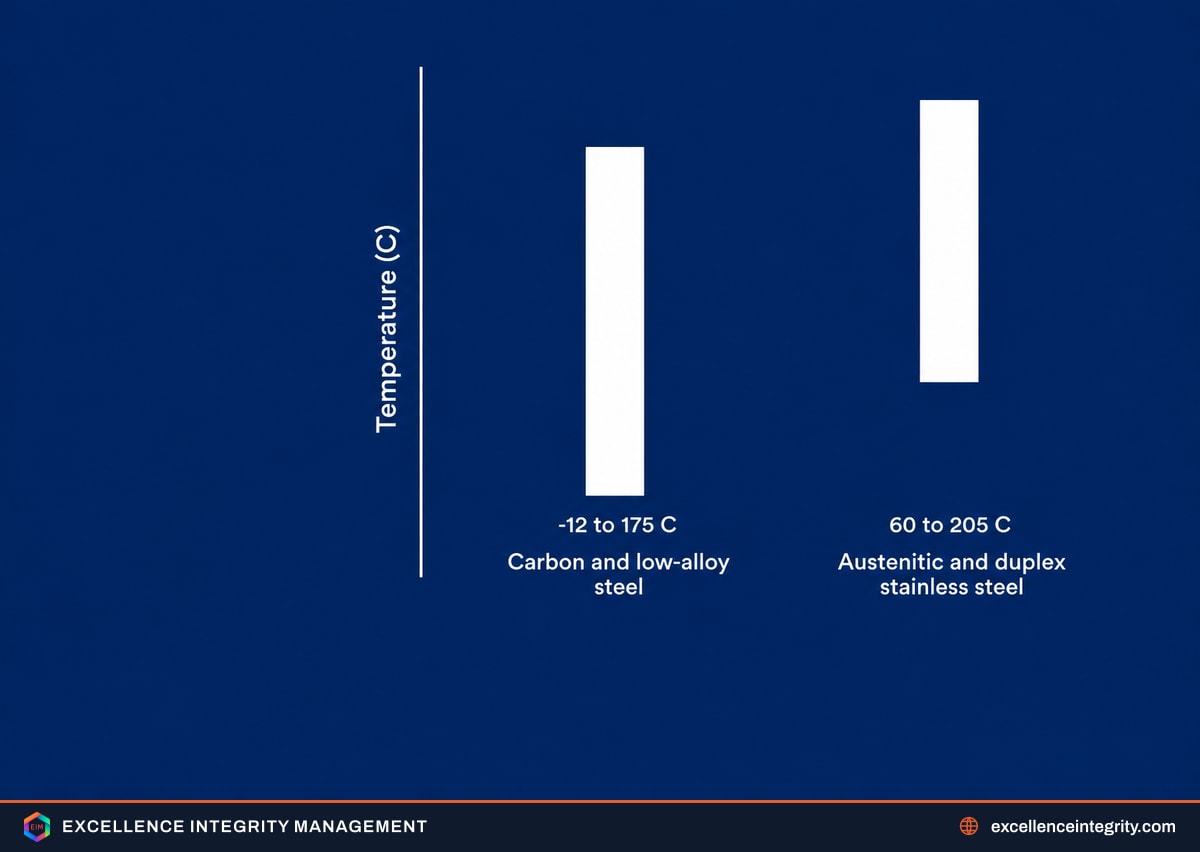
- Carbon and low-alloy steel: CUI is a concern roughly between −12 °C and 175 °C (10 to 350 °F). Below that, water tends to freeze; above it, the surface usually stays dry. Corrosion speeds up as temperature rises within the range, and the worst damage is often cited at around 75 to 110 °C, where water persists and reacts fastest.
- Austenitic and duplex stainless steel: the risk is external chloride stress corrosion cracking (ECSCC), roughly between 60 °C and 205 °C (140 to 400 °F). It produces cracks rather than wall loss, and needs chlorides, moisture and tensile stress.
- Hot equipment is not automatically safe. Equipment running above 175 °C can still suffer CUI at cooler spots: dead legs, nozzles, supports, and during shutdowns or intermittent service.
Where CUI hides
Damage is rarely uniform. It concentrates where the insulation and jacketing are broken or hard to seal:
- Pipe supports, shoes and clamps, especially bolted-on shoes
- Nozzles, branches, and small connections such as vents and drains
- Flanges, valves and fittings where insulation stops or changes
- Damaged, missing or poorly overlapped jacketing, and failed sealant
- Horizontal-to-vertical transitions, where water runs down and collects
- Low points and the bottom of vertical runs
- Insulation terminations and penetrations through platforms and walls
- Lines with steam tracing, areas wetted by cooling-tower drift or deluge testing, and cold service that sweats below ambient
In coastal Gulf plants, salt-laden humidity and frequent condensation make jacketing integrity and sealing details especially important.
How to find it without stripping everything
Removing all insulation to look is slow and expensive, and removing it can damage what you then have to reinstate. A structured programme, such as the risk-based approach set out in API RP 583, works in three steps.
- Rank the systems. Use material, operating temperature, insulation and jacket condition, age of coating, and environment to decide where CUI is most likely and where a leak would matter most.
- Screen with NDT. Visual survey of the jacketing first, then screening methods suited to the geometry: profile or real-time radiography for small-bore piping, pulsed eddy current for wall loss through insulation, guided-wave ultrasonics for long runs, and infrared thermography or neutron backscatter to find wet insulation.
- Strip and confirm where screening points. Remove insulation at the indicated locations, measure remaining wall with UT, and assess any damage found. For stainless steel, look for cracks, not just metal loss.
Each screening method has limits, such as wall-thickness range, pipe diameter, and how well it sees local pitting, so pick the method for the question you are asking.
Prevention
- Coat the steel under the insulation. A coating suited to the operating temperature is the main barrier. Thermal spray aluminium is used for longer life in hot service. On stainless steel, aluminium foil wrapping has been used as a barrier against chloride cracking.
- Design the jacketing to shed water. Overlaps facing downwards, sealed penetrations, and drainage at low points.
- Choose low-chloride insulation for stainless steel, and insulation that does not hold water.
- Remove insulation that is not needed. Where insulation exists only for personnel protection, a guard or cage avoids CUI completely.
- Maintain it. Inspect and repair jacketing and sealant routinely; most CUI starts at a small defect that nobody fixed.
Learn more with EIM
EIM's live Corrosion Under Insulation (CUI) course is led by Mr. Mahendra Kumar Rastogi, Mechanical and Metallurgical Engineer with more than 45 years in corrosion control, asset integrity and RBI. It covers CUI mechanisms, insulation types, water ingress and high-risk locations. It then moves to inspection planning, RBI and NDT for CUI, prevention and mitigation, and integrity management and standards. No batch is published at the moment, so check the course page for the next date.
For operators, EIM's asset integrity services include corrosion review and monitoring programmes.
Frequently asked questions
What temperature range causes CUI in carbon steel?
Roughly −12 °C to 175 °C (10 to 350 °F) metal temperature, with the most severe damage often cited in the middle of that range.
Can stainless steel suffer CUI?
Yes, mainly as external chloride stress corrosion cracking, roughly between 60 °C and 205 °C, when chlorides and moisture reach the surface under insulation.
Does cold insulation prevent CUI?
No. Cold equipment can sweat if the vapour barrier fails, and the wet insulation then holds water against the steel.
Is CUI covered in the API 510 and 570 exams?
Yes, CUI is among the damage mechanisms listed on the effectivity sheets for API 510, 570 and 653. Check the sheet for your window.
What is the most reliable way to confirm CUI?
Removing insulation at the suspect location and inspecting the surface, with UT for remaining wall. Screening methods tell you where to look.
Sources
- API RP 571, Damage Mechanisms Affecting Fixed Equipment in the Refining Industry, 3rd edition: Corrosion Under Insulation. Summarised, not quoted.
- API RP 583, Corrosion Under Insulation and Fireproofing. Cited by title.
- NACE SP0198, Control of Corrosion Under Thermal Insulation and Fireproofing Materials. Cited by number.
- Checked 7 October 2026.
Free mock tests
Preparing for an API, AMPP (NACE), CSWIP or CMRP exam?
Choose your certification and try a free mock test.
SMRP