Types of Corrosion: 9 Common Forms Explained in Plain English
Nine common types of corrosion explained simply: what each looks like, where it happens and how engineers prevent it, from pitting to MIC and filiform.
By Siddique23 Nov 20269 min read
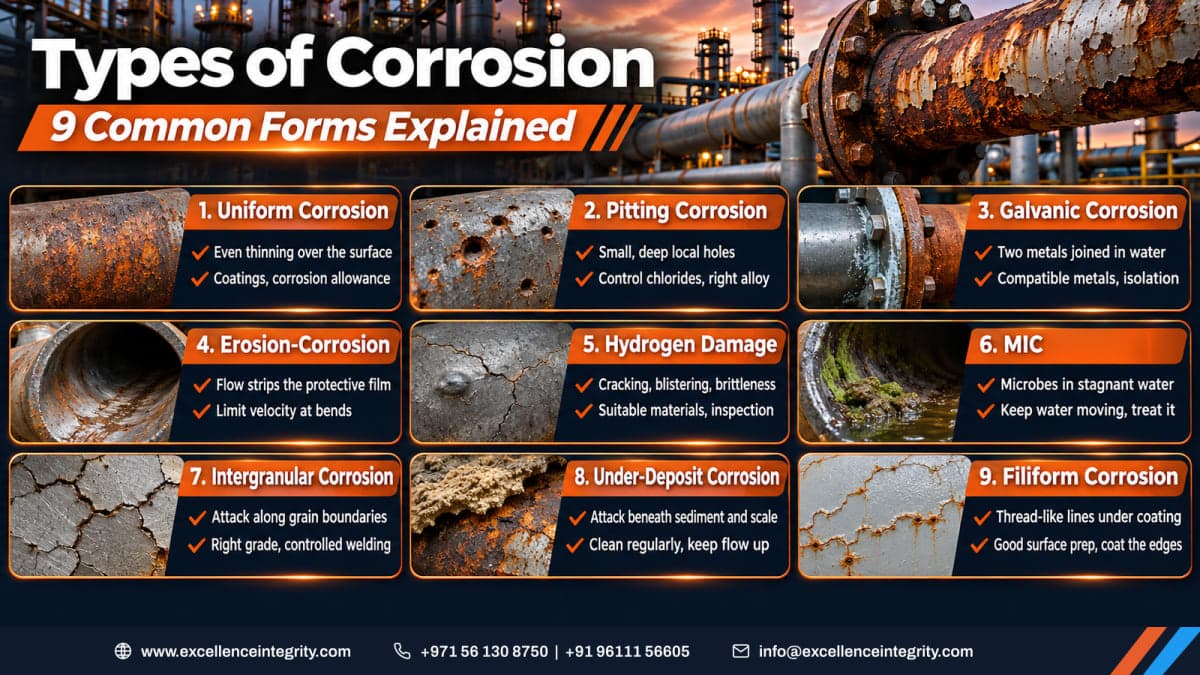
Walk round any plant with an inspector and you will hear the word corrosion used for a dozen different things. A rusty handrail, a pinhole leak in a stainless line, a crack near a weld, a blister under paint. They are all corrosion, but they do not start the same way, they do not grow at the same speed, and they are not stopped by the same fix.
This post walks through nine common types of corrosion in plain English. For each one you get what is actually happening, where it usually turns up, and what people do about it. By the end you should be able to look at a damaged surface and make a sensible first guess at the mechanism, which is the question every good inspection starts with.
Why the type of corrosion matters more than the amount
Two pipes can lose the same weight of metal and be in completely different danger. If the loss is spread evenly, the wall thins slowly and predictably, and you can calculate a remaining life from thickness readings. If the same loss is concentrated in a few deep pits, one of them can go through the wall while the average thickness still looks healthy.
That is why inspection planning begins with "which damage mechanisms can happen here?" and only then asks "how much?". The answer decides where you measure, which NDT method you use and how often you go back. It is also the backbone of the API 571 corrosion and materials certification preparation, which is built around recognising mechanisms rather than memorising rates.
1. Uniform corrosion
Uniform corrosion is the even, all-over attack most people picture when they hear the word: ordinary rusting of carbon steel exposed to moisture and oxygen. The metal thins at a roughly constant rate across the whole surface.
It is the most forgiving type because it is easy to see and easy to trend. Engineers handle it with protective coatings, a corrosion allowance added to the wall thickness at design, a more suitable material where the rate is too high, and corrosion inhibitors where the process allows them. Thickness readings taken over time give you a rate and a remaining life, which is covered step by step in how to calculate corrosion rate and remaining life.
2. Pitting corrosion
Pitting is localized attack that drills small, deep holes into the surface while the metal around them looks almost untouched. A classic case is stainless steel in water containing chlorides: the protective film breaks down at a few spots and the attack concentrates there.
Pits are dangerous because they are small at the surface and easy to miss, and because a single pit can perforate a wall long before general thinning becomes a concern. Prevention comes down to choosing a material that resists the chloride level and temperature you actually have, keeping chloride exposure under control, and inspecting with methods that can find local loss, not just average thickness.

3. Galvanic corrosion
Galvanic corrosion happens when two different metals are electrically connected and both are wetted by an electrolyte, such as water. The less noble metal becomes the anode and corrodes faster than it would on its own, while the more noble one is protected.
You see it at unsuitable connections between dissimilar metals in a wet environment: a carbon steel fitting on a copper alloy line, or stainless bolts on an aluminium bracket left out in the rain. The fixes are simple once you spot it. Use compatible materials, break the electrical path with insulating gaskets and sleeves where appropriate, and protect the joint from standing water.

4. Erosion-corrosion
Erosion-corrosion is what you get when moving fluid and corrosion work together. High velocity, turbulence, suspended solids or entrained droplets strip away the protective film faster than it can reform, so the metal underneath keeps corroding.
Look for it where flow changes direction or speed: pipe bends, reducers, tees, and the piping just downstream of control valves. The damage often has a smooth, grooved or horseshoe look that points in the flow direction. Engineers deal with it by keeping velocities within sensible limits, choosing more resistant materials for the worst spots, and putting those high-risk locations on the inspection plan by name.
5. Hydrogen damage
Hydrogen damage covers several mechanisms in which hydrogen enters the steel and changes how it behaves. Depending on the conditions it can cause cracking, blistering where hydrogen collects in the metal, or a loss of toughness so that the steel breaks more easily than expected.
It turns up in certain refinery and process equipment where hydrogen is produced by corrosion or is present in the process. Prevention means selecting materials suitable for the operating environment, controlling hydrogen exposure where possible, and following the applicable inspection practice. For one of the main forms in more detail, see hydrogen embrittlement as a damage mechanism.
6. Microbiologically influenced corrosion (MIC)
MIC is corrosion that microorganisms make worse. Bacteria and other microbes living in slime layers on the metal change the chemistry right at the surface, and the attack that follows is often local and deep.
It likes water and stillness. Typical places are water storage tanks, cooling-water systems, buried pipelines, dead legs and anywhere sediment sits undisturbed. Keeping water moving, removing deposits, treating the water where appropriate and monitoring are the usual tools. The full picture is in the MIC guide.
7. Intergranular corrosion
Metals are made of tiny crystals called grains. Intergranular corrosion attacks the boundaries between those grains rather than the grains themselves, so the metal can lose strength from the inside while the surface still looks reasonable.
A common example is susceptible stainless steel after certain fabrication or service conditions, such as heating in the wrong temperature range during welding. The result can be cracking or a sudden failure. Prevention is mostly about material and fabrication control: the right grade for the job and welding procedures that avoid sensitising the steel.
8. Under-deposit corrosion
Under-deposit corrosion happens beneath sediment, scale, sludge or other deposits sitting on a metal surface. The deposit cuts the metal off from the bulk fluid, and the small pocket underneath develops its own, more aggressive chemistry.
Pipes and vessels that collect solids are the usual suspects, especially in low-flow sections. Regular cleaning, keeping flow high enough to carry solids through, and inspecting the bottom of lines where deposits settle are the practical answers. When you find heavy deposits during a shutdown, treat the metal under them as a place to look closely, not as protected.

9. Filiform corrosion
Filiform corrosion is the odd one in this list. It grows as fine, thread-like lines under certain protective coatings, usually where moisture gets in at a scratch or an edge and conditions are humid.
It is mostly a coating durability problem on coated metal surfaces exposed to humid environments, rather than a cause of sudden structural failure. Good surface preparation before painting, sound coating at edges and prompt repair of coating damage keep it in check.
A quick way to tell the types of corrosion apart
| Type | What you usually see | First place to look |
|---|---|---|
| Uniform | Even thinning, general rust | Exposed carbon steel |
| Pitting | Small, deep holes | Stainless steel with chlorides |
| Galvanic | Attack on one metal at a joint | Dissimilar metal connections |
| Erosion-corrosion | Smooth grooves in the flow direction | Bends, tees, after control valves |
| Hydrogen damage | Cracks, blisters, brittle behaviour | Hydrogen-containing process units |
| MIC | Local pits under slime or deposits | Stagnant water, buried lines |
| Intergranular | Attack along grain boundaries | Susceptible stainless near welds |
| Under-deposit | Local loss beneath sediment or scale | Low-flow sections, line bottoms |
| Filiform | Thread-like lines under coating | Coated surfaces in humid air |
Real equipment rarely shows just one of these types of corrosion. Under-deposit attack and MIC often travel together, and a coating failure can open the door to uniform and pitting corrosion at the same time. The table is a starting point for your first guess, not a final answer.
Frequently asked questions
What is the difference between uniform and pitting corrosion?
Uniform corrosion thins the metal evenly across the whole surface, so thickness readings give you a rate and a remaining life. Pitting concentrates the attack in a few small, deep holes while the surrounding metal looks almost untouched. A single pit can go through the wall while the average thickness still looks healthy, which is why pitting is harder to find and more dangerous.
Which type of corrosion is the most dangerous?
The localized forms usually cause the nasty surprises, because they hide behind a healthy average. Pitting can perforate a wall long before general thinning is a concern, intergranular corrosion weakens the metal from the inside while the surface looks reasonable, and hydrogen damage can crack steel or make it break more easily than expected. Uniform corrosion is the most forgiving.
How do you prevent galvanic corrosion?
Galvanic corrosion needs two different metals, an electrical connection between them and an electrolyte such as water. Remove any one of the three and it stops. In practice that means using compatible materials, breaking the electrical path with insulating gaskets and sleeves where appropriate, and keeping standing water away from the joint.
What causes microbiologically influenced corrosion?
Bacteria and other microbes living in slime layers on the metal change the chemistry right at the surface, and the attack that follows is often local and deep. MIC likes water and stillness, so it turns up in water storage tanks, cooling-water systems, buried pipelines, dead legs and anywhere sediment sits undisturbed.
What to do next
The skill that separates a good inspector from an average one is naming the mechanism correctly before choosing the method. If you work in refining or process plants, the API 571 certification preparation takes these mechanisms much further, with the conditions that drive each one and how they are found. For plant teams who manage internal corrosion day to day, the internal corrosion management programme covers monitoring, control and the decisions that follow.
Exam preparation
Preparing for API 571?
Practise with exam-style questions, timed mocks and study notes. 3,357 questions in the bank.