Types of Bearings, Their Lubrication and Common Failures
The main types of bearings and where each is used, how to lubricate them properly, and how to read the common failures from overheating to electrical erosion.
By Harish Haseeb23 Nov 20267 min read
Bearings are small, cheap compared with the machines they sit in, and responsible for a large share of rotating equipment breakdowns. When a pump, fan or gearbox fails early, the bearing is usually the part that tells the story, and often it is not the bearing's fault. The wrong type, the wrong grease, too much grease, dirt, moisture or misalignment did the damage.
This post covers the common types of bearings and what each one is good at, how lubrication keeps them alive, and the failure patterns you are most likely to find when you open a housing. The aim is practical: pick the right bearing, look after it properly and read the evidence when one gives up.
Rolling bearings in one paragraph
A rolling bearing has an inner ring, an outer ring, rolling elements (balls or rollers) and a cage that keeps them spaced. Balls make point contact and suit higher speeds with lighter loads. Rollers make line contact and carry heavier loads. Load direction matters too: radial load acts at right angles to the shaft, axial (thrust) load acts along it. Most bearing choices come down to how much of each, at what speed, with how much misalignment.
Ball bearings
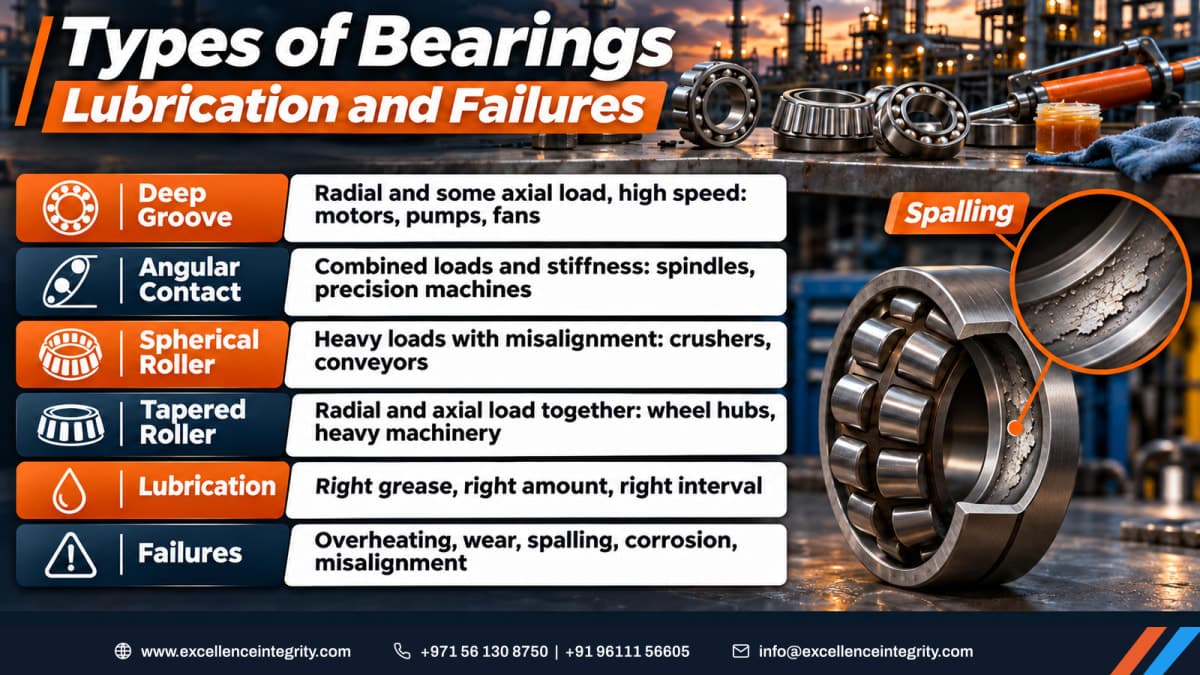
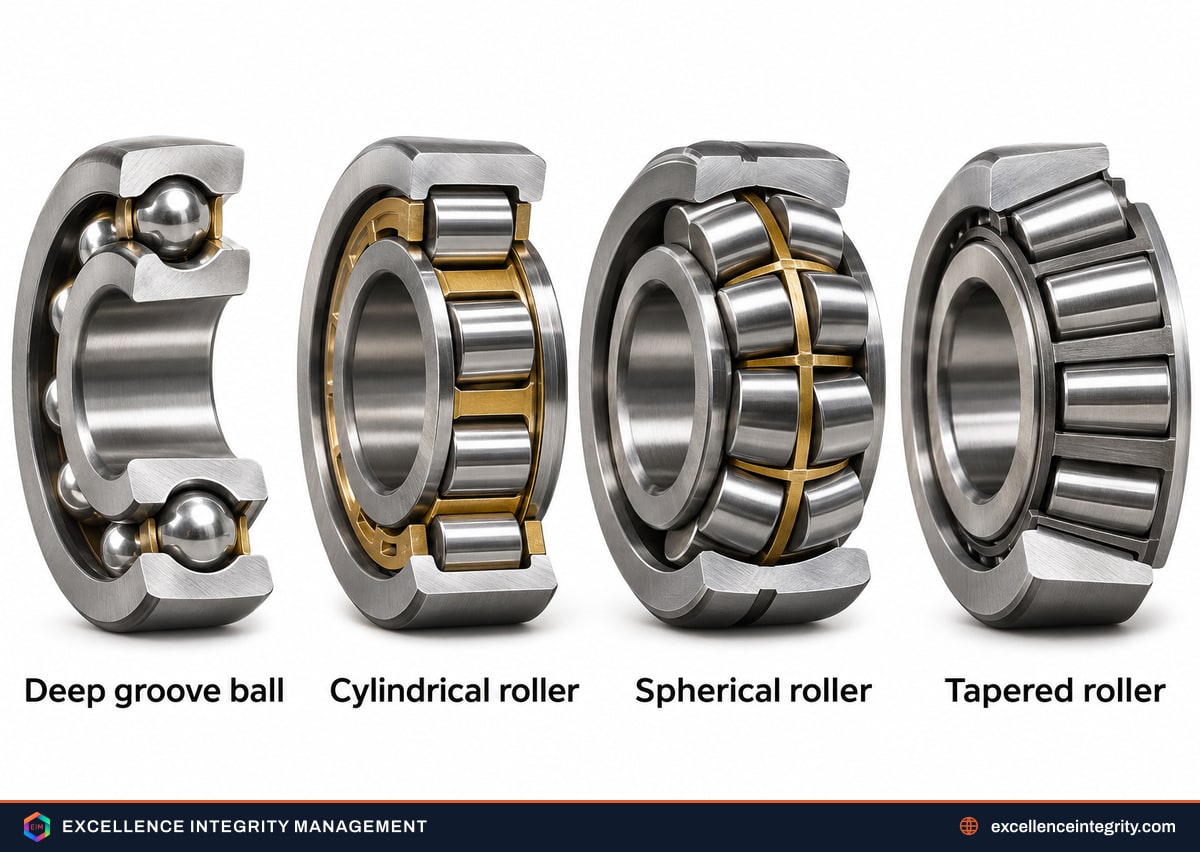
Deep groove ball bearing. The everyday bearing. It supports radial load and moderate axial load in both directions, runs fast and quietly, and is found in electric motors, pumps, fans and household appliances. If in doubt, this is usually where design starts.
Angular contact ball bearing. The raceways are offset so the balls carry combined radial and axial load, usually in one direction, so they are often mounted in pairs. Used in machine-tool spindles, pumps and precision machinery where stiffness and accuracy matter.
Self-aligning ball bearing. Two rows of balls run in a spherical outer raceway, so the inner ring can tilt and accommodate limited shaft misalignment or deflection. Common in agricultural machinery and textile equipment.
Thrust ball bearing. Designed mainly for axial load, with little or no radial capacity. Used in turntables and light-duty axial-load applications.
Roller bearings
Cylindrical roller bearing. High radial load capacity and stiffness, with limited or no axial capacity depending on the design. Used in gearboxes, electric motors and industrial machinery.
Spherical roller bearing. Two rows of barrel-shaped rollers in a spherical outer raceway. It carries heavy radial loads and combined loads while tolerating misalignment, which is why crushers, conveyors and mining equipment use it.
Tapered roller bearing. Cone-shaped rollers carry combined radial and axial load. Usually mounted in pairs and adjusted for the right clearance or preload. Common in automotive wheel hubs, differentials and heavy machinery.
Needle roller bearing. Long, thin rollers give high radial capacity in very little radial space. Used in transmissions, compressors and automotive components.
Thrust roller bearing. Rollers carry heavy axial load. Found in industrial gearboxes, cranes and heavy machinery.
Mounted and special bearings
Pillow block bearing. A bearing already fitted in a housing that bolts to a frame, which makes shaft support quick to install. Conveyors, fans and agricultural equipment use them widely.
Linear ball bearing. Gives low-friction straight-line movement along a shaft or rail, rather than rotation. Used in CNC machines, automation and packaging systems.
Slewing ring bearing. A large-diameter bearing that, depending on its design, carries axial, radial and tilting-moment loads together. Cranes, excavators and wind turbines rely on them.
Choosing between the types of bearings
| If the job has... | Look first at |
|---|---|
| High speed, light to moderate load | Deep groove ball |
| Combined load, need for stiffness | Angular contact ball, tapered roller |
| Heavy radial load | Cylindrical roller |
| Heavy load with shaft misalignment | Spherical roller, self-aligning ball |
| Little radial space | Needle roller |
| Mainly axial load | Thrust ball or thrust roller |
| Quick installation on a frame | Pillow block |
The bearing manufacturer's selection data and your equipment maker's specification settle the final choice, including size, clearance class and sealing. The table is for narrowing the field.
Lubrication: where most bearing lives are won or lost
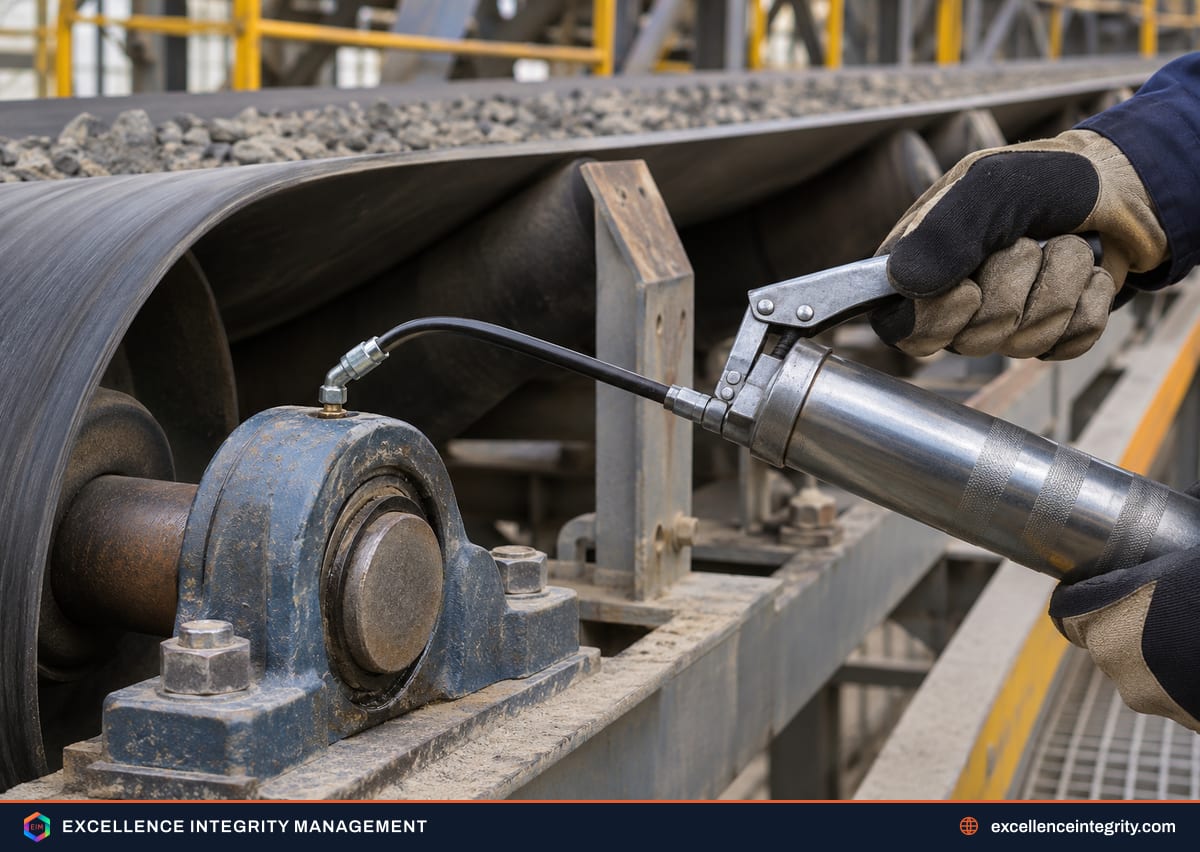
Good bearing lubrication keeps a thin film between the rolling elements and the raceways, carries away heat and keeps out moisture and dirt. Most bearing problems trace back to something going wrong with that film. A few habits make the biggest difference:
- Use the lubricant the bearing and equipment makers recommend for the speed, load and temperature. A grease that is right for a slow conveyor can be wrong for a fast motor.
- Get the quantity right. Too little starves the contact; too much makes the bearing churn the grease and run hot. Overgreasing is one of the most common causes of overheating.
- Keep to the relubrication intervals, and do not mix greases with incompatible thickeners.
- Keep the lubricant clean: wipe fittings before greasing and store grease and oil sealed.
- Look after the seals and housings, because a damaged seal lets in the dirt and water that ruin the lubricant.
Lubrication is the point where bearings, oil seals and housings meet. Good sealing keeps the lubricant in and contamination out, which is the same job a gland packing or a mechanical seal does further along the shaft.
Common bearing failures and what causes them
When you take out a failed bearing, the marks on it are evidence. Reading them correctly points to the real cause, which is the only way to stop the next one failing the same way.
- Overheating. Discoloured rings or burnt grease. Usual causes: poor lubrication, overgreasing, excessive preload or overload.
- Wear. Dull, worn raceways and increased clearance, often caused by contamination or inadequate lubrication.
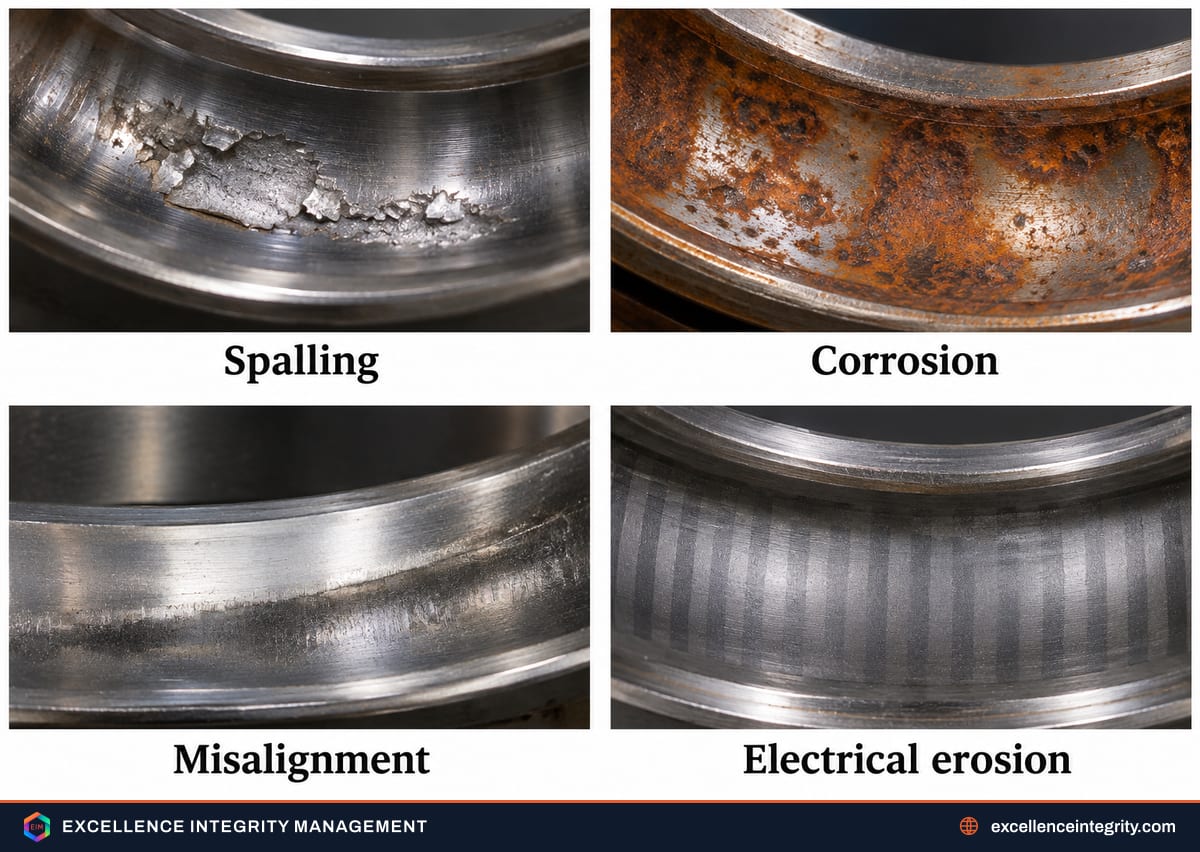
- Fatigue and spalling. Flakes of metal lifting from the raceway surface. Associated with cyclic loading, unsuitable operating conditions or lubrication problems, and sometimes simply with a bearing reaching the end of its life.
- Corrosion. Rust or etching from moisture or aggressive chemicals, often after water got past a seal or the machine stood idle in a damp place.
- Misalignment. A wear path that runs off-centre or at an angle on the raceway, with uneven loading, vibration and early failure. Shaft alignment and correct fits prevent it.
- Electrical erosion. Electrical currents passing through the bearing damage the raceways, sometimes leaving evenly spaced grey bands. It is most often seen in some electric motors, particularly those on variable speed drives.
Prevention comes down to the same short list every time: correct selection, clean installation with the right tools (never hammer on the rolling elements), suitable lubrication, effective sealing and regular condition monitoring.
Catching problems early
Bearings rarely fail without warning. Rising vibration, new noise, higher temperature and changes in the lubricant all come before the failure, and each can be measured. Vibration analysis picks up defects in the rolling elements and raceways, thermography shows hot bearings and housings, and oil analysis shows wear metals and contamination in oil-lubricated machines. Combined with sound alignment, fits and clearances, these turn bearing replacement from an emergency into a planned job.
Frequently asked questions
What are the main types of bearings?
Rolling bearings split into ball bearings and roller bearings. The ball family covers deep groove, angular contact, self-aligning and thrust ball bearings. The roller family covers cylindrical, spherical, tapered, needle and thrust roller bearings. Mounted and special designs, such as pillow blocks, linear ball bearings and slewing rings, are built on the same principles for particular jobs.
What is the difference between ball bearings and roller bearings?
Balls make point contact with the raceway, so they suit higher speeds with lighter loads. Rollers make line contact and carry heavier loads. That is why a deep groove ball bearing is the usual choice for a fast electric motor, while a crusher or a heavily loaded gearbox shaft uses spherical or cylindrical roller bearings.
What causes a bearing to fail early?
Usually it is not the bearing's fault. Poor lubrication, overgreasing, dirt or water getting past a damaged seal, misalignment, the wrong bearing for the load and electrical currents from variable speed drives all shorten bearing life. The marks on the failed bearing, such as discoloured rings, an off-centre wear path or spalling, point to the real cause.
How do you know a bearing is going bad?
Bearings rarely fail without warning. Rising vibration, new noise, higher temperature and changes in the lubricant all come first, and each can be measured. Vibration analysis finds defects in the rolling elements and raceways, thermography shows a hot housing, and oil analysis shows wear metals and contamination in oil-lubricated machines.
Where to go from here
Bearing selection, lubrication and failure analysis are core skills in rotating equipment work. The rotating equipment maintenance and troubleshooting course covers them hands-on, and why rotating equipment maintenance matters sets out the cost of getting them wrong. For pump bearings in particular, pump cavitation and NPSH explains another common source of vibration. Engineers moving into reliability roles can go further with the SMRP CMRP exam preparation.
Exam preparation
Preparing for SMRP CMRP?
Practise with exam-style questions, timed mocks and study notes. 1,448 questions in the bank.