Corrosion Rate and Remaining Life: How Inspectors Set the Next Inspection Date
How to calculate long-term and short-term corrosion rates, remaining life and the next inspection date for vessels and piping, with two worked examples.
EIM Editorial Team15 Oct 20265 min read
Every thickness reading you take answers a question somebody will ask later: how long can this run? API 510 for pressure vessels and API 570 for piping use the same simple arithmetic to answer it. The maths takes a minute. The judgement behind it, which rate to trust and what the code allows, is where inspectors earn their keep.
This article works through the method with two examples, then covers the calls the formulas do not make for you.
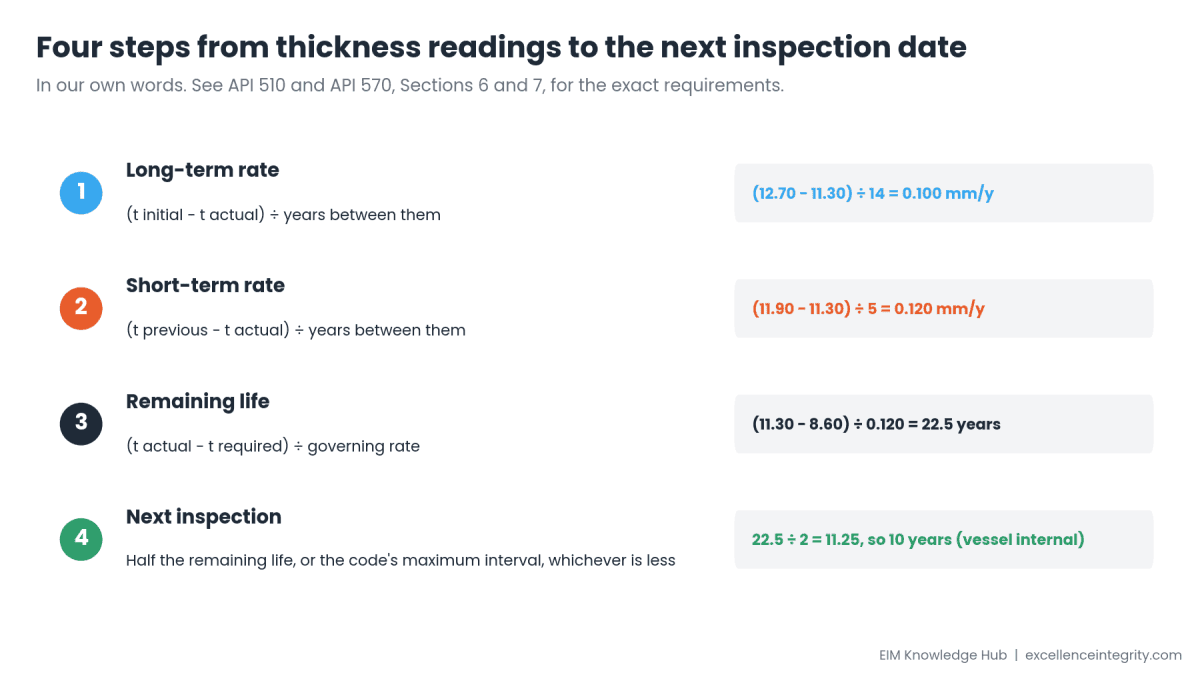
Short answer: Work out the long-term and short-term corrosion rates, use the one that best reflects current conditions (usually the higher), divide the metal you have left above the required thickness by that rate to get remaining life, and inspect again within half that life, or sooner if the code's maximum interval is shorter.
The four thicknesses you need
- t initial: the first measured thickness at that location, at installation or at the start of a new corrosion environment.
- t previous: the thickness from the previous inspection at the same location.
- t actual: the thickness measured now.
- t required: the minimum thickness the component needs, without any corrosion allowance. For piping in particular, this is the greater of the pressure design thickness and the structural minimum.
Each set of readings belongs to one condition monitoring location (CML). Keep locations consistent from one inspection to the next, or the rates become meaningless.
The method in four steps
Remaining life = (t actual − t required) ÷ governing corrosion rate
Worked example 1: a pressure vessel shell
| Input | Value |
|---|---|
| t initial (2012) | 12.70 mm |
| t previous (2021) | 11.90 mm |
| t actual (2026) | 11.30 mm |
| t required | 8.60 mm |
| Long-term rate | (12.70 − 11.30) ÷ 14 = 0.100 mm/y |
| Short-term rate | (11.90 − 11.30) ÷ 5 = 0.120 mm/y |
| Governing rate | 0.120 mm/y (about 4.7 mpy) |
| Remaining life | (11.30 − 8.60) ÷ 0.120 = 22.5 years |
| Next internal inspection | Half of 22.5 = 11.25 years, but capped at 10 years, so 2036 |
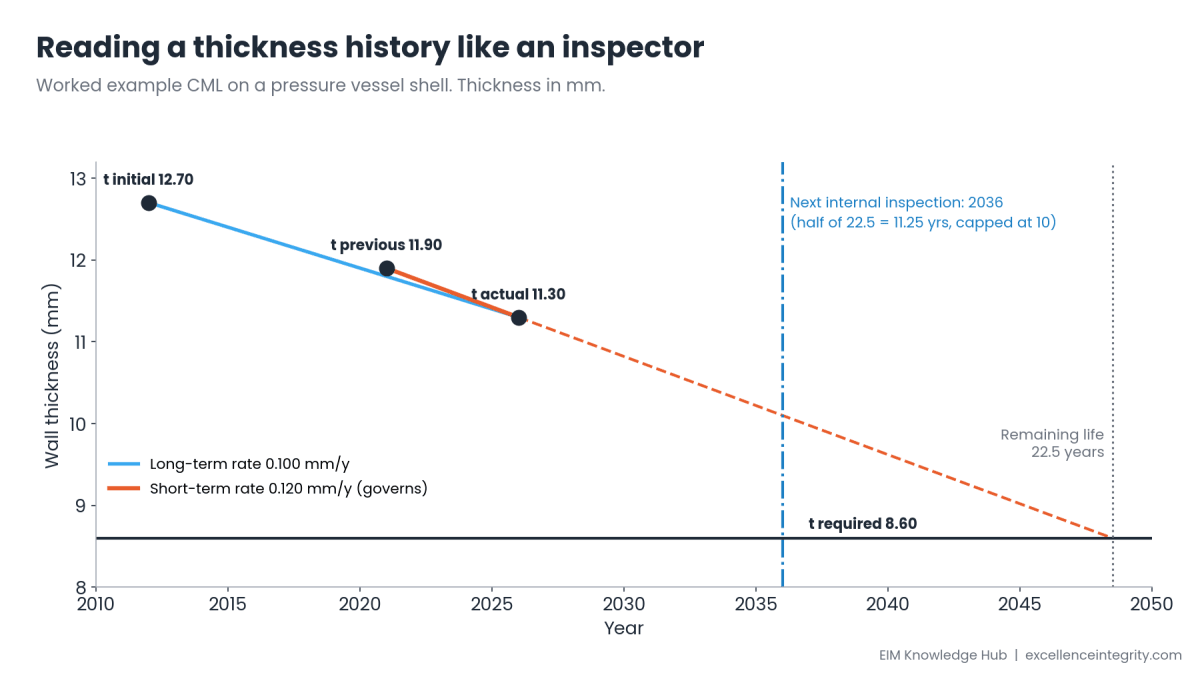
Here the code's maximum interval, not the corrosion rate, sets the date. That is common on vessels with low corrosion rates and generous thickness.
Worked example 2: a piping CML
| Input | Value |
|---|---|
| t initial (2014) | 7.11 mm |
| t previous (2022) | 6.60 mm |
| t actual (2026) | 6.10 mm |
| t required (structural minimum governs) | 4.80 mm |
| Long-term rate | (7.11 − 6.10) ÷ 12 = 0.084 mm/y |
| Short-term rate | (6.60 − 6.10) ÷ 4 = 0.125 mm/y |
| Remaining life | (6.10 − 4.80) ÷ 0.125 = 10.4 years |
| Next thickness measurement | Within 5.2 years (by 2031), or sooner if API 570's maximum interval for the piping class is shorter |
The short-term rate is about 50% higher than the long-term rate. Before you simply take the higher number, ask why the line is corroding faster now. A process change, a new injection point or a change in flow can all accelerate corrosion. If the cause is real, the short-term rate is the honest one, and the circuit may need more locations or monitoring as well as an earlier date.
Which rate governs?
The codes leave the choice to the inspector, working with a corrosion specialist where needed: use the rate that best reflects current conditions. In practice that is usually the higher of the two, but not automatically.
- The short-term rate can mislead when readings come from a different instrument, a slightly different spot, a different temperature, or a rushed survey. A very low or negative short-term rate is almost always measurement error, not good news.
- The long-term rate can mislead when conditions have changed. It averages old, gentle service with today's harsher service and hides the acceleration.
- Statistics help on circuits with many CMLs. Both codes allow statistical analysis of thickness data, which is more reliable than trusting a single location.
Five mistakes that change the answer
- Mixing units. Millimetres with inches, or months with years. Convert everything first.
- Using nominal thickness as t initial when a measured baseline exists. Follow the code's guidance where no initial reading was taken.
- Putting the corrosion allowance into t required. The required thickness excludes it.
- Averaging away local thinning. One low reading at a CML is a warning, not noise. Investigate it.
- Forgetting the code's maximum interval, as in example 1, or forgetting to recalculate after a process change.
When t actual is already below t required
Then remaining life is zero and the question changes: repair, rerate, replace, or show it is still fit for service. A fitness-for-service assessment to API 579-1/ASME FFS-1 is the structured way to make that call. EIM's self-paced API 579-1 Fitness-For-Service programme covers Level 1 to 3 assessments and remaining life.
Try it yourself
The EIM Calculator includes corrosion rate and remaining life, retirement thickness and MAWP calculations, with a live demo on the page. Run the two examples above and compare your answers. For a second opinion on a real case, EIM Daily offers quick expert calls on API 570 piping, standards and calculations, with a written summary.
Frequently asked questions
What if I only have two readings?
Then t initial and t previous are the same reading, and the long-term and short-term rates are equal.
Is the next inspection always at half the remaining life?
Half the remaining life is the limit set by corrosion. The code's maximum interval can be shorter, and where a risk-based inspection assessment is in place, the codes allow intervals to be set from it within their conditions.
How do I convert mm/y to mpy?
Divide by 0.0254. For example, 0.120 mm/y is about 4.7 mpy.
Does the same method apply to storage tanks?
API 653 uses its own methods for tank shells and bottoms, including minimum remaining thickness for bottoms. The principle of rate and remaining life is similar, but follow API 653 for tanks.
What is t required for piping?
The greater of the thickness needed for pressure and the structural minimum thickness, without corrosion allowance. On small-bore and low-pressure lines, the structural minimum often governs.
Sources
- API 510, Pressure Vessel Inspection Code, 11th edition: Section 6 (inspection intervals) and Section 7 (corrosion rate and remaining life). Cited by section; not quoted.
- API 570, Piping Inspection Code, 5th edition: Sections 6 and 7. Cited by section; not quoted.
- Worked examples prepared by EIM. Checked 7 October 2026.