Corrosion Coupons vs ER Probes vs LPR: Which Monitoring Method Should You Trust?
How corrosion coupons, ER probes and LPR probes work, what each can and cannot tell you, worked rate calculations, and where to place them in a pipeline.
EIM Editorial Team16 Oct 20267 min read
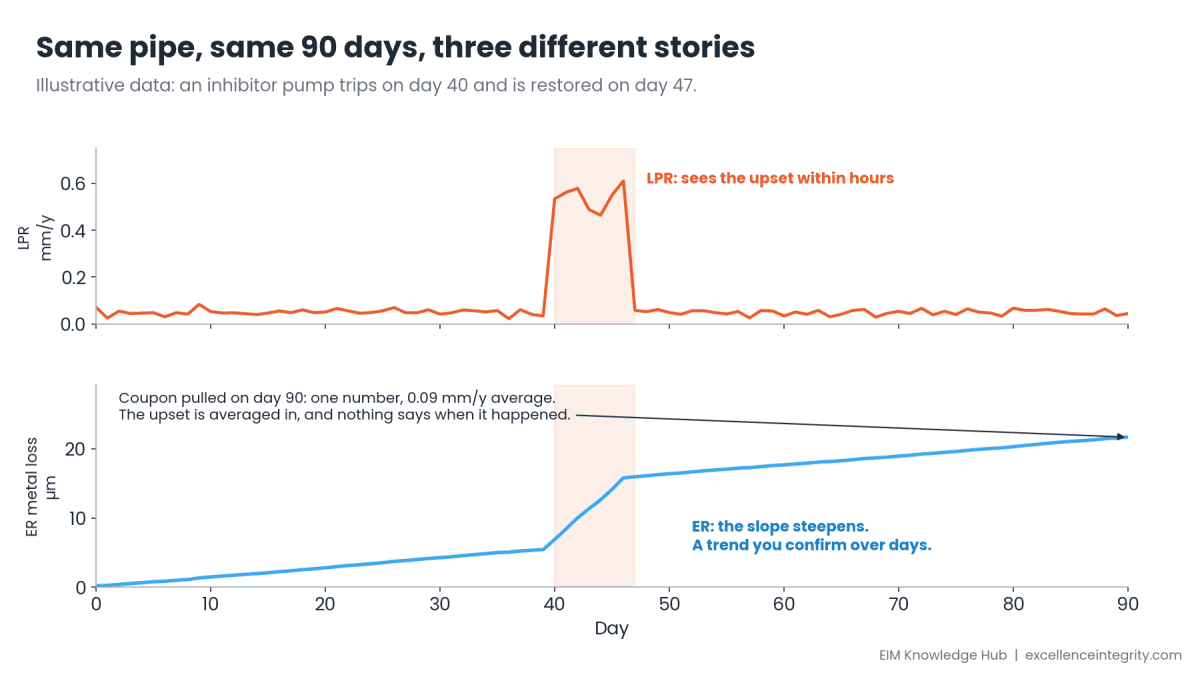
Inspection tells you how much wall is left. Corrosion monitoring tells you how fast it is going now, and whether your chemical treatment is working between inspections. The three workhorse methods in oil and gas are weight-loss coupons, electrical resistance (ER) probes and linear polarisation resistance (LPR) probes. They measure different things, respond at different speeds and fail in different ways. Most good programmes use more than one.
Short answer: Coupons give the most trusted average rate and show you pitting, but only after they are pulled. ER probes give a continuous record of metal loss in almost any fluid, but need days to show a trend. LPR gives a near-instant corrosion rate, but only in a conductive water phase.
Weight-loss coupons
A coupon is a weighed strip or disc of metal similar to the pipe, mounted in the flow for a set period, often 30 to 90 days. After removal it is cleaned, weighed again and examined. The mass lost gives an average general corrosion rate. The surface shows pits, deposits and attack patterns that no electronic probe can, and the deposits can be sampled for bacteria.
Worked example
The standard mass-loss formula, as used in ASTM G1 and NACE SP0775, is:
Corrosion rate (mm/y) = 87,600 × W ÷ (A × T × D)
where W is mass loss in grams, A is exposed area in cm², T is exposure time in hours and D is metal density in g/cm³.
A carbon steel coupon with 20 cm² exposed loses 0.250 g in 90 days (2,160 hours). Density is 7.86 g/cm³. Corrosion rate = 87,600 × 0.250 ÷ (20 × 2,160 × 7.86) = 0.065 mm/y, about 2.5 mpy.
That looks acceptable. But the deepest pit on the same coupon is 0.12 mm. Over 90 days that is a pitting rate of 0.12 × 365 ÷ 90 = 0.49 mm/y, about seven and a half times the general rate. A pipe does not fail at its average rate; it fails at its deepest pit. Always measure and report pitting, not just mass loss.
Limits
- The answer arrives only when the coupon is pulled, so a two-week upset is averaged into a three-month number.
- Results depend on careful preparation, handling, cleaning and weighing.
- The rate applies to the coupon's position, which may not be the worst point in the line.
Electrical resistance (ER) probes
An ER probe has a thin metal element exposed to the fluid. As the element corrodes and thins, its electrical resistance rises. Comparing it with a protected reference element, which compensates for temperature, gives cumulative metal loss, logged continuously. ER probes work in almost any environment, including gas, oil and low-conductivity fluids, because they do not rely on measuring an electrochemical reaction.
Worked example
ER instruments usually report readings in divisions from 0 to 1,000 across the element's useful thickness, called its span. Metal loss = span × change in reading ÷ 1,000. A probe with a 250 µm span moves from 200 to 260 divisions in 30 days. Metal loss = 250 × 60 ÷ 1,000 = 15 µm. Rate = 0.015 mm × 365 ÷ 30 = 0.18 mm/y.
Limits
- Thin elements respond faster but are used up sooner; thick elements last longer but take longer to show a trend.
- It measures general metal loss on the element and can mislead where pitting dominates.
- Conductive deposits such as iron sulfide on the element can distort readings.
Linear polarisation resistance (LPR) probes
An LPR probe has two or three electrodes in the water phase. The instrument shifts the electrode potential by a small amount, typically 10 to 20 mV, and measures the resulting current. From the polarisation resistance (Rp), the Stern-Geary relation gives the instantaneous corrosion current, and from that the corrosion rate, within minutes.
Worked example
icorr = B ÷ Rp. Using a Stern-Geary constant B of 26 mV, a common assumption for actively corroding carbon steel, and a measured Rp of 1,300 Ω·cm²: icorr = 0.026 ÷ 1,300 = 20 µA/cm². For carbon steel, 1 µA/cm² corresponds to about 0.0116 mm/y, so the rate is 0.23 mm/y.
Note the assumption. B varies from system to system, so treat LPR numbers as a trend first and an absolute value second, and calibrate them against coupons.
Limits
- Needs a continuous, conductive water phase wetting the electrodes. In oil-dominated or gas streams, readings are unreliable or impossible.
- Measures general corrosion. Any pitting indication from the instrument is qualitative at best.
- Electrode fouling and surface films can distort the reading.
The three methods side by side
| Coupon | ER probe | LPR probe | |
|---|---|---|---|
| Measures | Average mass loss and pitting over the exposure | Cumulative metal loss | Instantaneous corrosion rate |
| Response time | Weeks to months (at retrieval) | Days to weeks to show a trend | Minutes |
| Fluid needed | Any | Any, including gas and oil | Conductive water phase |
| Shows pitting? | Yes, directly | Not reliably | Not reliably |
| Best for | The reference rate, pitting, MIC sampling | Continuous trend in any service | Fast response: dosing changes, trials, upsets |
| Main weakness | Late answer; averages out upsets | Slow to show change; deposit effects | Water phase only; assumed B value |
Where to put them
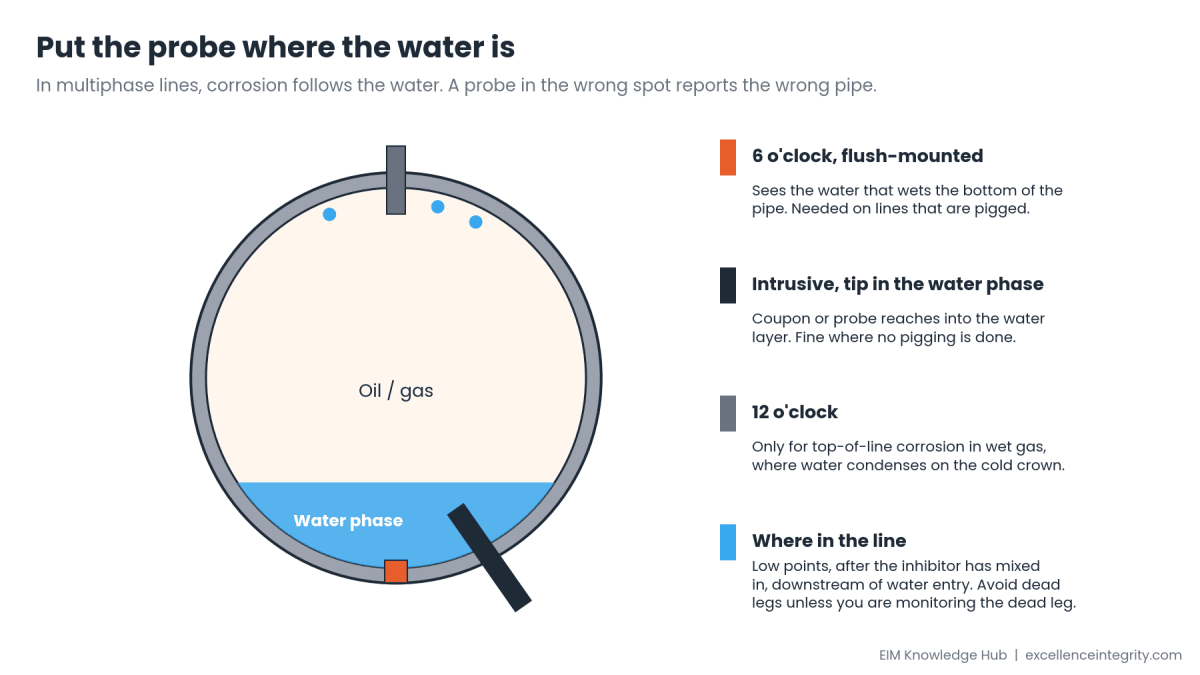
A perfect probe in the wrong place reports a pipe you do not have. In multiphase lines, corrosion follows the water, so the bottom of the line (the 6 o'clock position) is usually where it matters. Flush-mounted fittings are needed on lines that are pigged. In wet gas lines, top-of-line corrosion at 12 o'clock can be the bigger risk where water condenses on a cold pipe wall.
Along the line, favour low points, locations where the inhibitor has had time to mix, and points downstream of water entry. Choose positions from the flow regime and where water drops out, not from where access is easiest.
Using all three in a chemical field trial
Monitoring is how you prove a new inhibitor works. A sound trial combines the methods:
- Set a baseline with the current chemical before switching: at least one coupon cycle and a stable ER and LPR trend.
- Use LPR (where there is water) to see the response within hours of a dose change.
- Use ER to confirm the trend over weeks, in every phase.
- Use coupons to confirm the absolute rate and check for pitting before you sign off.
- Control or record the other variables (flow, water cut, temperature), so a change in rate can be pinned on the chemical.
For what goes wrong in trials, read Top 5 Mistakes Engineers Make During Chemical Field Trials.
Training
EIM's live course Chemical Treatment for Corrosion Control & Field Trials is led by Mr. Sandip Kuthe, Corrosion Specialist with more than 20 years in internal corrosion management internationally. Over four sessions it covers treatment chemicals and the field-trial workflow, site visits and baseline data, chemical selection, standards and monitoring, and corrosion trending, statistical process control, laboratory trials and HSE.
Next batch: 9 to 12 November 2026, Monday to Thursday, 19:00 to 21:00 UAE time.
4 sessions of 2 hours (8 CPD hours), with an EIM certificate of completion. See the course
For a self-paced route, the Internal Corrosion Management programme covers monitoring blind spots and inhibitor programmes in depth; it is EIM training, not an external credential. If you are working towards AMPP's internal corrosion certifications, see our guide to ICT vs SICT.
Frequently asked questions
Which method is most accurate?
For an average general corrosion rate over a period, a properly prepared coupon is usually treated as the reference. For speed of response, LPR. For continuous measurement in any fluid, ER.
How long should a coupon stay in?
Long enough for a measurable mass loss, short enough to be useful. 30 to 90 days is common in oil and gas. Very short exposures can overstate the rate, because corrosion is often faster on a fresh surface.
Can LPR be used in gas lines?
Generally not, because it needs a continuous conductive water phase on the electrodes. ER probes or coupons are used instead.
Why do my ER and coupon rates disagree?
They often measure different things over different periods. Check the coupon for pitting, the ER element for deposits, whether both sit at the same position, and whether the exposure periods match.
Does monitoring replace inspection?
No. Monitoring shows the rate at the probe; inspection, such as UT or inline inspection, shows the remaining wall across the asset. Use both.
Sources
- ASTM G1: preparing, cleaning and evaluating corrosion test specimens (cited by number).
- NACE SP0775: preparation, installation, analysis and interpretation of corrosion coupons in oilfield operations (cited by number).
- Worked examples and monitoring chart prepared by EIM for illustration. Checked 7 October 2026.