Consequence of Failure in RBI: How Bad Would It Be?
Consequence of failure in RBI: safety, environmental and business consequences, what drives them, and how detection and isolation reduce them.
EIM Editorial Team16 Oct 20263 min read
The second post in our API 580 cluster turns to the other half of risk. Two pipes can have the same probability of failure but very different risk: one carries cooling water, the other hot hydrocarbon near a control room. Consequence of failure (COF) is what separates them.
Short answer: COF estimates what would happen if an item leaked or ruptured: harm to people (fire, explosion, toxic exposure), damage to the environment, and business losses. It depends on the fluid, its pressure and temperature, the inventory that could be released, the size of the hole, and how quickly the leak is detected and isolated. Quantitative RBI often expresses COF as an affected area or as cost.
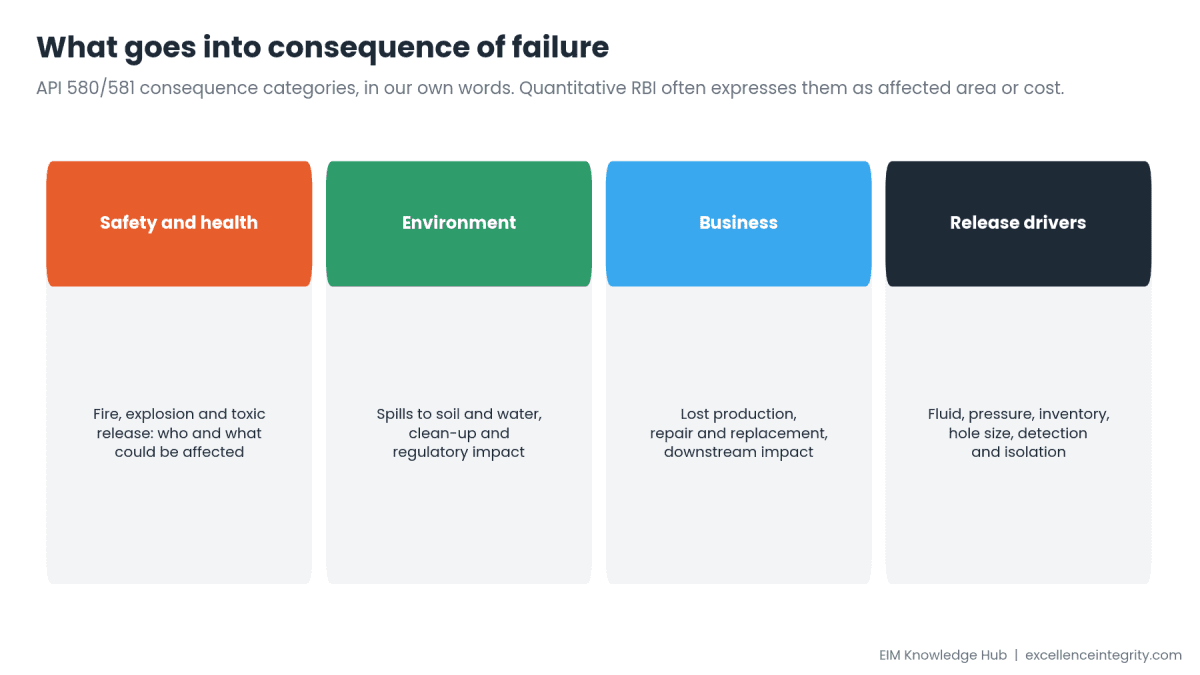
What goes into COF
- Safety and health: flammable consequences (jet fires, pool fires, vapour cloud explosions, flash fires) and toxic releases.
- Environment: spills to soil and water, clean-up and regulatory impact.
- Business: lost production, repair and replacement costs, and knock-on effects on other units.
- Release drivers: the fluid and its phase, operating pressure and temperature, available inventory, representative hole sizes, and detection and isolation systems.
From release to consequence
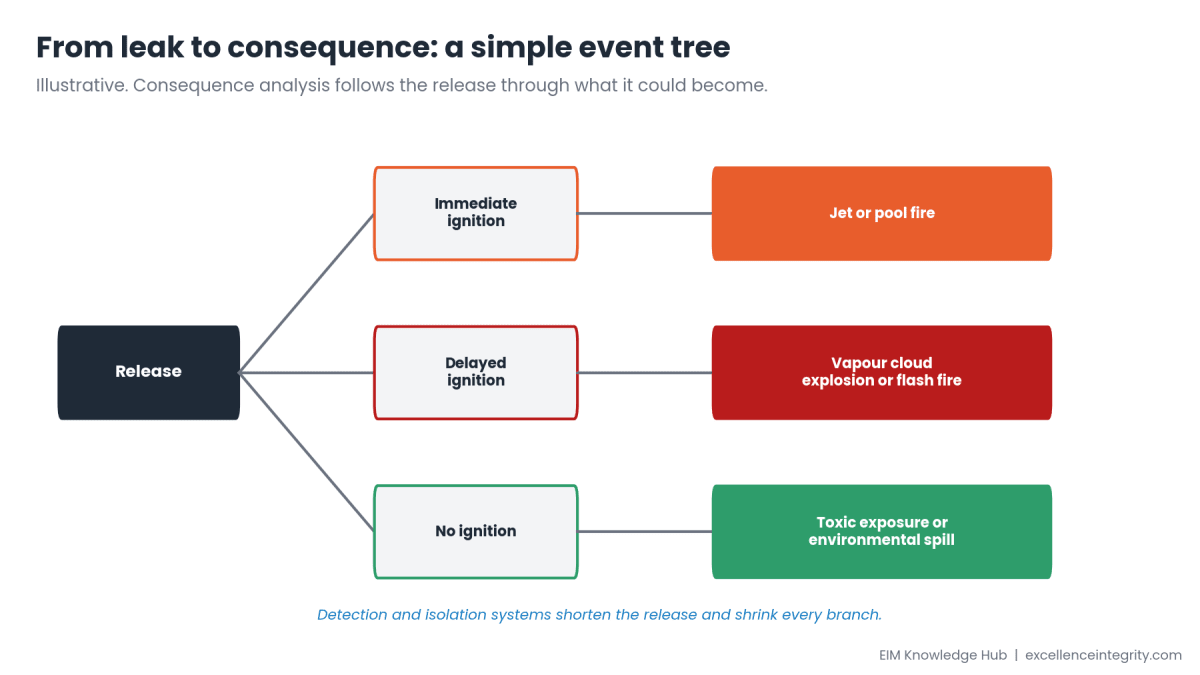
Consequence analysis follows a release through what it could become. A flammable release might ignite immediately, ignite later after forming a cloud, or not ignite at all and disperse as a toxic or environmental release. Each branch has its own consequence, and the analysis weights them.
Area or money?
Quantitative RBI in API RP 581 commonly expresses safety consequences as an affected area (for example, the area exposed to a damaging fire or explosion effect) and business consequences as cost. Qualitative methods place consequence into categories, such as A to E, based on the same drivers. Whatever the method, the categories must be calibrated to the company's own risk criteria.
Reducing consequence
- Detection: gas detectors and leak detection shorten the time before response.
- Isolation: remotely operated isolation valves limit the inventory released.
- Inventory reduction: smaller hold-ups mean smaller releases.
- Mitigation: water sprays, deluge, bunding and drainage reduce what a release can do.
- These are the levers when an item is high-risk because of consequence rather than probability; inspection alone cannot fix them.
Learn more with EIM
EIM is an independent training provider; API certifies inspectors. The API 580 certification exam is based on API RP 580 (4th edition, with Addendum 1) and is closed book; holders of API 510, 570 or 653 qualify automatically. EIM's self-paced API 580 preparation includes a question bank, practice mode with explanations, timed mock tests, study notes and flashcards, with one year of access. See the API 580 page. EIM's live Risk-Based Inspection (RBI) Techniques course with Mr. Deepak Rawtal covers RBI methodology and inspection planning, with an EIM certificate of completion; check the course page for the next batch.
Frequently asked questions
What is consequence of failure in RBI?
An estimate of the impact of a loss of containment: on people, the environment and the business.
What drives consequence?
The fluid and its phase, pressure and temperature, inventory, hole size, and detection and isolation.
How is COF expressed in quantitative RBI?
Often as an affected area for safety consequences and as cost for business consequences, as in API RP 581.
Can inspection reduce consequence?
No. Inspection reduces probability. Consequence is reduced by detection, isolation, inventory reduction and mitigation systems.
Why can two identical pipes have different risk?
Because their consequences differ: the fluid, the inventory behind them, and what is nearby.
Sources
- API RP 580, Risk-Based Inspection, 4th edition with Addendum 1; API RP 581, Risk-Based Inspection Methodology. Concepts summarised, not quoted.
- Event tree prepared by EIM. Checked 7 October 2026.