Inspecting Tank Roofs: Fixed Roofs, Floating Roofs and Seals
How inspectors check tank roofs under API 653: fixed roof plates and structure, floating roof decks, pontoons, seals, drains and the 0.09 in rule.
EIM Editorial Team12 Oct 20264 min read
Roofs are the least glamorous part of a storage tank inspection and one of the most important. A corroded fixed roof can collapse under an inspector's weight. A floating roof with a leaking pontoon can tilt, jam or sink. Damaged seals release vapour and let rainwater into the product. API 653 sets the evaluation rules and provides inspection checklists in its annexes, while API RP 575 describes inspection practice.
Short answer: On fixed roofs, check plate thickness (API 653 calls for repair or replacement where plates average less than 0.09 in in any 100 in² area), corrosion at the roof-to-shell joint, the supporting structure and the vents. On floating roofs, check the deck and every pontoon compartment, the primary and secondary seals, the roof drain, the legs, guide pole, shunts and vents, and how the roof floats. Never walk on a roof whose condition you have not confirmed.
Safety first
Roof inspections combine height, possible weak plates, and in floating roof tanks, a confined space above the product with vapour. Confirm the roof's condition before walking on it, follow the site's permit and gas-testing rules, and inspect from walkways and safe points where the roof's strength is uncertain.
Fixed roofs
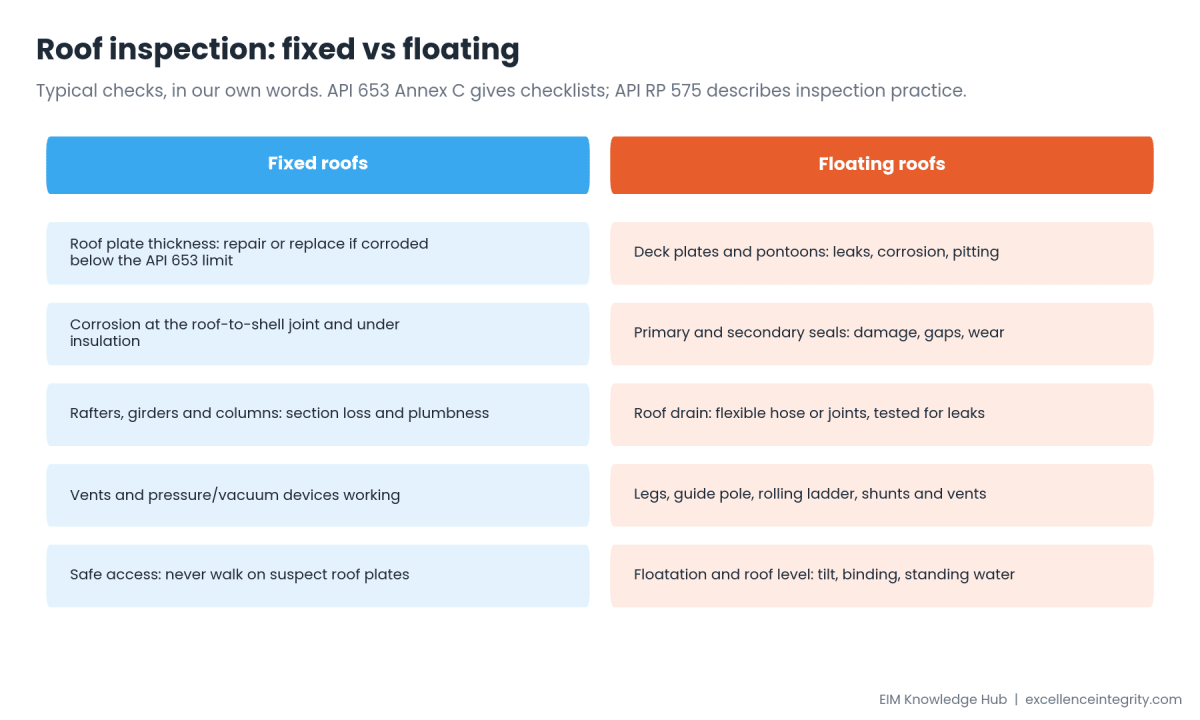
- Roof plate thickness: API 653 requires roof plates corroded to an average thickness of less than 0.09 in in any 100 in² area to be repaired or replaced. Corrosion is often worst on the underside, from the vapour space, and around the roof-to-shell joint.
- Structure: rafters, girders and columns can lose section to vapour-space corrosion. Columns also have a plumbness limit in reconstruction; see reconstruction tolerances.
- Roof-to-shell joint: corrosion here weakens the joint and can affect a frangible roof design that is meant to fail safely in an overpressure.
- Vents and pressure/vacuum devices: blocked vents can damage roofs and shells during filling and emptying.
Floating roofs
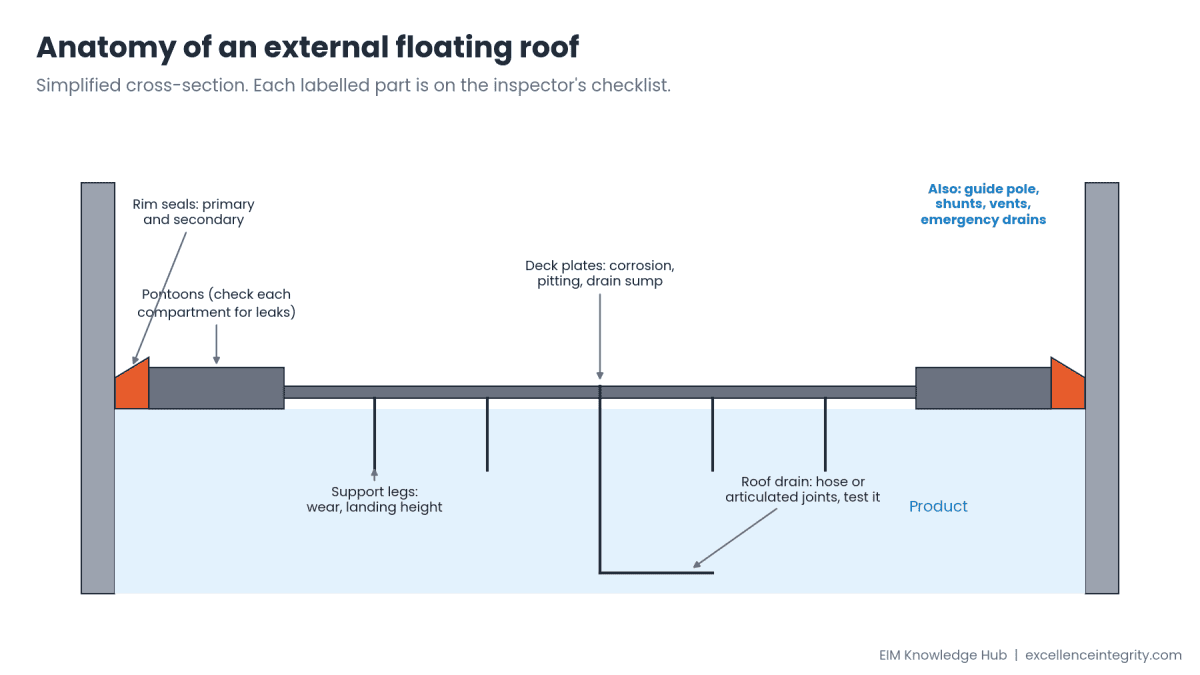
Floating roofs ride on the product to reduce vapour loss. External floating roofs are open to the weather; internal floating roofs sit under a fixed roof. The main inspection points:
- Deck plates: corrosion and pitting, especially at low points and around the drain sump.
- Pontoons: check each compartment for product or water, which shows a leak. A few leaking compartments can make the roof tilt or sink.
- Rim seals: primary seals (mechanical shoe, foam or other types) and secondary seals above them. Look for wear, tears, gaps against the shell and damaged components. Seals are designed to tolerate some shell deviation, which is one reason shell tolerances matter.
- Roof drain: the flexible hose or articulated piping that drains rainwater through the product. A leaking drain lets product onto the roof or water into the product; test it for leaks.
- Legs and landing: support legs, their pins and the landing height, plus the floor pads under them.
- Guide pole, rolling ladder, shunts and vents: wear, binding, and the electrical shunts that bond the roof to the shell.
- How it floats: tilt, binding, standing water or product on the deck.
Checklist
Common mistakes
- Measuring roof plates only from above, when corrosion is underneath.
- Checking a sample of pontoons instead of every compartment.
- Ignoring the roof drain, which is out of sight under the product.
- Treating seal gaps as a cosmetic issue, when they affect emissions and can point to shell distortion.
- Walking on an unverified roof.
Preparing for API 653
Roof evaluation and API RP 575 practice appear in API 653 exams. EIM is an independent training provider; EIM's self-paced API 653 preparation includes a question bank, practice mode with explanations, timed mock tests, study notes and flashcards, with one year of access. See the API 653 page. EIM's live AST Inspection & Maintenance course covers roofs and their testing; check the course page for the next batch.
Frequently asked questions
When must corroded roof plates be repaired under API 653?
When they are corroded to an average thickness of less than 0.09 in in any 100 in² area.
What is checked on a floating roof?
Deck plates, every pontoon compartment, the primary and secondary seals, the roof drain, support legs, guide pole, rolling ladder, shunts, vents, and how the roof floats.
Why check every pontoon?
A leaking pontoon fills with product or water. Several leaking compartments can make the roof tilt, jam or sink.
Why do floating roof seals matter?
They reduce vapour emissions and keep rainwater out of the product. Gaps and damage increase emissions and can indicate shell distortion.
Which documents cover roof inspection?
API 653 for evaluation and its annex checklists, and API RP 575 for inspection practice.
Sources
- API 653, roof evaluation and Annex C checklists; API RP 575, Inspection Practices for Atmospheric and Low-pressure Storage Tanks. Summarised, not quoted.
- API conference paper: Tank shell tolerances and floating roof seals
- Checked 7 October 2026.