Probability of Failure in RBI: What POF Really Means
Probability of failure in RBI explained: generic failure frequency, damage factors, the management systems factor, and how inspection changes POF.
EIM Editorial Team14 Oct 20264 min read
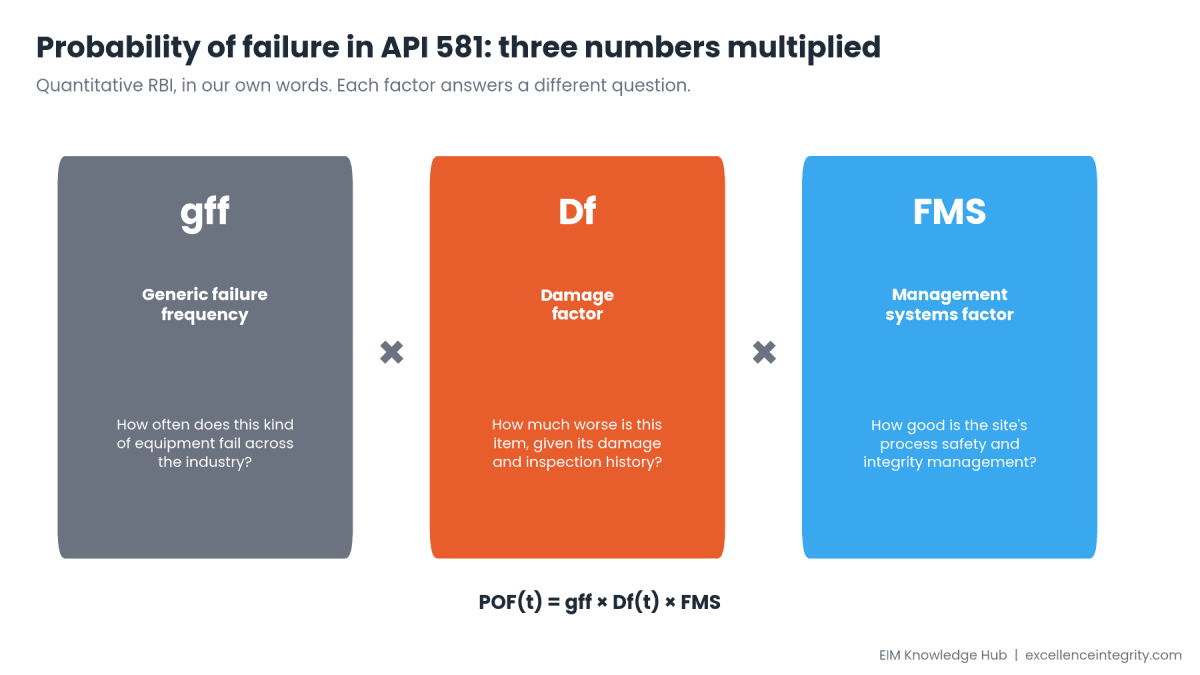
Risk-based inspection rests on two questions: how likely is this equipment to fail, and how bad would it be? This first post in our API 580 cluster tackles the first one. Probability of failure (POF) is often treated as a black box inside RBI software. It isn't: in quantitative RBI it is three understandable numbers multiplied together.
Short answer: In API RP 581's quantitative method, POF(t) = gff × Df(t) × FMS. The generic failure frequency (gff) is how often this type of equipment fails across the industry. The damage factor (Df) adjusts that for the item's own damage mechanisms, rates and inspection history, and grows with time. The management systems factor (FMS) adjusts for the quality of the site's integrity management. Inspection lowers POF by replacing uncertainty with data.
The formula
- gff, generic failure frequency: a starting point from industry data for each equipment type, such as a pipe, a drum or an exchanger shell.
- Df(t), damage factor: how much more likely this item is to fail because of its damage mechanisms: thinning, cracking, external damage, HTHA and others. It depends on the rates, the time in service, and how effective past inspections were.
- FMS, management systems factor: a site-wide adjustment from an evaluation of process safety and integrity management, rewarding strong systems and penalising weak ones.
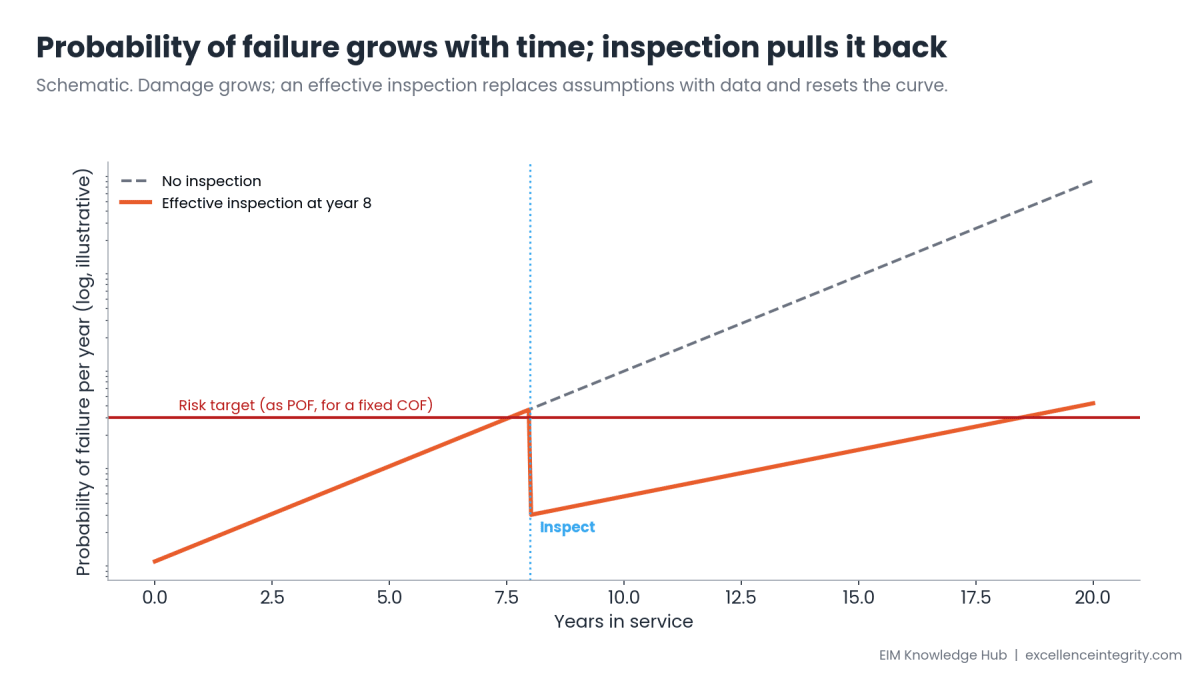
Why POF grows with time
Damage accumulates, and uncertainty about it grows with every year since the last good inspection. In a quantitative model, the damage factor for thinning, for example, depends on how much wall may have been lost relative to what was available, and on how confident we are in the measured rate. A highly effective inspection pins the actual condition down and reduces the damage factor; a poor one changes little.
Qualitative and semi-quantitative POF
Not every RBI programme uses the full quantitative method. API RP 580 recognises qualitative and semi-quantitative approaches, where POF is placed in categories (for example 1 to 5) based on damage mechanisms, rates, inspection history and expert judgement. The logic is the same: what is driving failure, how fast, and how well do we know it?
Common misunderstandings
- POF is not a prediction that the item will fail in a given year. It is a likelihood used to rank and compare.
- Inspection does not reduce damage; it reduces uncertainty about damage. That is why POF falls after an effective inspection.
- Garbage in, garbage out: wrong corrosion rates or unidentified damage mechanisms give a confident but wrong POF.
- The management systems factor is not cosmetic. It can shift every item on the site.
Learn more with EIM
EIM is an independent training provider; API certifies inspectors. The API 580 certification exam is based on API RP 580 (4th edition, with Addendum 1) and is closed book; holders of API 510, 570 or 653 qualify automatically. EIM's self-paced API 580 preparation includes a question bank, practice mode with explanations, timed mock tests, study notes and flashcards, with one year of access. See the API 580 page. EIM's live Risk-Based Inspection (RBI) Techniques course with Mr. Deepak Rawtal covers RBI methodology and inspection planning, with an EIM certificate of completion; check the course page for the next batch.
Frequently asked questions
What is probability of failure in RBI?
A measure of how likely an item is to fail (usually a loss of containment) over a period, used with consequence of failure to calculate and rank risk.
How is POF calculated in API 581?
As POF(t) = gff × Df(t) × FMS: generic failure frequency, times the damage factor for the item's damage mechanisms, times the management systems factor.
What is a damage factor?
A multiplier that adjusts the generic failure frequency for the item's specific damage mechanisms, rates, time in service and inspection history.
How does inspection reduce POF?
An effective inspection measures the actual damage state, reducing uncertainty and therefore the damage factor. It does not stop the damage itself.
Is there an API 581 exam?
No. API certifies RBI knowledge through API 580, whose exam is based on API RP 580.
Sources
- API RP 580, Risk-Based Inspection, 4th edition with Addendum 1; API RP 581, Risk-Based Inspection Methodology. Concepts summarised, not quoted.
- Charts prepared by EIM. Checked 7 October 2026.