HTHA and API 941: Why the Nelson Curve Now Has a Time Axis
High-temperature hydrogen attack explained: how Nelson curves work, why time-based curves change the picture for older equipment, and how to manage HTHA.
By Syed Hasan28 Oct 20266 min read
High-temperature hydrogen attack (HTHA) is one of the most dangerous damage mechanisms in refining. It happens inside the steel, gives little warning, and can lead to sudden rupture. For decades, engineers have managed it with the "Nelson curves" in API RP 941. Recent work shows those curves were missing something important: time.
This article explains how HTHA works, how Nelson curves are used, why time-based curves matter for older equipment, and what a sound HTHA programme looks like.
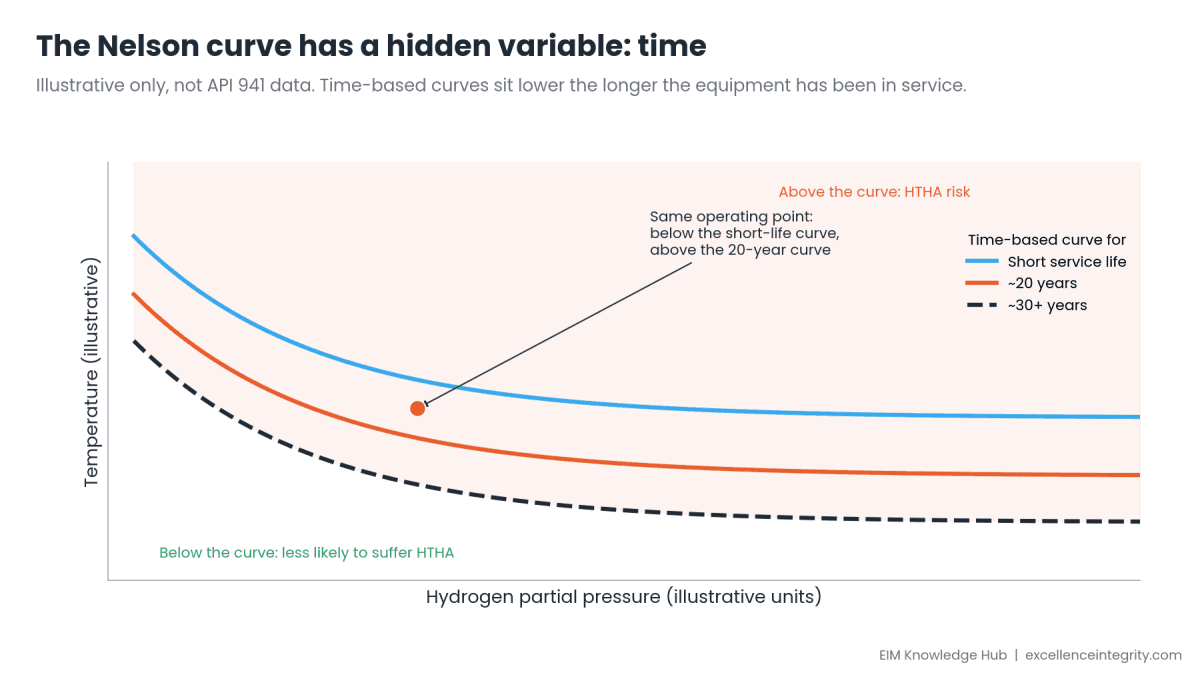
Short answer: Hot hydrogen enters steel and reacts with carbon to form methane at grain boundaries, causing fissures and loss of strength. Nelson curves set safe temperature and hydrogen partial pressure limits for each steel. New time-based analyses suggest the current carbon steel curves correspond to roughly 20 years of service, so equipment older than that, operating below the curves, may still be at risk.
What HTHA is
At high temperature and hydrogen partial pressure, atomic hydrogen diffuses into steel and reacts with carbon in iron carbides to form methane. Methane molecules are too big to diffuse out, so they collect at grain boundaries, build pressure and form tiny voids. The voids link into fissures, and the steel also loses carbon (decarburisation), so it becomes weaker.
HTHA matters in hydroprocessing, catalytic reforming, hydrogen plants and similar units operating above roughly 204 °C (400 °F) in hydrogen service. Carbon steel and C-0.5Mo steel are the most susceptible; chromium-molybdenum steels resist much better because chromium and molybdenum form more stable carbides.
How Nelson curves are used
API RP 941 plots temperature against hydrogen partial pressure, with a curve for each steel type. Operating below a steel's curve has historically been treated as safe from HTHA; above it, the steel is at risk. Engineers use the curves to select materials for new equipment and to check existing equipment, usually with a margin for uncertainty in operating conditions.
The curves have been revised repeatedly as failures turned up in the "safe" region. The 8th edition (2016) added a separate, lower curve for carbon steel without post-weld heat treatment, after failures were found in non-PWHT welds below the old carbon steel curve.
Why "below the curve" is not always safe
A fatal 2010 heat exchanger rupture at a US refinery, investigated by the US Chemical Safety Board (CSB), showed HTHA in equipment operating in what the curves treated as the safe region. CSB has warned that the carbon steel Nelson curve has repeatedly proven unreliable, noting that the 2016 edition itself reports 13 new failures below the carbon steel curve.
Part of the explanation is time. HTHA is a slow process. A curve built from field experience implicitly reflects how long that equipment had been in service. Technical work by industry groups, provided to API between 2021 and 2024, produced time-dependent curves and found that the current 8th edition curves correspond to roughly 20 years of service for non-PWHT carbon steel, C-0.5Mo and PWHT carbon steel.
What the next API 941 edition is expected to change
At the time of writing, the 8th edition (2016) is current. Technical articles from the firms involved in the committee work describe what the anticipated 9th edition is expected to include: time-based design curves in a new annex, in both graphical and tabular form, for selecting materials for new components. They also caution that design curves can be conservative and should not be used on their own for fitness-for-service assessment of existing equipment.
The practical message for operators is the same either way: equipment that has spent more than about 20 years near the current curves deserves a fresh look.
Managing HTHA in an existing plant
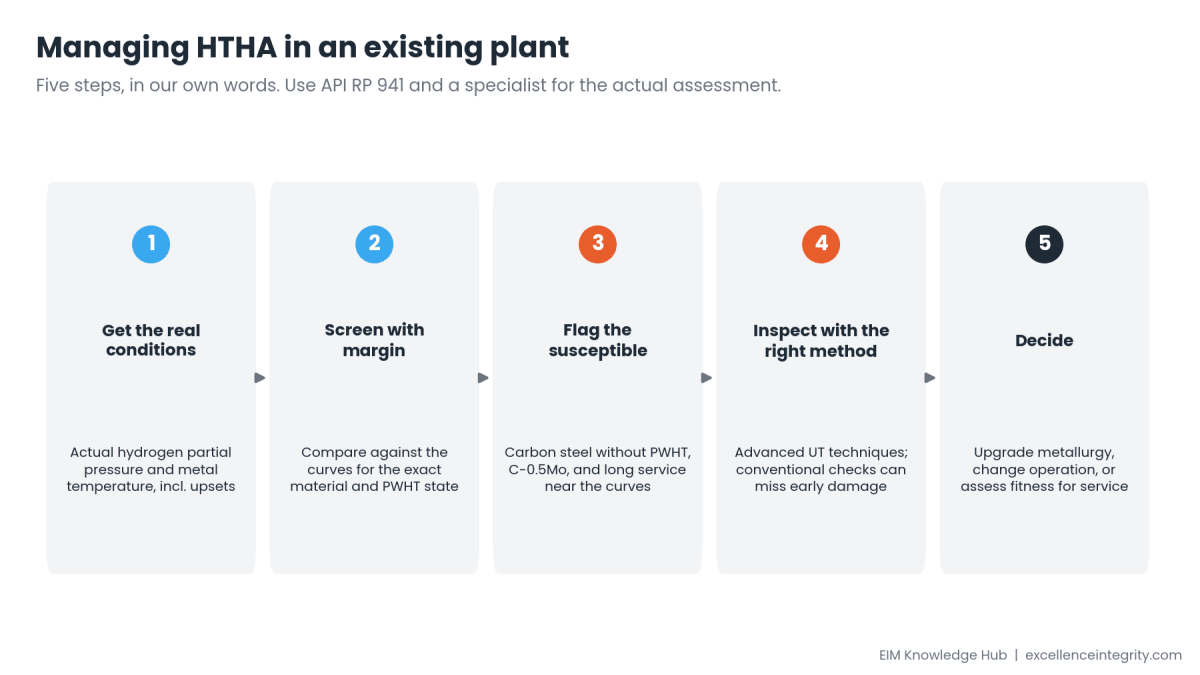
- Get the real conditions. Use actual metal temperature and hydrogen partial pressure, including start-ups, upsets and end-of-run conditions, not just design values. Hydrogen partial pressure in liquid-filled systems needs particular care.
- Screen with margin. Compare against the curve for the exact material and PWHT condition, and allow for uncertainty.
- Flag the susceptible. Carbon steel without PWHT, C-0.5Mo, welds and heat-affected zones, and anything with long service close to the curves.
- Inspect with the right method. Early HTHA is hard to detect. Advanced ultrasonic techniques, applied by qualified specialists, are needed; conventional thickness checks will not find it. API RP 941 gives inspection guidance.
- Decide. Options include upgrading to a resistant Cr-Mo steel, changing operating limits, adding monitoring, or a fitness-for-service assessment to API 579-1 where damage is found.
HTHA in exams and in RBI
HTHA appears in the API 571 body of knowledge and on the API 510 effectivity sheet's list of damage mechanisms, so inspectors are expected to know its critical factors, affected materials and inspection challenges. In risk-based inspection, HTHA susceptibility is a classic driver of high consequence and probability: getting the operating data right is what makes the RBI result credible.
Learn more with EIM
EIM is an independent training provider. Our live API 571 Damage Mechanisms - Exam Preparation course with Mr. Deepak Rawtal covers high-temperature and hydrogen damage in week 3; the next batch runs 16 January to 14 February 2027, Saturday and Sunday, 18:00 to 20:00 UAE time. Our live Risk-Based Inspection (RBI) Techniques course, also with Mr. Rawtal, runs 7 to 10 December 2026, Monday to Thursday, 19:00 to 21:00 UAE time, with an EIM certificate of completion. See the courses
For assessing damaged equipment, the self-paced API 579-1 Fitness-For-Service programme covers Level 1 to 3 assessments.
Frequently asked questions
What is the difference between HTHA and hydrogen embrittlement?
HTHA happens at high temperature: hydrogen reacts with carbon to form methane, causing internal fissures and decarburisation. Hydrogen embrittlement happens at lower temperatures and makes hard or high-strength steel crack under stress, without a chemical reaction with carbon.
Which steels are most at risk from HTHA?
Carbon steel, especially without PWHT, and C-0.5Mo. Cr-Mo steels such as 1.25Cr-0.5Mo and 2.25Cr-1Mo are much more resistant.
Is the 9th edition of API 941 published?
At the time of writing, the 8th edition (2016) is current, and technical articles describe the 9th edition as anticipated. Check API's catalogue for the latest status.
Can conventional UT find HTHA?
Not reliably in its early stages. Specialist advanced ultrasonic techniques are used, and even then detection is challenging.
Does PWHT prevent HTHA?
PWHT improves carbon steel's resistance, which is why API 941 has separate curves for PWHT and non-PWHT carbon steel, but it does not make carbon steel immune.
Sources
- US CSB: Safety Alert, Preventing High Temperature Hydrogen Attack
- E2G: Reassessing equipment in high-temperature hydrogen service using the new time-dependent Nelson curves
- Becht: A practical response to HTHA
- API RP 941, Steels for Hydrogen Service at Elevated Temperatures and Pressures, 8th edition (2016). Cited, not reproduced.
- All checked 7 October 2026.