HF Acid Corrosion: Damage Mechanism of the Week
HF acid corrosion in alkylation units: why water and temperature matter, residual elements, related hydrogen damage, and how to control it.
By Asjad Imam26 Oct 20263 min read
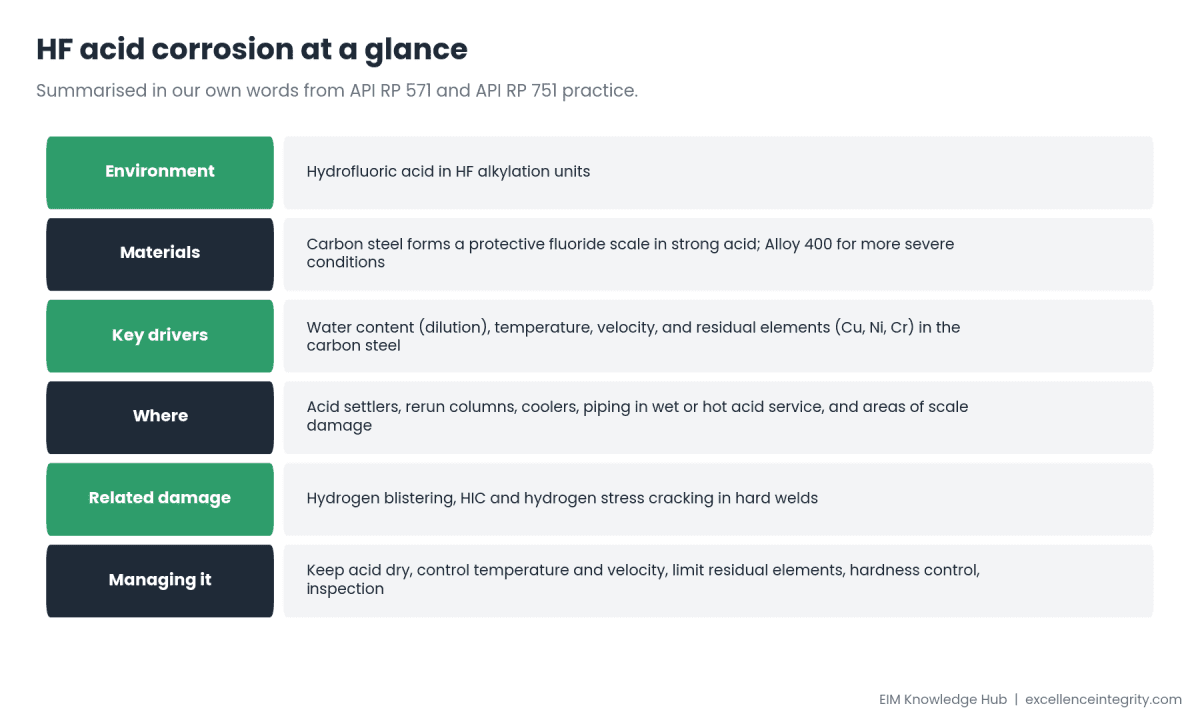
Week 9 of our Damage Mechanism of the Week series turns to HF alkylation units, where hydrofluoric acid is a catalyst and one of the most hazardous chemicals in a refinery. Carbon steel works in strong, dry HF because it forms a protective fluoride scale. Anything that disturbs that scale, above all water, can make corrosion rapid.
Short answer: In concentrated, dry hydrofluoric acid, carbon steel forms a protective iron fluoride scale. Corrosion rises sharply when the acid is diluted by water, when temperature rises, when high velocity strips the scale, and in steels with higher residual elements such as copper, nickel and chromium. HF service also brings hydrogen damage: blistering, HIC and cracking of hard welds. Control focuses on keeping acid dry, limiting temperature and velocity, controlling materials, and targeted inspection, with API RP 751 covering safe operation.
At a glance
What drives corrosion

Where to look
- Acid settlers, rerun columns and acid coolers, where acid strength and temperature vary.
- Piping and fittings with high velocity or turbulence.
- Areas where water can enter or concentrate, such as after upsets or during start-up.
- Welds and heat-affected zones, for hydrogen-related cracking.
Related hydrogen damage
Corrosion in HF service releases atomic hydrogen into the steel. That can cause hydrogen blistering and hydrogen-induced cracking in plate, and hydrogen stress cracking in hard welds or heat-affected zones. Hardness control of welds and suitable plate quality are part of HF service material requirements. See our guide to wet H2S damage for the similar hydrogen mechanisms.
Controlling it
- Keep the acid dry and its strength controlled; water ingress is the biggest single risk.
- Limit temperature and velocity, especially in carbon steel.
- Control materials: limits on residual elements in carbon steel, hardness limits for welds, and Alloy 400 where conditions are severe.
- Inspect targeted locations: UT scanning of known high-risk areas, attention to flanges, valves and small connections.
- Follow API RP 751 for safe operation of HF alkylation units, including inspection and maintenance practices.
Learn more with EIM
HF acid corrosion is one of the damage mechanisms in API RP 571 (3rd edition), the body of knowledge for the API 571 certification. EIM is an independent training provider; API certifies inspectors. EIM's self-paced API 571 preparation includes a question bank, practice mode with explanations, timed mock tests, study notes and flashcards, with one year of access, and EIM's live API 571 Damage Mechanisms - Exam Preparation course with Mr. Deepak Rawtal runs weekend batches. See the API 571 page This post is part of our weekly Damage Mechanism of the Week series.
Frequently asked questions
Why can carbon steel be used in HF service?
In concentrated, dry HF it forms a protective iron fluoride scale that slows corrosion.
What makes HF more corrosive?
Water dilution above all, plus higher temperature, high velocity and higher residual elements in the steel.
What are residual elements and why do they matter?
Elements such as copper, nickel and chromium present in small amounts in carbon steel. Higher levels can increase corrosion in HF service.
Which alloy is used where carbon steel is not suitable?
Alloy 400 (a nickel-copper alloy) is commonly used for more severe HF conditions.
Which document covers HF alkylation units?
API RP 751, Safe Operation of Hydrofluoric Acid Alkylation Units.
Sources
- API RP 571, 3rd edition: hydrofluoric acid corrosion. Summarised, not quoted.
- API RP 751, Safe Operation of Hydrofluoric Acid Alkylation Units. Cited, not quoted.
- Checked 7 October 2026.